Identify, Retain and Preserve
-INTERIOR SPACES-

Identifying, retaining, and preserving a floor plan
or interior spaces that are important in defining the
overall historic character of the building. This includes
the size, configuration, proportion, and relationship
of rooms and corridors; the relationship of features
to spaces; and the spaces themselves such as lobbies,
reception halls, entrance halls, double parlors, theaters,
auditoriums, and important industrial or commercial
spaces.
 |
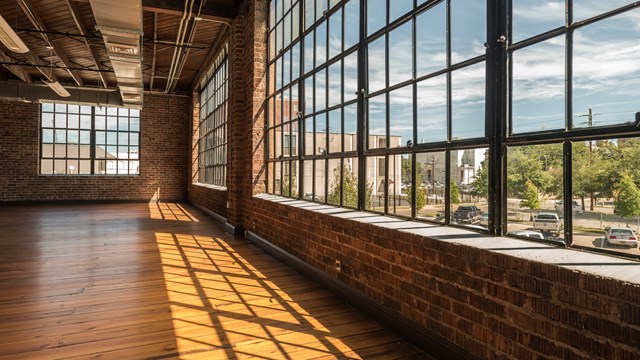
In assessing the interior visual
character of any historic building, it is necessary
to ask whether there are spaces that are important
to the character of this particular building,
whether the building is architecturally rich or
modest. A simple or utilitarian structure canhave
just as much--or more--character as a grand space.
|
Altering a floor plan or interior spaces--including
individual rooms--which are important in defining the
overall historic character of the building so that,
as a result, the character is diminished.
-INTERIOR FEATURES AND FINISHES-

Identifying, retaining, and preserving interior features
and finishes that are important in defining the overall
historic character of the building, including columns,
cornices, baseboards, fireplaces and mantels, panelling,
light fixtures, hardware, and flooring; and wallpaper,
plaster, paint, and finishes such as stencilling, marbling,
and graining; and other decorative materials that accent
interior features and provide color, texture, and patterning
to walls, floors, and ceilings.
 |
This Minton encaustic floor tile was installed in the U.S. Capitol in the 1850s. Before undertaking any work more complicated than regular maintenance
or a very simple repair on a significant historic ceramic tile
floor, it is recommended that a professional conservator of
ceramics, an historical architect, an architectural historian,
or a chemist with particular knowledge and experience in this
field be consulted. Photo: NPS files.
|
Altering features and finishes which are important in
defining the overall historic character of the building
so that, as a result, the character is diminished.
Replacing historic interior features and finishes instead
of repairing or replacing only the deteriorated masonry.Installing
new decorative material that obscures or damages character-defining
interior features or finishes.
Removing historic finishes, such as paint and plaster,
or historic wall coverings, such as wallpaper.
Applying paint, plaster, or other finishes to surfaces
that have been historically unfinished.
Stripping paint to bare wood rather than repairing
or re-applying grained or marbled finishes to features
such as doors and paneling.
Changing the type of finish or its color, such as painting
a previously varnished wood feature.

Stabilize

Stabilizing deteriorated or damaged interior features
and finishes as a preliminary measure, when necessary,
prior to undertaking appropriate preservation work.

Failing to stabilize a deteriorated or damaged interior
feature or finish until additional work is undertaken,
thus allowing further damage to occur to the historic
building.

Protect and Maintain

Protecting and maintaining masonry, wood, and architectural
metals that comprise interior features through appropriate
surface treatments such as cleaning, rust removal, limited
paint removal, and reapplication of protective coatings
systems.
Protecting interior features and finishes against
arson and vandalism before project work begins, boarding-up
windows, and installing fire alarm systems that are
keyed to local protection agencies.
Protecting interior features such as a staircase,
mantel, or decorative finishes and wall coverings against
damage during project work by covering them with heavy
canvas or plastic sheets.
 |
 |
Careful documentation of a building's physical
condition is the critical first step in determining
an appropriate level of intervention. This
may include documenting
a particular problem, such as this cracked ceiling (left); or relating the historical research to
existing materials and features (right).
Photos: NPS files.
|
Installing protective coverings in areas of heavy
pedestrian traffic to protect historic features such
as wall coverings, parquet flooring and panelling.
Removing damaged or deteriorated paints and finishes
to the next sound layer using the gentlest method possible,
then repainting or refinishing using compatible paint
or other coating systems.
Repainting with colors that are appropriate to the
historic building.
Limiting abrasive cleaning methods to certain industrial
warehouse buildings where the interior masonry or plaster
features do not have distinguishing design, detailing,
tooling, or finishes; and where wood features are not
finished, molded, beaded, or worked by hand. Abrasive
cleaning should only be considered after other, gentler
methods have been proven ineffective.
Evaluating the existing condition of materials to
determine whether more than protection and maintenance
are required, that is, if repairs to interior features
and finishes will be necessary.

Failing to provide adequate protection to materials
on a cyclical basis so that deterioration of interior
features results.
Permitting entry into historic buildings through unsecured
or broken windows and doors so that the interior features
and finishes are damaged by exposure to weather or vandalism.
Stripping interiors of features such as woodwork, doors,
windows, light fixtures, copper piping, radiators; or
of decorative materials.
Failing to provide proper protection of interior features
and finishes during work so that they are gouged, scratched,
dented, or otherwise damaged.
Failing to take new use patterns into consideration
so that interior features and finishes are damaged.
Using destructive methods such as propane or butane
torches or sandblasting to remove paint or other coatings.
These methods can irreversibly damage the historic materials
that comprise interior features.
Using new paint colors that are inappropriate to the
historic building.
Changing the texture and patina of character-defining
features through sandblasting or use of abrasive methods
to remove paint, discoloration or plaster. This includes
both exposed wood (including structural members) and
masonry.
Failing to undertake adequate measures to assure the
protection of interior features and finishes.

Repair

Repairing historic interior features and finishes
by reinforcing the materials using recognized preservation
methods. The new work should match the old in material,
design, color, and texture; and be unobtrusively dated
to guide future research and treatment.
 |
 |
In Preservation, an appropriate level of intervention
is established prior to work in order to maximize
retention of historic materials. (a) A conservator
is applying adhesive to 19th century composition
ornament that has delaminated from its wood substrate.
(b) The compo fragment is carefully held in place
until the quick-setting adhesive takes hold. Photos:
Jonathan Thornton.
|

Removing materials that could be repaired, using improper
techniques, or failing to document the new work.
The following work
is highlighted to indicate that it represents
the greatest degree of intervention generally
recommended within the treatment Preservation,
and should only be considered after protection,
stabilization, and repair concerns have been addressed.
Limited Replacement in Kind

Replacing in kind extensively deteriorated
or missing parts of repeated interior features
when there are surviving prototypes such as stairs,
balustrades, wood panelling, columns; or decorative
wall coverings or ornamental tin or plaster ceilings.
New work should match the old in material, design,
color, and texture; and be unobtrusively dated
to guide future research and treatment.

Replacing an entire interior feature when limited
replacement of deteriorated and missing parts
is appropriate.
Using replacement material that does not match
the interior feature; or failing to properly document
the new work.
|
|
 |

|