Identify, Retain and Preserve

Identifying retaining, and preserving building and
landscape features which are important in defining the
historic character of the setting. Such features can
include roads and streets, furnishings such as lights
or benches, vegetation, gardens and yards, adjacent
open space such as fields, parks, commons or woodlands,
and important views or visual relationships.
Retaining the historic relationship between buildings
and landscape features of the setting. For example,
preserving the relationship between a town common and
its adjacent historic houses, municipal buildings, historic
roads, and landscape features.
 |
The goal of Preservation is to retain the historic
form, materials, and features of the building
and its setting as they have changed--or evolved--over
time. This bank barn was built in the 1820s, then
enlarged in 1898 and again in 1914. Today, it
continues its role as a working farm structure
as a result of sensitive preservation work. This
included foundation re-grading; a new gutter system;
structural strengthening; and replacement of a
severely deteriorated metal roof. Photo: Jack
E. Boucher, HABS.
|
Altering those features of the setting which are important
in defining the historic character.
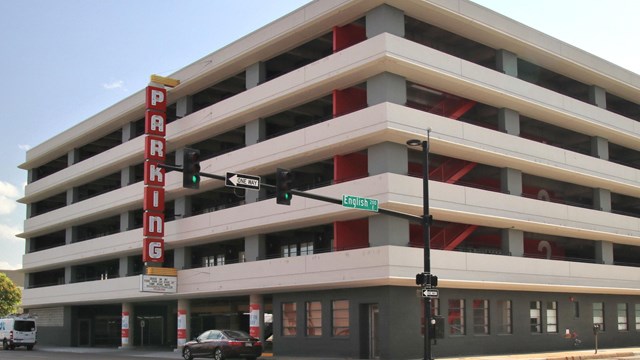
Altering the relationship between the buildings and
landscape features within the setting by widening existing
streets, changing landscape materials, or constructing
inappropriately located new streets or parking.
Removing or relocating historic buildings or landscape
features, thus destroying their historic relationship
within the setting.

Stabilize

Stabilizing deteriorated or damaged building and
landscape features of the setting as a preliminary measure,
when necessary, prior to undertaking appropriate preservation
work.

Failing to stabilize a deteriorated or damaged building
or landscape feature of the setting until additional
work is undertaken, thus allowing further damage to
the setting to occur.

Protect and Maintain

Protecting and maintaining historic building materials
and plant features through appropriate cleaning, rust
removal, limited paint removal, and reapplication of
protective coating systems; and pruning and vegetation
management.
 |
Patterns on the land have been preserved through
the continuation of traditional uses, such as
the grape fields at the Sterling Vineyards in
Calistoga, California. Photo: NPS files.
|
Protecting building and landscape features against
arson and vandalism before preservation work begins
by erecting protective fencing and installing alarm
systems that are keyed into local preservation agencies.
Evaluating the existing condition of the building
and landscape features to determine whether more than
protection and maintenance are required, that is, if
repairs to features will be necessary.

Failing to provide adequate protection of materials
on a cyclical basis which results in the deterioration
of building and landscape features.
Permitting the building and setting to remain unprotected
so that interior or exterior features are damaged.
Stripping or removing features from buildings or the
setting such as wood siding, iron fencing, terra cotta
balusters, or plant material.
Failing to undertake adequate measures to assure the
protection of building and landscape features.

Repair

Repairing features of the building and landscape
using recognized preservation methods. The new work
should be unobtrusively dated to guide future research
and treatment.

Removing material that could be repaired, using improper
repair techniques, or failing to document the new work.
The following work
is highlighted to indicate that it represents
the greatest degree of intervention generally
recommended within the treatment Preservation,
and should only be considered after protection,
stabilization, and repair concerns have been addressed.
Limited Replacement in Kind

Replacing in kind extensively deteriorated
or missing parts of building and landscape features
where there are surviving prototypes such as porch
balustrades or paving materials.

Replacing an entire feature of the building or
landscape when limited replacement of deteriorated
and missing parts is appropriate.
Using replacement material that does not match
the building or landscape feature; or failing
to properly document the new work.
|
|