Problem
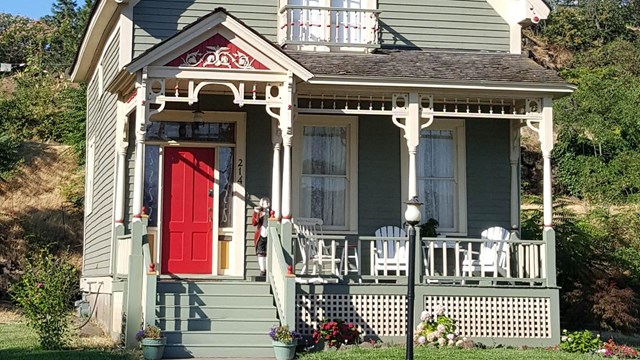
The house had been poorly maintained for several decades and, more recently, had been unoccupied. The asphalt shingle roof that replaced the original standing seam metal roof leaked badly, allowing water to penetrate into the wall cavities behind the stamped metal siding. Due to neglected repairs and cleaning, the original drain spout system failed to divert rainwater away from the house (see figure 3). In some places, rainwater ran directly down the exterior walls. Although the original galvanized (zinc-coated) steel and zinc siding had been back-primed, long-term water infiltration caused the siding to corrode from the inside toward the face. The location of the building at Little Traverse Bay also contributed to the slow deterioration of the siding. In extremely deteriorated areas, the metal had been reduced to an easily breakable, crusty mass. An assessment of the exterior revealed that nearly 90% of the stamped siding had moderately or severely deteriorated to the point that replacement was required (see figure 4). Since only a small percentage of the siding was salvageable and all needed to be removed to facilitate
other project work, the decision was made to replace all of the metal siding. In contrast to the exterior metal siding, the interior stamped ceilings and walls remained in good condition. All of the interior metal was retained, with only isolated areas requiring patching due to minor rust. In addition, the exterior window hoods had not deteriorated like the siding and only routine repairs were necessary for their retention.
Solution Five exterior sheet metal patterns required replacement: the brick pattern that covered more than half of the exterior, two ornamental band patterns, the wall corner pattern, and the molding that separated the ornamental bands from the brick pattern (see figure 5).
The owner decided to duplicate the original siding becauseof its historical significance and its important contribution to the appearance of the building. Although historical investigation failed to identify its original manufacturer, a sheet metal manufacturing company in business in the midwest since the turn of the century was identified as a possible source for replacement stamped metal siding. Photographs of the original siding and sample sections of all five
patterns were sent to the sheet metal company. The brick pattern matched
one of the company's old stock designs, while the other four could
be replicated as custom work. Of the four custom pieces, three required
stamping and the fourth could be formed on a brake press. |
||||||||
Home | Search | E-mail | Technical Preservation Services | NPS History & Culture