| WINDOWS
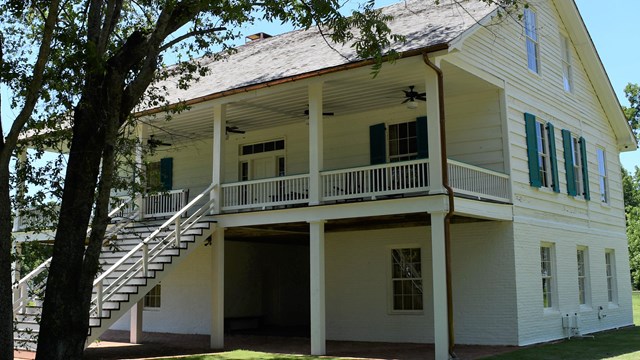
NUMBER 10 Temporary Window Vents in Unoccupied Historic Buildings Charles E. Fisher Preservation Assistance Division National Park Service and Thomas A. Vitanza Williamsport Preservation Training Center National Park Service WORTHINGTON HOUSE Located on the grounds of the Monocacy National Battlefield, the Worthington House is a mid. 19th century ell-shaped brick farmhouse. Judging from the modest exterior, it is rather surprising to find that the building contains noteworthy interior stenciling. The two front rooms on either side of the center stair hall and the stair hall itself all have remarkably intact examples of trompe l'oeil stenciled paneling combined with an egg and dart motif frieze border. The National Park Service acquired the 282 acre Worthington property in 1982, principally to protect this detached portion of the battlefield from intensive development. At the time of acquisition, the farmhouse was vacant and severely deteriorated with extensive water damage occurring as a result of major roof leaks and a predominance of broken and missing windows. Vines and saplings were growing up through the building and roof, destroying the mortar and displacing the bricks. The one-story porch across the front had collapsed, causing noticeable dislocation of the front masonry wall. In several areas large numbers of the handmade brick had been scavenged from the exterior, leaving gaping holes in the bearing walls. With no immediate use planned for the building, it was necessary to repair and stabilize the structure or lose it to deterioration. Work was undertaken using limited funds to make the building structurally sound, weathertight, and less vulnerable to vandalism. Rather than using traditional mothballing techniques, which rely heavily on temporary measures and the introduction of non-historic elements, the project team utilized high quality but cost-effective stabilization measures whenever possible to ensure the long-term preservation of the historic building. Temporary features, such as window vents, were designed and installed in such a manner as to be reversible and to cause little additional loss of historic fabric. Preservation Problem Early work focused on the need to make the building as weathertight as possible, yet allow for adequate ventilation. Consideration was given to devising a solution that would incorporate the window work with a passive ventilation system. It was recognized that if the house was tightly sealed with insufficient ventilation, the building would be particularly susceptible to condensation and moisture damage, Another factor to consider was that the building would remain unheated and unoccupied for an undetermined length of time. Neither boarding over the openings nor installing full sash throughout would provide optimum ventilation on the interior. This would be required to deter fungal decay of the wood and to avoid condensation damage to plaster walls and to their decorative stencil work. Hot daytime temperatures followed by cold nights in the spring and early fall could result in significant condensation damage to the plaster and stencil work. Damage would be particularly acute when nighttime temperatures fell below freezing. Furthermore, the hot moist air of the long Maryland summer would create problems, since high humidity can present a favorable condition for fungal growth. This is particularly true when the drying effect of air movement, normally induced in an occupied building, is not present. The potential for damage in these circumstances was great. Once wood absorbs enough moisture from the hot humid air and if fungal attack begins, the process of wood decay would enable the fungi to maintain the wood in a wet condition since fungi reduces wood to water and carbon dioxide. While such moisture problems could arise throughout the house, the basement was particularly susceptible to such damage due to moisture infiltration through the dirt floor, the below grade location, and seepage through the walls and basement doors. Special care should be taken to provide sufficient ventilation in unoccupied
historic buildings to deter fungal decay and condensation damage. Because cross-room ventilation was desirable, the location of the ventilating louvers was critical. With proper planning, natural ventilation could be induced through the ''chimney'' or ''updraft effect'' within the building by which warm air raises and escapes through higher level vents, to be replaced with cooler air entering at lower levels. Good air movement would also tend to equalize interior and exterior temperatures, thus lessening condensation problems within the brick wails and on interior painted plaster surfaces. The window louvers had to be located so as to promote cross-room ventilation
and avoid stagnant air pockets in the rooms. Furthermore, improvements
to the appearance of the exterior of this long neglected building were
desired. Efforts were taken, therefore, to locate as many of the louvers
as possible on side and rear elevations, thereby minimizing the visual
impact on the front elevation. Full double-sash vents could be placed
in some side and rear windows to permit more glass on the front elevation.
Even the glazing in the reconditioned or replacement windows would help
to facilitate air movement within the building, since the sunlight passing
through the glass would heat inside air and cause it to rise out through
upper floor level vents. Cooler air entering through the basement windows
would replace the warmer air. Louvered Window Vents Wooden fixed louver vents were custom-made and installed. The easily fabricated louvers were sized to fit the lower sash opening 341/2" wide by 341/4" high on the first floor, while those for the smaller second floor windows were only 25 1/4'' high. Full units were installed in all single-sash basement windows, since the window area was much less and the moisture problems more severe. At the same time, the three attic windows were also replaced with full louvers to encourage thorough multi-level ventilation. Custom-built wooden louvers were selected over stock, pre-fabricated metal vents for the following reasons: most pre-fabricated vent systems would require modifications of the historic jamb in order to get a secure fit; a single style metal unit could not be found to fit the variety of opening sizes and the depth of the jamb; costs would be greater than making the custom units; and most important, it was felt that the thin gauge metal units offered little or no deterrent to unlawful entry. The wooden units presented a more secure system, The louver frame was designed to fit snugly into the existing sash tracks and simultaneously to secure the glazed upper sash. An added benefit of the 6'' stock width is that it provided a fairly rigid - and thus secure - louver frame. The louver frame was constructed of 1'' x 6'' shelf grade northeastern white pine; the louver slats were made from 1'' x 8'' pine. The spacing of the louver slats did not exceed 4'' in order to provide additional lateral strength (and security) to the frame. The relative closeness of the slats also would make it more difficult to kick out the grade level units. The slats were set into the frame at a 45 degree angle by routing a 1/4 deep dado cut into the jamb of the louver. The exposed edges of the slats were plumb cut in order to create a water drip on the exterior. Prior to assembly, the louver members were primed using an alcohol base paint in order to get at least one protective coat on all surfaces. After assembly, they were given one shop coat of oil base exterior house paint. A final coat was applied after installation. For aesthetic reasons. the paint color used on the sash and trim was selected for the final coat on the louvers. In order to secure the vents in place, common 6d galvanized box nails were driven through the louver jambs into the sash tracks of the historic window jambs. To keep the jamb and stops from being damaged by the louver installation, temporary blocking was set between the parting bead and the inner and outer stops. By attaching the vents in this location, little damage was done as the nails were driven into the sash track rather than an exposed portion of the jamb. Once the building is returned to use, the lower sash will be installed and the nail holes will be filled with wood putty. Since the nails were driven in on the interior of the building, nearly 3'' from the exterior wall, adequate security was achieved without driving the nails all the way in. Thus it will be relatively easy to grab onto the nail heads and back them out when the vents are eventually removed. After the louvers were secured in place, 1/16'' mesh copper wire screening was installed on the interior of the louver frame using a l/2'' square wood frame. The screening is an integral part of the louver design. This seemingly minor detail was necessary to prevent the recurrence of insect, bird, and rodent infestation. The 1/16 '' mesh was specified to keep out the ever-present mud-dauber wasp, whose hive-building instincts have no regard for historic plaster or paint. The cost of constructing and installing the louvers in 27 window openings was around $ l ,800, including 17 full size louvers, 7 basement and 3 attic units. This work was undertaken concurrently with the construction and installation of the reconstructed window sash and repairs to the frames, sills, jambs, and surrounding brickwork. The total cost of the window work was less than $9,000, involving 3l window openings. Project Evaluation PROJECT DATA Building: Worthington House Owner: National Park Service Project Date: January-lune 1983 Project Staff: Williamsport Preservation Training Center National Park
Service Williamsport, Maryland Project Cost: Material and labor for construction of the 17 full size, 7 basement and 3 attic louvers was approximately $1,800. The material and labor cost for reconstruction of the sash, including glazing, painting, sizing and installation was around $5,200 (roughly $100 per sash unit), involving 21 pairs of double-hung sash and 7 basement and 3 attic windows. All other related work for the 31 openings, including sizing and installation of the louvers, repair to window openings (repair/replacement of sills and jambs and related masonry work), painting, and installation of screening and blocking cost between $1 ,000 and $2,000. Total window costs for complete sash and the louvers as well as installation and finish work was between $8,000 and $9,000. This PRESERVATION TECH NOTE was prepared by the National Park Service. Charles E, Fisher, Preservation Assistance Division, National Park Service serves as Technical Coordinator for the PRESERVATION TECH NOTES . Special thanks go to James S. Askins, Branch Chief . Williamsport Preservation Training Center, for his time and generous assistance in providing information concerning the ventilation problems of mothballed historic buildings. Thanks also go to Doug Hicks, Project Supervisor, Williamsport Preservation Training Center, for his contributions to this Tech Note. The following Preservation Assistance Division staff contributed to the production of this Tech Note: Michael J. Auer, Brenda Johnson, Christine Henry, Janet L. Thomas , Theresa Robinson, and Alicia Hardison. Cover Photo: Tom Vitanza. This and many of the PRESERVATION TECH NOTES on windows are included in ''The Window Handbook: Successful Strategies for Rehabilitating Windows in Historic building's a joint publication of the Preservation Assistance Division, National Park Service, and the Center for Architectural Conservation, Georgia Institute of Technology. For information write to The Center for Architectural Conservation, P.O. Box 93402, Atlanta, Georgia 30377. PRESERVATION TECH NOTES are designed to provide practical information on practices and innovative techniques for successfully maintaining and preserving cultural resources. Al1 techniques and practices described herein conform to established National Park Service policies, procedures, and standards. This Tech Note was prepared pursuant to the National Historic Preservation Act Amendments of 1980 which directs the Secretary of the Interior to develop and make available to government agencies and individuals information concerning professional methods and techniques for the preservation of historic properties. ISSN:0741 -9023 PTN- l I August l 985 |
Home | Search | E-mail | Technical Preservation Services | NPS History & Culture