| 26 | |
|
The Preservation and Repair of Historic Log BuildingsBruce D. Bomberger
»Historical Background
The intent of this Brief is to present a concise history and description
of the diversity of American log buildings and to provide basic guidance
regarding their preservation and maintenance. A log building is defined
as a building whose structural walls are composed of horizontally laid
or vertically positioned logs. While this Brief will focus upon horizontally-laid,
corner-notched log construction, and, in particular, houses as a building
type, the basic approach to preservation presented here, as well as many
of the physical treatments, can be applied to virtually any kind of log
structure. Log buildings, because of their distinct material, physical structure,
and sometimes their architectural design, can develop their own unique
deterioration problems. The information presented here is intended to convey
the range of appropriate preservation techniques available. It does not,
however, detail how to perform these treatments; this work should be left
to professionals experienced in the preservation of historic log buildings.
Despite the publication since the 1930s of a number of books and
articles on the history of log construction in America, some misconceptions
persist about log buildings. Log cabins were not the first type of shelter
built by all American colonists. The term "log cabin" today is
often loosely applied to any type of log house, regardless of its form
and the historic context of its setting. "Log cabin" or "log
house" often conjures up associations with colonial American history
and rough frontier life. While unaltered colonial era buildings
in general are rare, historic log buildings as a group are neither as old
nor as rare as generally believed. One and two-story log houses were built
in towns and settlements across the country until about the middle of the
19th century, and in many areas, particularly in the West, as well as the
Midwest and southern mountain regions, log continued to be a basic building
material despite the introduction of wooden balloon frame construction. By the early 20th century, the popularity of "rustic"
architecture had revived log construction throughout the country, and in
many areas where it had not been used for decades. A distinction should be drawn between the traditional meanings of
"log cabin" and "log house." "Log cabin"
generally denotes a simple one, or one-and-one-half story structure, somewhat
impermanent, and less finished or less architecturally sophisticated. A
"log cabin" was usually constructed with round rather than hewn,
or hand-worked, logs, and it was the first generation homestead erected
quickly for frontier shelter. "Log house" historically denotes
a more permanent, hewn-log dwelling, either one or two stories, of more
complex design, often built as a second generation replacement. Many of
the earliest 18th and early 19th century log houses were traditionally
clad, sooner or later, with wood siding or stucco. No other architectural form has so captured the imagination of the
American people than the log cabin. Political supporters of 1840 presidential
candidate William Henry Harrison appropriated the log cabin as a campaign
symbol. The log cabin was birthplace and home for young Abe Lincoln, as
well as other national figures, and assumed by many 19th century historians
to be the very first type of house constructed by English colonists. In
1893 Frederick Jackson Turner in his influential paper, "The Significance
of the Frontier in American History" suggested that European colonists
had adopted this means of shelter from the Indians. More recent 20th century scholarship has demonstrated that horizontal
log buildings were not the first form of shelter erected by all colonists
in America. Nor was log construction technology invented here, but brought
by Northern and Central European colonists. Finnish and Swedish settlers
are credited with first introducing horizontal log building in the colony
of New Sweden (now Pennsylvania) on the upper shores of Delaware Bay in
1638, who later passed on their tradition of log construction to the Welsh
settlers in Pennsylvania. During the 17th and 18th centuries, new waves of Eastern and Central
Europeans, including Swiss and Germans, came to America bringing their
knowledge of log construction. Even the Scotch-Irish, who did not possess
a log building tradition of their own, adapted the form of the stone houses
of their native country to log construction, and contributed to spreading
it across the frontier. In the Mississippi Valley, Colonial French fur
traders and settlers had introduced vertical log construction in the 17th
century. Through the late 18th and early 19th centuries, frontier settlers
erected log cabins as they cleared land, winding their way south in and
along the Appalachian valleys through the back country areas of Maryland,
Virginia, the Carolinas and Georgia. They moved westward across the Appalachian
Mountain barrier into the Ohio and Mississippi River valleys transporting
their indispensable logcraft with them, into Kentucky and Tennessee, and
as far to the southwest as eastern Texas. Log buildings are known to have
been constructed as temporary shelters by soldiers during the Revolutionary
War, and across the country, Americans used logs not only to build houses,
but also commercial structures, schools, churches, gristmills, barns, corncribs
and a variety of outbuildings. Around the mid-19th century, successive generations of fur traders,
metal prospectors, and settlers that included farmers and ranchers began
to construct log buildings in the Rocky Mountains, the Northwest, California,
and Alaska. In California and Alaska, Americans encountered log
buildings that had been erected by Russian traders and colonists in the
late 18th and early 19th centuries. Scandinavian and Finnish immigrants
who settled in the Upper Midwest later in the 19th century also brought
their own log building techniques with them. And, many log structures in
the Southwest, particularly in New Mexico, show Hispanic influences of
its early settlers. While many parts of the country never stopped building with logs,
wooden balloon frame construction had made it obsolete in some of the more
populous parts of the country by about the mid-19th century. However, later
in the century, log construction was employed in new ways. In the 1870s,
wealthy Americans initiated the Great Camp Movement for rustic vacation
retreats in the Adirondack Mountains of upstate New York. Developers such
as William Durant, who used natural materials, including wood shingles,
stone, and log--often with its bark retained to emphasize the Rustic
style--designed comfortable summer houses and lodges that blended with
the natural setting. Durant and other creators of the Rustic style
drew upon Swiss chalets, traditional Japanese design, and other sources
for simple compositions harmonious with nature. The Adirondack or Rustic style was balanced in the West with construction
of the Old Faithful Inn at Yellowstone National Park in Wyoming, designed
by Robert C. Reamer, and begun in 1903. This popular resort was
tremendously influential in its use of locally-available natural materials,
especially log, and gave impetus to Rustic as a true national style. From
the turn of the century through the 1920s, Gustav Stickley and other leaders
of the Craftsman Movement promoted exposed log construction. During the
1930s and 40s, the Civilian Conservation Corps (CCC) used log construction
extensively in many of the country's Federal and State parks to build cabins,
lean-tos, visitor centers, and maintenance and support buildings that are
still in service. When settlers took the craft of log construction with them onto the
frontier, they successfully adapted it to regional materials, climates
and terrains. One of the most notable characteristics of the earliest 18th
and 19th century log houses is the plan and form. The plan can sometimes
provide clues to the ethnic origin or route of migration of the original
inhabitant or builder. But in the absence of corroborating documentary
evidence, it is important not to infer too much about the ethnic craft
traditions of a particular log house. Historians have identified a number of traditional house plans and
forms as prototypes. They were often repeated with simple variations.
The basic unit of each of these types is the one room enclosure formed
by four log walls joined at their corners, called a single "pen"
or "crib." The single pen was improved upon by installing interior
partitions or by adding another log pen. Some variations of historic log
house plans include: the typically mid-Atlantic "continental"
plan, consisting of a single-pen of three rooms organized around a central
hearth; the "saddlebag" or double-pen plan, composed of two contiguous
log pens; and the "dogtrot" plan, formed by two pens separated
by an open passage space (sometimes enclosed later), all covered by a continuous
roof. The continental plan originated in central and eastern Europe and
is attributed to 18th century German immigrants to Pennsylvania. Non-log
interior partition walls form the multi-room plan within the exterior log
walls. The saddlebag plan consists of two adjoining log pens that share
a central chimney. A saddlebag is often the evolution of a single pen with
an end chimney, expanded by adding a second pen onto the chimney endwall.
The saddlebag was built in a number of different regions across the country.
The dogtrot plan may be seen with variation in many parts of the country,
although it is sometimes, perhaps erroneously, considered the most typically
southern, because its covered passageway provided both air circulation
and shelter from the heat. All these plan types were typically built in
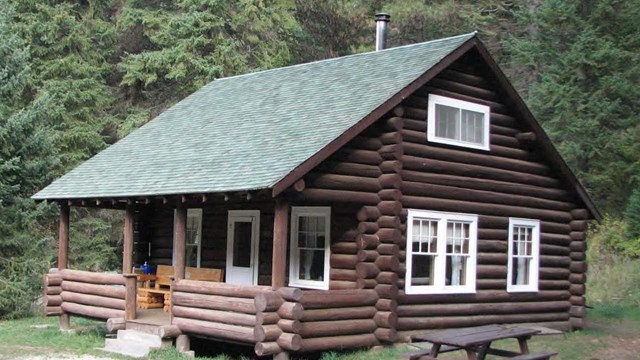
the form of one or one-and-one-half story settlement cabins. A somewhat different form evolved in the West around the middle of
the 19th century which became especially distinctive of the Rocky Mountain
cabin. While the entrance doorway to most earlier log houses was generally
placed beneath the eaves, as a means of adapting to the greater snowfall
in the Rockies, here the entrance was placed in the gable end, and sometimes
protected from roof slides by a porch supported by two corner posts created
by an extension of the roof beyond the gable wall. From the late 18th through the mid-19th centuries, Americans also
built many substantial two-story log houses in towns throughout the eastern
half of the country. In rural areas two-story log houses were sometimes
built to replace earlier, first-generation settlement cabins, but just as
often the early hewn-log house was retained and enlarged. A second story
was added by removing the roof and gables, constructing a second floor,
laying additional courses of logs, and building a new roof, or reassembling
the old one. Each generation of owners might expand an early log core building
by adding on new log pens, or masonry or wood frame extensions. The addition
of a rear ell, or infill construction to link a formerly freestanding outbuilding,
such as a kitchen to the log main house was particularly common. Such a
layering of alterations is part of the evolution of many log buildings.
Corner notching is another of the characteristic features of log
construction. Most notching methods provide structural integrity, by locking
the log ends in place, and give the pen rigidity and stability. Like the
floor plan, the type of corner notching can sometimes be a clue to the
ethnic craft origin of a log building, but it is important not to draw
conclusions based only on notching details. Numerous corner notching techniques
have been identified throughout the country. They range from
the simple "saddle" notching, which demands minimal time and
hewing skill, to the very common "V" notching or "steeple"
notching, to "full dovetail" notching, one of the tightest but
most time-consuming to accomplish, "half-dovetail" notching which
is probably one of the most common, and "square" notching secured
with pegs or spikes. The notching method on some of the earliest eastern cabins and most
19th century western cabins, particularly saddle notching, left an extended
log end or "crown." Crowns are especially pronounced or exaggerated
in Rustic style structures, and sometimes they are cut shorter as the wall
rises, creating a buttress effect at the corners of the building. Another method of securing log ends consists of fastening logs that
are laid without notching ("false notching") with tenons into
vertical corner posts, or using spikes or pegs to attach them to vertical
corner planks. Vertically positioned logs were secured at their top and
bottom ends, usually into roof and sill plate timbers. Although wood selection was most likely to be determined by availability,
chestnut, white oak, cedar, and fir were preferred because these trees
could provide long, straight, rot-resistant logs. Pine, which also provided
long straight logs, was also used in areas where it was plentiful. Woods
were often mixed, utilizing harder, heavier rot-resistant wood such as white
oak for the foundation,"sill log", and lighter, more easily hewn
wood such as yellow poplar for the upper
log courses. One of the principal advantages of log construction was the economy
of tools required to complete a structure. A felling axe was
the traditional tool for bringing down the tree and cutting the logs to
length. For many frontier and western structures the round logs were debarked
or used in their original form with the bark left on, or one or more sides
of the logs were hewn flat with a broadaxe, or more finely finished with
an adze as smooth thick planks. Notching was done with an axe, hatchet
or saw; openings for doors and windows were usually cut after the logs
were set into place, and door and window frames, particularly jambs, were
put in place during construction to help hold the logs in place. Roof framing
members and floor joists were either hewn from logs or of milled lumber.
A log cabin could be raised and largely completed with as few as two to
four different tools, including a felling axe, a broad axe, and a hand
saw or crosscut saw. The upper gable walls were completed with logs if the roof was constructed
with purlins, which is more typical of Scandinavian or Finnish construction,
and western and 20th century Rustic styles. However, vertical or horizontal
weatherboard sheathing was commonly used throughout the country to cover
wood-framed gables. The horizontal spaces or joints between logs are usually filled with
a combination of materials that together is known as "chinking"
and "daubing." Chinking and daubing completed the exterior walls
of the log pen by sealing them against driving wind and snow, helping them
to shed rain, and blocking the entry of vermin. In addition, chinking and
daubing could compensate for a minimal amount of hewing and save time if
immediate shelter was needed. Not all types of log buildings were chinked.
Corncribs, and sometimes portions of barns where ventilation was needed
were not chinked. While more typical of Swedish or Finnish techniques,
and not as common in American log construction, tight-fitting plank-hewn
or scribed-fit round logs have little or no need for chinking and daubing.
A variety of materials were used for chinking and daubing, including
whatever was most conveniently at hand. Generally though, it is a three-part
system applied in several steps. The chinking consists of two parts: first,
a dry, bulky, rigid blocking, such as wood slabs or stones is inserted
into the joint, followed by a soft packing filler such as oakum, moss,
clay, or dried animal dung. Daubing, which completes the system,
is the outer wet-troweled finish layer of varying composition, but often
consisting of a mixture of clay and lime or other locally available materials.
Instead of daubing, carefully fitted quarter poles or narrow wood strips
were sometimes nailed lengthwise across the log joints. Chinking, especially the daubing, is the least durable part of a
log building. It is susceptible to cracking as a result of freeze-thaw action,
structural settlement, drying of the logs, and a thermal expansion-contraction
rate that differs from that of the logs. Seasonal deterioration of chinking
necessitates continual inspection and regular patching or replacement.
Although the exterior logs of cabins in the West, and 20th century
Rustic buildings are generally not covered, many 18th and 19th century
log houses east of the Mississippi, with the exception of some of the simpler
cabins and houses in remote or poorer areas, were covered with exterior
cladding. The exterior of the log walls was covered for both aesthetic
and practical reasons either as soon as the building was completed or sometime
later. In some instances, the exterior (and interior) of the logs was whitewashed.
This served to discourage insects, and sealed hairline cracks in the daubing
and fissures between the daubing and logs. Although the solubility of whitewash
allows it to heal some of its own hairline cracks with the wash of rain,
like daubing it has to be periodically reapplied. Usually, a more permanent
covering such as wood siding or stucco was applied to the walls, which
provided better insulation and protection, and reduced the maintenance
of the log walls. Sometimes log houses were sided or stuccoed later in an attempt to
express a newly-achieved financial or social status. Many log houses were
immediately sided and trimmed upon completion to disguise their simple
construction beneath Georgian, Federal and later architectural styles.
Frequently a log house was covered, or recovered, when a new addition was
erected in order to harmonize the whole, especially if the original core
and its addition were constructed of different materials such as log and
wood frame. Vertical wood furring strips were generally nailed to the logs prior
to applying weatherboarding or stucco. This ensured that the
walls would be plumb, and provided a base on which to attach the clapboards,
or on which to nail the wood lath for stucco. Log building foundations varied considerably in quality, material,
and configuration. In many cases, the foundation consisted of a continuous
course of flat stones (with or without mortar), several piers consisting of rubblestone, single stones, brick, short vertical log pilings, or horizontal log "sleepers" set on grade. The two "sill logs," were laid directly upon one of these types of foundations. Climate and intended permanence of the structure were the primary
factors affecting foundation construction. The earliest log cabins, and
temporary log dwellings in general, were the most likely to be constructed
on log pilings or log sleepers set directly on grade. Where a more permanent
log dwelling was intended, or where a warm, humid climate accelerated wood
decay, such as in the South, it was sometimes more common to use stone
piers which allowed air to circulate beneath the sill logs. Full cellars
were not generally included in the original construction of most of the
earliest log houses, but root cellars were often dug later. Log buildings were roofed with a variety of different framing systems
and covering materials. Like log house plans and corner notching styles,
the types of roof framing systems used were often variations on particular
ethnic and regional carpentry traditions. In most cases wood shingles were
the first roof covering used on the earliest 18th and 19th century log
houses. As wood shingle roofs deteriorated, many were replaced with standing
seam metal roofs, many of which continue to provide good service today.
Later pioneer log buildings west of the Mississippi were likely to be roofed
with metal or roll roofing, or even with sod. Other log buildings have
been re-roofed in the 20th century with asphalt shingles. For some rustic
log buildings in the West and Great Camps in the Adirondacks, asphalt shingles
are the original historic roofing material. Ethnic tradition and regional adaptation also influenced chimney
construction and placement. Chimneys in log houses were usually built of
stone or brick, a combination of the two, or even clay-lined, notched logs
or smaller sticks. Later log buildings were frequently constructed
with only metal stacks to accommodate wood stoves. The chimneys of log
buildings erected in cold climates tended to be located entirely inside
the house to maximize heat retention. In the South, where winters were
less severe the chimney stack was more typically constructed outside the
log walls. With the advent of more efficient heating systems, interior
chimneys were frequently demolished or relocated and rebuilt to maximize
interior space. Logs on the interiors of many of the simpler cabins and Rustic style
structures were often given a flattened surface or left exposed. But, in
the more finished log houses of the 18th and 19th century, they were more
commonly covered for most of the same reasons that the exterior of the
logs was covered--improved insulation, ease of maintenance, aesthetics,
and keeping out vermin. Covering the interior log walls with planks, lath
and plaster, boards pasted with newspaper, fabric such as muslin, or wallpaper
increased their resistance to air infiltration and their insulation value.
Finished walls could be cleaned and painted more easily, and plastered
walls and ceilings obscured the rough log construction and prepared interior
surfaces for decorative wood trim in the current styles. Before undertaking preservation work on a historic log building,
its history and design should be investigated, and physical condition evaluated.
It is always advisable to hire a historical architect or qualified professional
experienced in preservation work to supervise the project. In addition,
State Historic Preservation Offices, regional offices of the National Park
Service, and local historical commissions may also provide technical and
procedural advice. The historical investigation should be carried out in conjunction
with a visual inspection of the log building. Physical assessment needs
to be systematic and thorough. It should include taking notes, photographs
or video recording, and making drawings of existing conditions, including
overall and detail views. This will serve as a record of the appearance
and condition which can be referred to once work is under way. A physical
assessment should also identify causes of deterioration, not just symptoms
or manifestations and, in some instances, may need to include a structural
investigation. The foundation of a log building should always be inspected before
beginning work because, as in any building, foundation-related problems
can transfer structural defects to other components of the building. Settling
of the foundation is a typical condition of log buildings. If settlement
is not severe and is no longer active, it is not necessarily a problem.
If, however, settlement is active or uneven, if it is shifting structural
weight to unintended bearing points away from the intended main bearing
points of the corner notches and sill log, serious wall deflections may
have resulted. Causes of settlement may include foundation or chimney stones
or sill logs that have sunk into the ground, decay of log pilings, log
sleepers, or of the sill logs themselves. Foundation problems usually result in damage to the sill logs and
spandrels, which are often the most susceptible to deterioration. Sill
logs, along with the corner notching, tend to bear most of the weight of
the building, and are closest to vegetation and the ground, which harbors
wood-destroying moisture and insects. If the sill log has come into contact
with the ground, deterioration is probably underway or likely to begin. It is also important to check the drainage around the building.
The building assessment should note the condition of each log and attempt
to identify the sources of problems that appear to exist. Sill log inspection should not necessitate destruction of historic
exterior cladding if it exists. Inspection can usually be made in areas
where cladding is missing, loose, or deteriorated. Sill log, as well as
upper log, deterioration may also be revealed by loose or peeling areas
of the cladding. If pieces of cladding must be removed for log inspection,
they should be labeled and saved for reinstallation, or as samples for
replacement work. Historic cladding generally need not be disturbed unless
there are obvious signs of settling or other indications of deterioration.
Other areas of the log walls which are particularly susceptible to
deterioration include window and door sills, corner notches, and crowns,
and any other areas regularly saturated by rain runoff or backsplash. The
characteristic design feature of Adirondack or Rustic style log buildings
of leaving log ends or crowns to extend beyond the notched corners of the
building positions the crowns beyond the drip-line of the roof edge. This
makes them vulnerable to saturation from roof runoff, and a likely spot
for deterioration. Saddle notching in which the cut was made out of the
top surface of the log and which cups upward, and flat notching, may also
be especially susceptible to collecting runoff moisture. Detection of decay requires thorough inspection. Probing for rot
should be done carefully since repair techniques can sometimes save even
badly deteriorated logs. Soft areas should be probed with a small knife
blade or icepick to determine the depth of decay. Logs should be gently
tapped at regular intervals up and down their lengths with the tool handle
to detect hollow-sounding areas of possible interior decay. Long cracks
which run with the wood grain, called "checks," are not signs
of rot, but are characteristic features of the seasoning of the logs. However,
a check can admit moisture and fungal decay into a log, especially if it
is located on the log's upper surface. Checks should also be probed with
a tool blade to determine whether decay is underway inside the log. Sill log ground contact and relative moisture content also provide
ideal conditions for certain types of insect infestation. Wood building
members, such as sill logs or weatherboarding, less than eight inches from
th~ ground, should be noted as a potential problem for monitoring or correction.
Sighting of insects, or their damage, or telltale signs of their activity,
such as mud tunnels, exit holes, or "frass," a sawdust-like powder,
should be recorded. Insect infestation is best treated by a professionally
licensed exterminator, as the chemicals used to kill wood-destroying insects
and deter reinfestation are generally toxic. Along with the foundation, the roof is the other most vital component
of any building. The roof system consists of, from top to bottom, the covering,
usually some form of shingles or metal sheeting and flashing; board sheathing
or roof lath strips; the framing structure, such as rafters or purlins;
the top log, sometimes referred to as the "roof plate" or "rafter
plate;" and, sometimes, but not always, gutters and downspouts. The roof and gutters should be inspected and checked for leaks both
from the exterior, as well as inside if possible. Inspection may reveal
evidence of an earlier roof type, or covering, and sometimes remnants of
more than one historic covering material. The roof may be the result of
a later alteration, or raised when a second story was added, or repaired
as the result of storm or fire damage. Often, roof framing may be composed
of reused material recycled from earlier buildings. Inspection of the roof
framing should note its configuration and condition. Typical problems to
look for are framing members that have been dislodged from their sockets
in the roof plate, or that are cracked, ridge damage, sagging rafters,
broken ties and braces, and decay of exterior exposed rafter or purlin
ends, especially common on Rustic style buildings. The rest of the building should also be inspected as part of the
overall assessment, including siding, window sash and frames, door frames
and leafs, chimneys, porches, and interior walls, trim, and finishes. Any
of these features may exhibit deterioration problems, inherent to the material
or to a construction detail, or may show the effects of problems transmitted
from elsewhere, such as a deformed or mis-shapen window frame resulting
from a failed sill log. The inspection should note alterations and repairs
made over time, and identify those modifications which have acquired significance
and should be preserved. Nothing should be removed or altered before it
has been examined and its historical significance noted. Since excessive moisture promotes and hastens both fungal and insect
attack, it should be dealt with immediately. Not only must the roof and
gutters be repaired--if none exist, gutters should probably be added--but
the foundation grade should be sloped to ensure drainage away from the
building. If the distance from the ground to the sill log or exterior sheathing
is less than eight inches, the ground should be graded to achieve this
minimum distance. Excess vegetation and debris such as firewood, dead leaves,
or rubbish should be cleared from the foundation perimeter, and climbing
vines whose leaves retain moisture and tendrils erode daubing, should be
killed and removed. Moisture problems due to faulty interior plumbing should
also be remedied. Solving or reducing moisture problems may in itself end
or halt the progress of rot and wood-destroying insects. Stabilizing and repairing a log that has been only partially damaged
by decay or insects is always preferable to replacing it. Retaining the
log, rather than substituting a new one, preserves more of the building's
integrity, including historic tool marks and the wood species which may
no longer be obtainable in original dimensions. Log repair can generally
be done with the log in place at less cost, in less time, and with less
damage to building fabric, than by removing, and installing a new hewn
and notched replacement log. Log repair is accomplished by two basic methods:
traditional methods of splicing in new or old wood, or through the use of
epoxies. These treatments are sometimes combined, and may also be used
in conjunction with reinforcing members. Historic log repair, whether it
involves patching techniques or the use of epoxies, should always be performed
only by an experienced craftsperson or architectural conservator. Wood splicing can involve several types of techniques. Also referred
to as "piecing-in" or "Dutchman" repair, it involves
treating a localized area of deterioration by cutting out the decayed area
of the log, and carefully carving and installing a matching, seasoned wood
replacement plug or splice. The wood species, if available, and the direction
and pattern of the grain should match that of adjacent original wood. The
location and depth of decay should determine the splicing technique to
be used. In a case where decay runs deep within a log, a full-depth segment
containing the affected area can be cut out, severing the log completely,
and a new segment of log spliced in, using angled "scarf" joints
or square-cut "half-lap" joints. The splice is secured
to the severed log by angling lag screws or bolts through the upper and
lower surfaces that will be concealed by daubing. Splicing can also be performed using epoxy as an adhesive. A log
with shallow decay on its outer face can be cut back to sound depth, and
a half-log face spliced on, adhered with epoxy, screws or bolts. A technique
for the repair of badly deteriorated log crowns involves cutting them back
to sound wood, and into the notching joint if necessary, and installing
new crowns cut to match. Fiberglass or aluminum reinforcement rods are
inserted into holes drilled into the new crowns, and into corresponding
holes drilled in the ends of the original cutoff logs. Epoxy is used as
an adhesive to attach and hold the new crowns in place. Long lag screws
can be angled up through the underside of the crown into the log above
to provide additional support for the repair. In some instances, epoxies may be used by themselves to consolidate
and fill the voids left by deteriorated wood. Epoxies are versatile in
performance, relatively easy to use by experts, and, after curing, may
be shaped with woodworking tools. Their use requires that sufficient sound
wood survives for the epoxy to adhere. But they can be used to stabilize
rotted wood, return full or greater than original strength to decayed structure-bearing
members, and to reconstitute the shape of decayed log ends. Epoxies resist
decay and insects, and while epoxy itself is resistant to moisture, epoxy
tends to cause adjacent wood to retain moisture rather than dry out, and
if not used in the right location, can actually further a continuing cycle
of wood decay. Hence, epoxy repairs are most successful in areas where
they are protected from moisture. Epoxies, of which there are a variety
of commercially-available products on the market, are prepared in essentially
two forms: a liquid consolidant and a flexible putty filler.Each
consists of a resin and a hardener which must be mixed prior to use. The technique of treating, for an example, a decayed log crown with
epoxies is begun by removing loose decayed wood, and drying the area if
necessary. The rot-affected cavity and surface of the log end
is then saturated with liquid epoxy by repeated brushing, or by soaking
it in a plastic bag filled with epoxy that is attached to the log. The
porous condition of the rot-damaged wood will draw up the epoxy like a
lamp wick. Once the liquid epoxy has saturated the log end and cured, the
log end has been consolidated, and is ready for the application of an epoxy
putty filler. The filler resin and hardener must also be mixed, pigments
must be mixed with the filler epoxy to color the patch, and more importantly
to protect it from ultraviolet sunlight. The filler can be applied with
a putty knife, pressing it into the irregularities of the cavity. The cured
patch can be worked like wood and painted with an opaque stain or a dull
finish paint to help it blend with surrounding wood, although epoxy repairs
can be difficult to disguise on natural, unpainted wood. Epoxies can be used to consolidate and repair other areas of a log,
including rotted internal areas which have not yet progressed to damage
the log's outer surface. Saturation of small internal areas can be accomplished
by drilling several random holes into the log through an area that will
be concealed by daubing, and then pouring in liquid epoxy. If a pure resin
is used, it should be a casting resin to minimize shrinkage, and it is
best to fill voids with a resin that contains aggregates such as sand,
or micro-balloons. Epoxy is frequently used by architectural conservators
to strengthen deteriorated structural members. The damaged log can be strengthened
by removing the deteriorated wood, and filling the void by imbedding a
reinforcing bar in epoxy filler, making sure the void is properly sealed
to contain the epoxy before using it. Sometimes larger decayed
internal areas of a log can be more easily accessed and repaired from the
interior of a structure. This may be a useful technique if it can be accomplished without causing undue damage to the interior finishes in the log building. However, despite its many advantages, epoxy may not be an appropriate treatment for all log repairs, and it should not be used in an attempt to conceal checking, or extensive log surface patching that is exposed to view, or logs that are substantially decayed or collapsed. Repairing or replacing only a segment of a log is not always possible.
Replacement of an entire log may be the only solution if it has been substantially
lost to decay and collapsed under the weight of logs above it. Log replacement,
which should be carried out only by experienced craftspersons, is begun
by temporarily supporting the logs above, and then jacking them up just
enough to insert the new log. Potential danger to the structure may include
creating inadequate temporary bearing points, and crushing chinking and
interior finishes which may have settled slowly into non-original positions
that cannot withstand jacking. To begin the process of log replacement, the entire length of the
log must be inspected from the exterior and the interior of the structure
to determine whether it supports any structural members or features, and
how their load can be taken up by bracing during jacking and removal. On
the exterior, sheathing such as weatherboard, and adjacent chinking, must
be removed along the length of the log to perform this inspection. Likewise,
on the interior, abutting partition walls and plaster may also need to
be removed around the log to determine what, if any, features are supported
by or tied into the log to be removed. A replacement log should be obtained to match the wood species of
the original being removed. If it is a hewn log, then the replacement must
be hewn to replicate the dimensions and tool marks of the original. If the same wood species cannot be obtained in the original dimensions,
a substitute species may have to be used, and may even be preferable in
some instances if a more durable wood can be found than the original wood
species. It should, however, be chosen to match the visual characteristics
of the original species as closely as possible. In most instances, the use of chemical wood preservatives is not
generally recommended on historic log buildings. Preservatives tend to
change the color or appearance of the logs. In addition, many are toxic,
they tend to leach out of the wood over time, and like paint, must be periodically
reapplied. Many of the late 19th and early 20th century Rustic structures
were constructed of logs with the bark left on which may provide protection,
while others have been painted. However, some log buildings, and especially
log houses that have been inappropriately stripped of historic cladding
in an earlier restoration, and now show signs of weathering, such as deep
checking, may be exceptions to this guidance. A preservative treatment
may be worth considering in these cases. Boiled linseed oil may sometimes
be appropriate to use on selected exposures of a building that are particularly
vulnerable to weathering, although linseed oil does tend to darken over
time. Borate solutions, which do not alter the color or appearance of wood,
may be another of the few effective, nonhazardous preservatives available.
However, borate solutions do not penetrate dry wood well, and thus the
wood must be green or wet. Because borate solutions are water-soluble, after
treating, the wood must be coated with a water-repellent coating. In some
instances, it may be appropriate to reapply varnish where it was used as
the original finish treatment. Pressure-treating, while effective for new
wood, is not applicable to in-place log treatment, and is generally not
effective for large timbers and logs because it does not penetrate deeply
enough. The foundation should have good drainage, be stable, adequately support
the building as well as any future floorloads, and keep the sill log sufficiently
clear of the ground and moisture to deter decay and insect infestation.
Log buildings with cellars are less likely to suffer problems than those
built upon the ground or with crawl spaces, as long as the cellar is kept
dry and ventilated. Because the foundations of many log buildings were
neither dug nor laid below the frost-like, they generally tend to be susceptible
to freeze-thaw ground heaving and settlement. Also, as previously noted,
some foundations consisted of wooden sleepers or pilings in direct contact
with the ground. If a foundation problem is minor, such as the need for
repointing or resetting a few stones, work should address only those areas.
Loose stones should be reset in their original locations if possible. A
clearly inadequate foundation that has virtually disappeared into the ground,
or where large areas of masonry have buckled or sunk, resulting in excessively
uneven or active settlement, will need to be rebuilt using modern construction
methods but to match the historic appearance. Repair of chinking, whether it is finished on the exterior with wooden
strips or with daubing, should not be done until all log repair or replacement,
structural jacking and shoring is completed, and all replacement logs have
seasoned. Historically, patching and replacing daubing on a routine basis
was a seasonal chore. This was because environmental factors--building
settlement, seasonal expansion and contraction of logs, and moisture infiltration
followed by freeze-thaw action--cracks and loosens daubing. If the exterior
log walls are exposed, and the chinking or daubing requires repair, as
much of the remaining inner blocking filler and daubing should be retained
as possible. A daubing formula and tooled finish that matches the historic
daubing, if known, should be used, or based on one of the mixes listed
here. For the most part, modern commercially-available chinking products
are not suitable for use on historic log buildings, although an exception
might be on the interior of a log building where it will be covered by
plaster or wood, and will not be visible. These products tend to have a
sandy appearance that may be compatible with some historic daubing, but
the color, and other visual and physical characteristics are generally
incompatible with historic log surfaces. Sections of wood chinking which are gone or cannot be made weathertight
should be replaced with same-sized species saplings or quarter poles cut
to fit. Generally, unless bark was used originally, it should be removed
before nailing the new wood chinking replacements tightly into place. Analysis of daubing can be done in much the same way as mortar analysis.
If that is not feasible, by crushing a loose piece of daubing its constituent
parts can be exposed, which may typically include lime, sand, clay, and,
as binders, straw or animal hair. The color imparted by the sand or pigmented
constituents should be noted, and any areas of original daubing should
be recorded with color film for later reference. Daubing that is loose
or is not adhered to the logs must first be cleaned out by hand. Blocking
filler should be left intact, refitting only loose pieces. (Sometimes it
may be difficult to obtain a good bond in which case it may be necessary
to clean out the joint entirely.) If needed, soft filler should be added,
such as jute or bits of fiberglass batt, pressed firmly into voids with
a stick or blunt tool. Concealed reinforcement may sometimes be used, depending
upon the authenticity of the restoration. This can include galvanized nails
partially inserted only on the upper side of the log to allow for the daubing
to move with the upper log and keep the top joint sealed, or galvanized
wire mesh secured with galvanized nails. Like repointing masonry,
daubing should not be done in full sun, excessive heat or when freezing
temperatures are expected. The daubing materials should be dry-mixed, the
chinking rechecked as being tight and secure, and the mix wetted and stirred
to a stiff, paste-like consistency. The mix dries quickly, so no more daubing
should be prepared at a time than can be applied in about 30 minutes. A
test patch of new daubing, either on the building, or in a mockup elsewhere,
will help test the suitability of the formula's color and texture match.
Before applying the daubing, the chinking area, including filler
and log surfaces to be covered, should be sprayed with water to prevent
the dry filler from too rapidly drawing off the daubing moisture which
will result in hairline cracking. A trowel, ground to the width of the
daubing, is used to press the daubing into the chinking space, and to smooth
the filled areas. Wide or deep chinking spaces or joints may have to be
daubed in layers, to prevent sagging and separation from the logs, by applying
one or two scratch coats before finishing the surface. Portland cement was a part of the original daubing used in many late
19th and early 20th century log buildings, and is therefore appropriate
to include in repairing buildings of this period. Although a small amount
of portland cement may be added to a lime, clay and sand mix for workability,
there should not be more than 1 part portland cement to 2 parts of lime
in daubing mixes intended for most historic log buildings. Portland cement
tends to shrink and develop hairline cracks, and retain moisture, all of
which can be potentially damaging to the logs. Mix A (Donald A. Hutsler, "Log Cabin Restoration: Guidelines
for the Historical Society," American Association for State and Local
History, Technical Leaflet No. 74, "History News," Vol. 29, No.
5 (May 1974.) Mix B and C are reprinted from "Log Structures: Preservation
and Problem-Solving," by Harrison Goodall and Renee Friedman, Nashville,
TN: American Association for State and Local History, 1980. There is no single appropriate way to finish or restore the interior
of a historic log house. Each building and its history is unique. The temptation
should be resisted to impart an unfinished frontier character by removing
plaster to expose interior log walls or joists in the ceiling. Instead,
interior treatments should be based on existing evidence, and guided by
old photographs, written documentation, and interviews with previous owners.
Interior features and finishes that might exist in some 18th and 19th century
log houses include wood paneled walls, wood moldings, stairs, and fireplace
mantels; where they have survived, these features should be retained. Many
of the more rustic log buildings built later in the 19th or early 20th
century intentionally featured exposed interior log walls, sometimes with
the logs peeled and varnished. If interior plaster is severely damaged
or has previously been removed, and evidence such as lath ghosting on the
logs exists, walls should be replastered or recovered with gypsum board
or dry wall to match the historic appearance. Log buildings are too often viewed as portable resources. Like other
historic buildings, moved or relocated log structures can suffer a loss
of integrity of materials and of setting. Historic buildings
listed in the National Register of Historic Places may be subject to loss
of that status if moved. Despite the popularity of dismantling and relocating
log buildings, they should be moved only as a last resort, if that is the
only way to save them from demolition. If they must be moved, it is preferable
that they be moved intact-- that is, in one piece rather than disassembled.
Disassembling and moving a log building can result in considerable loss
of the historic building materials. While the logs and roof framing members
can be numbered for reassembly, dismantling a log building can result in
loss of such features as foundation and chimney, chinking and daubing,
exterior cladding, and interior finishes. Furthermore, log buildings can
rarely be put back together as easily as they were taken apart. Historic log buildings regardless of whether they are of horizontal
or vertical construction, or whether they are 18th century log houses or
early 20th century Rustic style cabins, are unique. Their conservation
essentially centers on the preservation and repair of the logs, and appropriate
repairs to chinking and daubing, which like repointing of masonry, is necessary
to ensure that most log buildings are weathertight. Log building preservation
may be accomplished with a variety of techniques including splicing and
piecing-in, the use of epoxy, or a combination of patching and epoxy, and
often, selected replacement. But, like any historic building, a log structure
is a system that functions through the maintenance of the totality of its
parts. The exterior of many of the earliest late 18th and 19th century log
buildings, and particularly those east of the Mississippi, were commonly
covered with some type of cladding, either horizontal or vertical wood
siding, stucco, or sometimes a combination. If extant, this historic cladding,
which may be hidden under a later, non-historic artificial siding such
as aluminum, vinyl, or asbestos, should be preserved and repaired, or replaced
if evidence indicates that it existed, as a significant character-defining
feature of the building. Briscoe, Frank. "Wood-Destroying Insects." The Old-House
Journal. Vol. XIX, No. 2 (March/April 1991), pp. 3439. Caron, Peter. "Jacking Techniques for Log Buildings." Association
for Preservation Technology Bulletin. Special Issue: Alberta Culture. Vol.
XX, No. 4 (1988), pp. 4254. Cotton, J. Randall. "Log Houses in America." The Old-House
Journal. Vol. XVIII, No. 1 (January/February 1990), pp. 37-44. Elbert, Duane E., and Keith A. Sculle. Log Buildings in Illinois:
Their Interpretation and Preservation. Illinois Preservation Series: Number 3. Springfield, IL: Illinois Department of Conservation, Division of Historic Sites, 1982. Goodall, Harrison. "Log Crown Repair and Selective Replacement
Using Epoxy and Fiberglass Reinforcing Rebars: Lamar Barn, Yellowstone
National Park, Wyoming." Preservation Tech Notes, Exterior Woodwork Number 3. Washington, D.C.: Preservation Assistance Division, National Park Service, U.S. Department of the Interior, 1989. ___________, and Renee Friedman. Log Structures: Preservation and
Problem-Solving. Nashville, TN: American Association for State and Local
History, 1980. Hutslar, Donald A. The Architecture of Migration: Log Construction
in the Ohio Country, 17501850. Athens, OH: Ohio University Press, 1986.
____________. Log Cabin Restoration: Guidelines for the Historical
Society. American Association for State and Local History Technical Leaflet 74. History News. Vol. 29, No. 5, May 1974. Jordan, Terry G. American Log Buildings: An Old World Heritage. Chapel Hill, NC: The University of North Carolina Press, 1985. Kaiser, Harvey H. Great Camps of the Adirondacks. Boston: David R.
Godine Publisher, Inc., 1986. Merrill, William. "Wood Deterioration: Causes, Detection and
Prevention." American Association for State and Local History Technical
Leaflet 77. History News. Vol. 29, No. 8, August, 1974. Rowell, R.M., J.M. Black, L.R. Gjovik, and W.C. Feist. Protecting
Log Cabins from Decay. U.S.D.A. Forest Service Products Laboratory, General Technical Report, FPL11. Madison, WI: Forest Products Laboratory, Forest Service, U.S. Department of Agriculture, 1977. St. George, R.A. Protecting Log Cabins, Rustic Work and Unseasoned
Wood from Injurious Insects in the Eastern United States. Farmer's Bulletin No. 2104, United States Department of Agriculture. Washington, D.C.: Government Printing Office, 1962 (Rev. 1970). Tweed, William C., Laura E. Soulliere, and Henry G. Law. National
Park Service Rustic Architecture: 1916-1942. San Francisco, CA: Division
of Cultural Resource Management, Western Regional Office, National Park
Service, February 1977. Wilson, Mary. Log Cabin Studies. Cultural Resources Report No. 9.
Ogden, UT: United States Department of Agriculture, Forest Service, 1984.
The author, Curator, Landis Valley Museum, Lancaster, PA, wishes to thank those experts who reviewed and commented upon the draft manuscript: James Caufield; J. Randall Cotton; Harrison Goodall; Donald A. Hutslar; Terry G. Jordan; Bernard Weisgerber; Rodd Wheaton; and National Park Service professional staff. Anne E. Grimmer is credited with directing this cooperative publication project and general editorship.
Washington, D.C. September, 1991 This publication has been prepared pursuant to the National
Historic Preservation Act of 1966, as amended, which directs the Secretary
of the Interior to develop and make available information concerning historic
properties. Technical Preservation Services (TPS), Heritage Preservation
Services Division, National Park Service prepares standards, guidelines,
and other educational materials on responsible historic preservation treatments
for a broad public.
|