Choosing Preservation as a Treatment
In Preservation, the options for replacement are less
extensive than in the treatment, Rehabilitation. This
is because it is assumed at the outset that building
materials and character-defining features are essentially
intact, i.e, that more historic fabric has survived,
unchanged over time. The expressed goal of the Standards
for Preservation and Guidelines for Preserving Historic
Buildings is retention of the building's existing form,
features and detailing. This may be as simple as basic
maintenance of existing materials and features or may
involve preparing a historic structure report, undertaking
laboratory testing such as paint and mortar analysis,
and hiring conservators to perform sensitive work such
as reconstituting interior finishes. Protection, maintenance,
and repair are emphasized while replacement is minimized.

Identify, Retain, and Preserve Historic Materials
and Features
The guidance for the treatment Preservation begins
with recommendations to identify the form and detailing
of those architectural materials and features that are
important in defining the building's historic character
and which must be retained in order to preserve that
character. Therefore, guidance on identifying, retaining,
and preserving character-defining features is always
given first. The character of a historic building may
be defined by the form and detailing of exterior materials,
such as masonry, wood, and metal; exterior features,
such as roofs, porches, and windows; interior materials,
such as plaster and paint; and interior features, such
as moldings and stairways, room configuration and spatial
relationships, as well as structural and mechanical
systems; and the building's site and setting.

Stabilize Deteriorated Historic Materials and Features
as a Preliminary Measure
Deteriorated portions of a historic building may need
to be protected thorough preliminary stabilization measures
until additional work can be undertaken. Stabilizing
may include structural reinforcement, weatherization,
or correcting unsafe conditions. Temporary stabilization
should always be carried out in such a manner that it
detracts as little as possible from the historic building's
appearance. Although it may not be necessary in every
preservation project, stabilization is nonetheless an
integral part of the treatment Preservation; it is equally
applicable, if circumstances warrant, for the other
treatments.

Protect and Maintain Historic Materials and Features
 |
 |
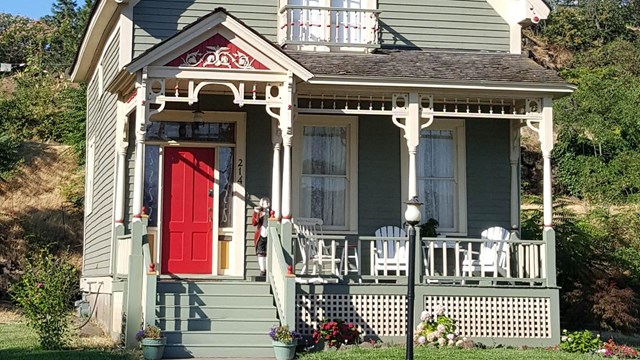
Preservation of the exterior of the Hale House,
Los Angeles, California, involved repainting the exterior walls and decorative features in historically appropriate colors. In excellent example of the Preservation treatment focused upon the ongoing maintenance of historic materials and features. Photo:
Before, NPS files; After: Bruce Boehner.
|
After identifying those materials and features that
are important and must be retained in the process of
Preservation work, then protecting and maintaining them
are addressed. Protection generally involves the least
degree of intervention and is preparatory to other work.
For example, protection includes the maintenance of
historic materials through treatments such as rust removal,
caulking, limited paint removal, and re-application
of protective coatings; the cyclical cleaning of roof
gutter systems; or installation of fencing, alarm systems
and other temporary protective measures. Although a
historic building will usually require more extensive
work, an overall evaluation of its physical condition
should always begin at this level.

Repair (Stabilize, Consolidate, and Conserve) Historic
Materials and Features
Next, when the physical condition of character-defining
materials and features requires additional work, repairing
by stabilizing, consolidating, and conserving is recommended.
Preservation strives to retain existing materials and
features while employing as little new material as possible.
Consequently, guidance for repairing a historic material,
such as masonry, again begins with the least degree
of intervention possible such as strengthening fragile
materials through consolidation, when appropriate, and
repointing with mortar of an appropriate strength. Repairing
masonry as well as wood and architectural metal features
may also include patching, splicing, or otherwise reinforcing
them using recognized preservation methods. Similarly,
within the treatment Preservation, portions of a historic
structural system could be reinforced using contemporary
materials such as steel rods. All work should be physically
and visually compatible, identifiable upon close inspection
and documented for future research.

Limited Replacement In Kind of Extensively Deteriorated
Portions of Historic Features
If repair by stabilization, consolidation, and conservation
proves inadequate, the next level of intervention involves
the limited replacement in kind of extensively deteriorated
or missing parts of features when there are surviving
prototypes (for example, brackets, dentils, steps, plaster,
or portions of slate or tile roofing). The replacement
material needs to match the old both physically and
visually, i.e., wood with wood, etc. Thus, with the
exception of hidden structural reinforcement and new
mechanical system components, substitute materials are
not appropriate in the treatment Preservation. Again,
it is important that all new material be identified
and properly documented for future research. If prominent
features are missing, such as an interior staircase,
exterior cornice, or a roof dormer, then a Rehabilitation
or Restoration treatment may be more appropriate.

Energy Efficiency/Accessibility Considerations/Health
and Safety Code Considerations
These sections of the Preservation guidance address
work done to meet accessibility requirements and health
and safety code requirements; or limited retrofitting
measures to improve energy efficiency. Although this
work is quite often an important aspect of preservation
projects, it is usually not part of the overall process
of protecting, stabilizing, conserving, or repairing
character-defining features; rather, such work is assessed
for its potential negative impact on the building's
historic character. For this reason, particular care
must be taken not to obscure, damage, or destroy character-defining
materials or features in the process of undertaking
work to meet code and energy requirements.
|
 |

|