|
Products
& Services > Wayside Exhibits >
Work Process >
Wayside Exhibit Planning |
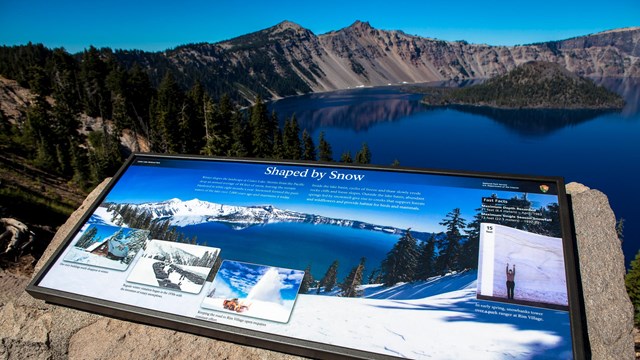
Wayside exhibits often are planned at a point
where the need to know intersects with the need to explain. Typically
these wayside exhibits are flat panels mounted on a low base, angled
to refer to a particular scene. They may also be mounted upright
as trailhead exhibits or as orientation exhibits. |
|
Focusing on Significant Terrain
By Richard B. Hoffman, National Park Service, Harpers
Ferry Center
The asphalt path climbs to an overlook above a stream valley where
herds of elk and bison are grazing. Beyond rises a mountain ridge
with dark green islands of subalpine fir. Think of this site as
Elk Mountain Overlook. Mediating the experience is a plaque with
a color photograph of the scene and labels naming each peak. A series
of four geologic diagrams depicts the evolution of the mountain
range over a period of two hundred million years. The main text
announces that here is a spectacular view, and diagram captions
present a highly detailed story of deposition, uplift, folding,
and erosion.
The panel at Elk Mountain Overlook may or may not be an effective
wayside exhibit. Our relationship to the landscape is individualized,
variable, sometimes intensely personal. The following ideas are
an attempt to outline a series of standards for wayside exhibit
planning. Keep in mind the Elk Mountain Overlook wayside, and critique
it according to these standards.
Planning Wayside Exhibits
Outdoor, or “wayside,” exhibits often are planned at
a point where the need to know intersects with the need to explain.
Typically these wayside exhibits are flat panels mounted on a low
base, angled to refer to a particular scene. They may also be mounted
upright as trailhead exhibits or as orientation exhibits near visitor
centers, marinas, or other major access points. For the purpose
of this discussion, a wayside exhibit is defined as a combination
of words and pictures on a two-dimensional outdoor panel providing
interpretation, information, or orientation to a specific landscape.
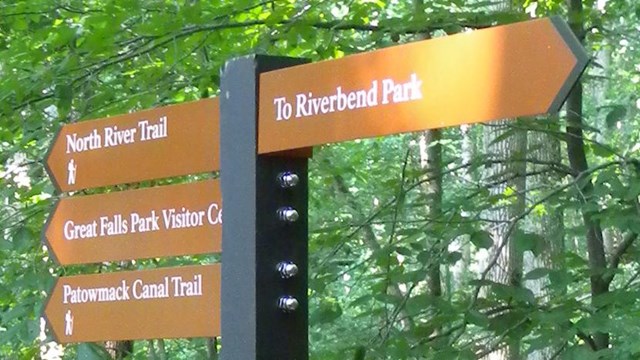
Waysides are very much a graphic medium. Although the boundaries
are somewhat blurred, directional signs are not considered wayside
exhibits.
Wayside exhibits have the challenge of interpreting a sometimes
dynamic landscape in a setting that has multiple distractions. When
a family emerges from their minivan at a park visitor center or
overlook, many things compete for their attention. Arriving in a
park, people may be scanning for wildlife or a dramatic vista, looking
for a restroom or the start of a trail, or checking the schedule
of the next guided walk. For a first-time visitor in Yosemite Valley,
there are so many interesting features that it’s difficult
to know where to focus. To complicate matters further, this potential
audience (or victims) of the wayside may be seeking an enlarging
or inspiring experience rather than a didactic one.
In attempting to interpret everything significant in a setting,
a park could spawn a dense forest of waysides. This thinking leads
to the trap of the Wayside Exhibit Paradox: In a natural area, a
wayside is a manufactured intrusion; in a historic area, a wayside
is a contemporary intrusion. Too many wayside exhibits can dilute
each message and compromise the resource; too few might shortchange
the visitor.
It is possible to select sites and subjects judiciously, to present
the interpretation to optimal effect, and to blend harmoniously
with the resource. But to achieve this, planning must go according
to the strengths of the medium. Planners who allow wayside exhibits
to be theme-driven often underestimate the importance of the medium’s
third dimension—the piece of significant terrain that appears
just beyond the frame of the wayside’s twodimensional panel.
The best wayside exhibits are site-specific. A specific piece of
ground should drive the idea and provide the creative tension—the
interplay between the landscape being viewed and the emotional and
intellectual reaction of the person entering and apprehending the
scene. Think of wayside exhibits as captioning the scenery. In that
way, the particular geyser or fort bastion or customs house foundation
remains the primary focus of the exhibit. Just as the best writing
is packed with highly specific language, the best waysides illuminate
the specifics and significance of the immediate terrain. |
|
TABLE OF CONTENTS:
Wayside Exhibits »
PDF DOCUMENTS:
HFC Editorial Style Guide »
Help With PDF »
|
Rather than distinguish between planning and
design, or viewing them as sequential aspects of the process, think
of planning and design as having co-responsibility for the interpretive
solution. |
|
Show Me the Graphics
Implicit in any discussion of wayside exhibit planning should be
the notion that design is an integral part of the exercise. Rather
than distinguish between planning and design, or viewing them as
sequential aspects of the process, think of planning and design
as having co-responsibility for the interpretive solution.
At Antietam National Battlefield near Sharpsburg, Maryland, a wayside
exhibit faces a small church, approximately one hundred yards distant.
The one-room whitewashed building has simple unremarkable lines.
On the wayside exhibit is a large black-and-white photograph taken
immediately after the battle. The church, though a bit shot up,
looks much as it does today, but in the foreground are corpses of
soldiers. Much of the wayside exhibit’s power derives from
this historic photo, taken from the precise site where the exhibit
is installed.
Wayside Exhibit Text
Few people come to parks for the express purpose of reading. At
its best, the text should succinctly illuminate the terrain and
help people immerse themselves in the resource. The text is the
springboard. Admittedly, some of the subject matter may be fiendishly
complex. That is where succinct expression finds an enjoyable challenge.
Outdoors, the exhibit audience is mobile. The wayside graphic must
attract people’s attention; the title must be short and intriguing;
the first sentence (most crucially the first sentence) must seduce
the audience into wanting to know more. A wayside exhibit audience
is the opposite of captive. Show them something predictable, academic,
or jargon ridden, and they move on, having far better things to
do. The best waysides make one point and one point only.
Landscaping
It is not enough to design and write a well-crafted wayside exhibit
panel. It must be integrated into the scene. Too many outdoor exhibits
appear to be located arbitrarily, as if javelined into the ground
by a cargo plane flying at ten thousand feet. Wayside exhibits are
part of the built environment. They normally should be accessible
to all, including wheelchair users and people with arthritic knees.
Develop a landscape architect’s eye, or trick a landscape
architect into joining your interpretive team. Remember that exhibits
don’t simply interpret the resource—they intrude on
it as well. Blend the exhibits into pedestrian turnouts on boardwalk
trails. Or blend them with railings, boulder groupings, or hedges.
The Planning Process
Ideally begin with media planning or a long-range interpretive
plan. For any park area, wayside exhibits should be just one component
of a mix of media. Sequential narrative or in-depth analysis of
a subject can be covered better in a publication than on the limited
area of a wayside exhibit panel. Parcel the park’s story according
to each medium’s strengths. |
|
|
The core of any wayside exhibit planning venture
is the site visit. Identify potential sites and how they fit into
visitor use patterns. |
|
The core of any wayside exhibit planning venture
is the site visit. First, survey the entire area, getting an overview
of the outdoor resource and significant features. Identify potential
sites and how they fit into visitor use patterns - the tour roads,
trails, and interpretive loops. Closely observe visitor behavior,
paying special attention to how people make use of existing interpretive
media. Then return to each potential wayside exhibit site and study
it in depth. Think about graphics as well as the story, and trust
your perspective as a first-time visitor. Like a detective, seek
the visual clues that reveal the significance of this particular
piece of terrain. Notice how the rise of the land favors Stonewall
Jackson’s troops crouched in the sunken railroad; notice the
pattern of the dry desert wash, the way the angle of debris may
reveal the power of a flash flood. Let the landscape itself - the
telling detail - illuminate the subject.
The initial result of the site visit should be a wayside exhibit
proposal. This is essentially a list of all the sites that made
the cut. For each exhibit, provide an outline that identifies the
subject, the interpretive purpose or intent, the panel’s orientation
or view, and a detailed description of the precise location and
any landscaping considerations. At this stage, each exhibit in the
proposal should reflect a team perspective, including the views
of a subject matter expert, park interpreter, designer, wayside
exhibit planner, and park superintendent. As often as possible,
include the maintenance foreman (who may be installing and maintaining
the exhibit) and a landscape architect on the initial team. This
is also the time to begin determining materials based on factors
such as weather, potential vandalism, and the relative permanence
of the information.
After the proposal has been reviewed and approved, the wayside
exhibit planning/designing begins in earnest. The wayside exhibit
plan, as a document, consists of draft text and a scaled layout
of each exhibit panel. While developing text, particularly for a
historic site, look for quotations that refer to the specific landscape.
|
|
|
At its best, a wayside exhibit inspires a more
active park visit. Good waysides often provide perceptual tools
for further exploration.
|
|
Concluding Strategies
As in theater, wayside exhibits depend on an audience response.
Obsessively field- test your products; spend hours observing people
interacting with outdoor exhibits. Eavesdrop on their comments.
Use a stopwatch to time people who stop at (or pass by) the exhibit.
To test wayside exhibit concepts and effectiveness, cultivate a
group of informal evaluators —“civilians” with
little or no connection to the profession of interpretation or outdoor
recreation. Solicit candid responses; don’t let them pull
punches. Real people in a realworld outdoor setting may provide
you with responses far different from those of your client park
interpreter.
At its best, a wayside exhibit inspires a more active park visit.
Good waysides often provide perceptual tools for further exploration.
When the wayside exhibit across from Glacier National Park’s
Bird Woman Falls interprets that specific hanging valley above the
waterfall, visitors learn how to recognize this glacial feature
and can look for other hanging valleys during a tour of the park. |
|
|
 |
 |
 |
 |
 |
|