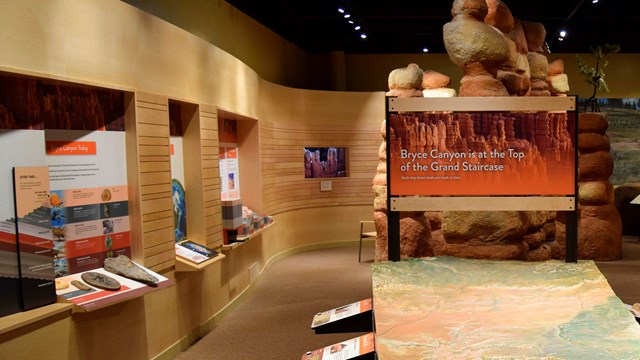
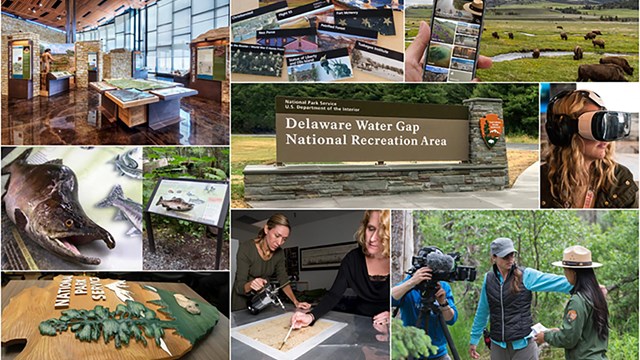
Discovery Center Exhibits at Martin Luther King,
Jr., National Historical Park, Georgia.
Learn more » |
|
An exhibit contract or task order has a beginning
and an end, yet many aspects overlap, and no two projects are alike.
Here are some notes from Harpers Ferry Center Exhibit Designer Mitch
Zetlin on what to think about and look for during the administration
of an exhibit planning and design contract.
Understand all aspects of the scope of work. Be aware of and understand
all deliverables.
Be aware of review times. Establish who will be the reviewers.
Are there any partners, such as friends groups, Indian tribes, regional
reviewers, or HFC staff that should be accommodated in the review
scheduling? Allow time for these.
Understand the payment schedule. Be concerned for the contractor’s
cash flow. Prompt payment for acceptable work goes a long way toward
ensuring good working relations with a planning and design firm.
In the early stages of the project—when first meeting the
contractor—making them aware of the park's story is critical.
Miscommunication of the design direction is a major cause of planning
and design problems. Initial discussion of the themes or “thesis”
of an exhibit is critical. It helps if a contract designer can do
sketches at the site. An exhibit is by its very nature a tangible,
designed product, and different people form different images in
their heads early on. It works best when some early drawing takes
place to help ensure the direction so that all parties understand
the visual direction of the story. As deliverables proceed, they
should be a refinement of the design direction. It's ok if these
drawings are simplistic; they give everyone involved the opportunity
to explore space configurations with possible exhibit elements.
Organizing the resources for exhibit elements as soon as possible
will define what possibilities the design can take. This means that
photos, illustrations, artifacts, models, electronic or AV elements,
maps, and reproductions are available early on for the palling and
design team to consider. If artifacts are to be used, begin defining
the conservation needs and requirements for case design. The Exhibit
Conservation Guidelines prepared by the HFC Department of Conservation
may be useful.
Having the space for the exhibit accessible to the planning and
design team is critical. If it is an existing space the contractor
will need to be able to take measurements, review any building constraints,
and be aware of electrical conditions in order to design lighting
for the exhibit space. To ensure artifact conservation needs will
be met it is helpful if the changes in room temperature can be monitored.
If it is a proposed new building it is important that the planning
and design team work with the architects to ensure compatibility
with the overall visitor experience.
Exhibit text, drawings, schedules, and related data are contained
in phased deliverables called the Schematic Plan, Concept Plan,
and Final Plan Packages. If there are unusual circumstances, or
you want better control of the contractor’s direction, you
can ask for intermediate deliverables or progress reports. These
should not be seen as extra deliverables, but as work in progress.
The goal is to ensure the project is going in the right direction.
It is better to be sure the direction is proceeding without any
miscommunications early in the process rather than after a great
deal of effort has been placed in a design direction.
When things go wrong or the Scope of Work changes, be sure the
Contracting Officer or Contract Specialist is aware of any proposed
changes. Define what changes to the contract you wish to make, and
submit the proposed modification to the contracting office before
you ask the contractor to do work outside the original scope of
work.
Follow up on the acquisition of photos, illustrations, reproduction
artifacts, and all other elements that must be obtained. Establish
a budget for the acquisition of these elements.
At each critical stage of planning and design development, and
as they correspond to deliverables, have the contractor develop
cost estimates for fabrication to ensure the design you like is
realistic with respect to the fabrication budget specified in the
contract.
|
|
TABLE OF CONTENTS:
Exhibits & Museums »
|