Products & Services > Exhibits & Museums > Exhibits In-Depth > Exhibit Work Processes & Comparable Costs

Exhibit Work Processes & Costs

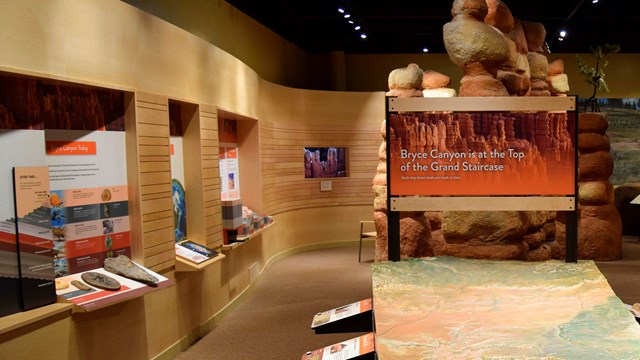
The Lure of the Mountains exhibit on the Blue Ridge Parkway

"The Lure of the Mountains" exhibit at Peaks of Otter Visitor Center on the Blue Ridge Parkway.

Learn more »


Exhibition Planning, Design, & Production

Exhibition development typically involves three basic functions or disciplines: planning, design, and production/installation. Work processes and project variables affect costs.

Planning

In general, planning responsibilities include interpretation, research, curation, writing/editing, and content management. Planners facilitate the establishment of an exhibition’s goals, themes, and objectives, and document park artifact and graphic collections. They work with stakeholders, subject matter experts, and evaluators conducting audience research. As the project develops, planners manage databases for organizing all exhibition elements and purchase use rights for selected media assets. Planning outputs include: content outlines; bibliographies; exhibition descriptions; walk-through narratives; evaluation protocols and OMB social science applications; COTR review correspondence; media asset databases; and graphic source material packages.

Design

Design is primarily responsible for the creation and management of the exhibition’s visual, spatial, and technological elements, as well as coordination with facilities design. Designers collaborate with project team members to study visitor flow and circulation patterns; integrate the exhibits with the building; design all exhibit areas and their associated physical, graphic, and audiovisual elements; prepare cost estimates; and produce and present submittal packages for client and stakeholder review. Design outputs include: preliminary bubble diagrams; schematic alternatives; concept and final designs; production-ready drawings including all structural details and graphic layouts; exhibit models; architectural modification drawings; lighting plans; audiovisual and computer system designs; and material and finish specifications and schedules.

Production

The production/installation manager ensures that final planning and design packages are complete, prepares fabrication contract documents and government cost estimates, and manages the production and installation of exhibits. The producer manages the flow of all media assets to the production firm; solves an array of technical issues; inspects work in progress that has been completed; supervises the installation; orients the client to proper maintenance procedures and warranty issues; and coordinates the project close-out process, including the return of all original media assets.

Collaborative Nature of the Work

It should be emphasized that planners, designers, and producers need to work in a collaborative way so that the multitude of project elements are developed and produced in a coordinated process. The three disciplines often share roles, responsibilities, and tasks.

Work Phases in the Exhibit World

While the museum exhibit industry has not articulated a universally-accepted work process, the overall development of any project, whether NPS or not, usually follows these phases:

  1. project definition/schematic,
  2. concept,
  3. final, and
  4. production/installation.

With the rapid advances in computer technology in the fields of both design and production, the boundaries between the two disciplines are blurring, with designers increasingly taking on more pre-production and production tasks. Ideally, all three disciplines are involved with a project from beginning to end, although their respective efforts will vary according to the project phase.

The old saying that “no two projects are alike” is especially true for museum exhibition development. Curators at museums contracting with private design firms might provide all—or a significant portion of—the research and planning tasks (thus, driving down the documented planning and design costs as a percentage of production). In the NPS, parks rarely have time to provide a high degree of planning on projects (although when they are co-planners it makes for a higher-quality product and smoother process), leaving that function to HFC to either do in-house or by contract.

Variables that Affect Outcomes

Key variables affecting planning and design costs include the: amount of research required; need for hiring subject matter expertise; degree of stakeholder involvement; level of architectural coordination required; amount of original art work, maps, and photography; and, object acquisition needs. In addition, planning and design percentages typically vary according to the scale of the project (generally an inverse relationship); the percentage for larger projects is usually lower. Other factors include the number of client change orders (sometimes costly), and irregularities in the project schedule (planning and design costs will typically increase if the project is fast-track or extensively delayed).

 
Author: Harpers Ferry Center
Last Updated: Tuesday, 11-Mar-2008 08:18:21 Eastern Daylight Time
http://www.nps.gov/hfc/products/exhibits/ex-indepth-costs.htm