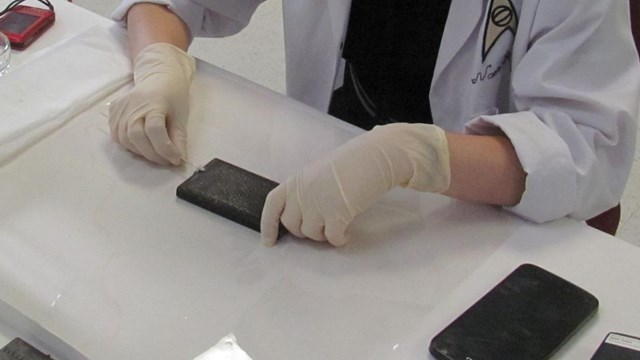
Pest monitoring trap used in one of the Harpers
Ferry Center conservation labs. |
|
What can we do to protect our museum collections
from museum pests?
Establish an Integrated Pest Management (IPM) program for your
museum. This is a site-specific decision-making system to determine
if, when, and where pest suppression is necessary. Pesticides are
used only as a last resort, because they are a hazard to the environment,
museum collections, and the health of people handling the pesticides
and the collections. The IPM process is cyclical and involves regular
inspections and pest monitoring as well as environmental monitoring.
Pest identification, establishing priorities and action thresholds,
modifying pest habitats, good housekeeping, and pest exclusion techniques
are all a part of this process. Non-chemical and chemical treatments
are used when necessary and the results are evaluated. All monitoring
and treatments are documented. Educating and building consensus
with other park staff to participate in the process is key to the
success of any IPM program.
What should I do if I find live pests or pest evidence in the
museum?
If an infestation is found on objects, isolate them immediately.
Identify the pests and determine if they are museum pests likely
to harm the objects. Determine the source and extent of the infestation.
Develop a treatment strategy based on the identity of the pest and
the materials and condition of the object. Consult a conservator
to discuss treatment options such as cleaning (often vacuum cleaning),
freezing, anoxic environments, chemical fumigation, or other options.
Document the infestation and treatments.
If the infestation is not found on museum objects, it is important
to keep the pests from contact with objects with effective exclusion
and isolation techniques. Eliminate the infestation through other
IPM methods. Do not panic and rush to use inappropriate chemical
treatments to kill pests. Your regional or Servicewide IPM Coordinator
must first approve any pesticide use on National Park Service property.
Consult Carol DiSalvo, WASO IPM Coordinator, or your regional IPM
Coordinator when any pesticides are being considered for use at
a NPS site.
Is help available to set up an Integrated Pest Management (IPM)
plan at our National Park?
Chapter 5: Biological Infestations in the NPS Museum Handbook,
Part 1, gives clear and thoughtful guidelines on setting up an Integrated
Pest Management plan for museum collections at a park. Park staff
with collections care responsibilities can contact Barbara Cumberland,
IPM Coordinator at Harpers Ferry Center-Conservation, for advice
on any aspect of collection pest management.
Can this assistance include travel to our park and to develop
an IPM program specific to our site and conditions?
The HFC Conservation IPM Coordinator is available to give on-site
assistance to parks wishing to establish a museum-oriented IPM program.
We will help set up a monitoring and trapping program, discuss systems
of documentation, advise on structural modifications, and offer
strategies for dealing with and avoiding infestations.
We recognize that parks vary widely in the conditions surrounding
their museum objects, collection storage facilities, exhibit areas
and historic furnished structures. The climate and physical structures
influence pest problems at these varied sites. Staff to deal with
pest monitoring and control is often limited at many parks. However,
the park needs to provide the commitment that a staff member or
members will have the time available to follow through with an ongoing
pest-monitoring program and other IPM actions.
A computer program is used to document pest monitoring data and
organize them in various reports and graphs. Our updated program
uses Microsoft Access and Microsoft Excel software. This is only
one of many suitable methods that document monitoring information
by computer. Contact Barbara Cumberland for more information. Non-computer
generated survey forms can also be used and be kept as a permanent
record at the park.
|
|
TABLE OF CONTENTS:
Artifact Conservation »
|