Home > Making Exhibits More Accessible

Making Exhibits More Accessible

Oak tree model at Naval Live Oaks Visitor Center  
 

Massive oak tree model dominates the Naval Live Oaks Visitor Center at Gulf Islands National Seashore. (NPS Photo by Anita Smith)


Universal Design Comes of Age in NPS Exhibits

HFC exhibit planner Krista Kovach-Hindsley recently reflected on the state of accessibility in National Park Service exhibits. “Exhibits are inherently visual experiences,” she says, “so our challenge is to provide multiple opportunities for all our visitors to access information and gain the same benefit.”

Universal Design

According to Kovach-Hindsley, good exhibits feature redundant, multisensory experiences. “Take tactile elements,” she says. “Tactile models and exhibit components appeal to diverse age groups, people who speak different languages, and people who are blind or have low vision. Tactile elements are perfect examples of Universal Design.”

Kovach-Hindsley is referring to the principles of Universal Design, which advocate the design of products and environments to be usable by all people, to the greatest extent possible, without the need for adaptation or specialized design. These principles were developed by The Center for Universal Design at North Carolina State University in Raleigh, North Carolina (see The Principles of Universal Design).

Accessibility Design Charettes

Harpers Ferry Center has become a much greater advocate for accessibility in all National Park Service media in recent years. HFC partnered with the U.S. Access Board, Smithsonian Institution, and Chesapeake & Ohio Canal National Historical Park in November 2007 to host an accessibility design charette for new exhibits at Great Falls Tavern. Subsequent accessibility charettes were conducted for new exhibits at USS Arizona Memorial in December 2007, at San Juan National Historic Site in May 2008, at the White House Visitor Center in June 2008, and at Frederick Douglas National Historic Site in August 2008.

HFC project manager Michael Paskowsky has attended several of these charettes. “One thing we’ve learned from users who are blind or have low vision,” says Paskowsky, “is how important it is to orient them to both the exhibit space and the surrounding park site.”

NPS accessibility coordinator Ray Bloomer, who has participated in some of these charettes, agrees. “Providing some kind of tactile or audio orientation really helps people who are blind or have vision-loss better visualize and participate in the available experiences.” Bloomer also emphasizes that people who are either deaf or have hearing loss, or who are blind or have low vision, are for various reasons often reluctant to self-identify themselves. “By providing multi-sensory experiences,” says Bloomer, “all your visitors will have multiple opportunities to access information.”

HFC exhibit producer Anita Smith also advocates Universal Design. “Provide interpretive experiences in multisensory ways,” she says, “including tactile, visual, and auditory experiences.” Smith was producer for one of the Park Service’s newest exhibit, the Naval Live Oaks Visitor Center at Gulf Islands National Seashore.

Visitor in wheelchair Digital terrain model at Shenandoah National Park

Above: Park visitor in a wheelchair. Right: Touchable digital terrain model at the Dickey Ridge Visitor Center in Shenandoah National Park.

Physical Accessibility

Smith stresses the importance of physical accessibility, which is governed by the Architectural Barriers Act (ABA) of 1968. Accessibility for exhibits usually starts with the visitor center information desk, which has to be fully accessible and functional not only for the visitor but also for NPS staff. Exhibit designers works with the park and the ABA guidelines to configure this structure so that it will comply with requirements and meet the park’s individual needs. Usually, one section of the desk is designed to be open underneath, so it can be approached from the front by a visitor in a wheelchair or used by a staff member in a wheelchair from the other side as well.

Circulation through the exhibits must comply with minimum requirements for wheelchair access. If the design includes raised areas of flooring or special floor treatments, slopes and slip-resistance of the floor must be in accordance with the accessibility guidelines. If the exhibits include a small mini-theater, it must accommodate at least one wheelchair and allow an unobstructed view of the presentation. Interactive and touchable exhibits must be reachable by a person in a wheelchair. Graphics, texts, and objects in the displays need to be located at a height from the floor that is within the correct visual range to be viewed by both standing visitors and visitors in wheelchairs.

A person who is blind or has low vision may be navigating through the exhibit space using a cane. The structures need to comply with the ABA standards for protruding objects and configured so that the cane hits the structure in time to warn the person they are approaching the protruding structure.

If an exhibit has mechanical interactive—levers to pull, drawers to open, doors to flip, wheels to turn, and so forth—the force required has to be kept below a certain threshold measured in pounds of force. Mechanical interactive have to also adhere to the “closed fist” rule: any of the knobs or handles must be operable by a person with a closed fist, instead of requiring gripping with the hand.

Tactile model of acorns
Tactile model of oak leaves
Tactile model of female flounder
Tactile exhibit at Great Falls Park
Above: Tactile models of acorns, oak leaves, and a female flounder. Right: Tactile models in exhibit at Great Falls Park, Virginia.

Tactile Exhibit Elements

HFC exhibit planners and designers are constantly expanding their toolkit for delivering multisensory experiences that engage all visitors. At the Naval Live Oaks Visitor Center in Gulf Islands National Seashore, new exhibits recently replaced ones destroyed by Hurricane Ivan in 2004.

The new exhibits, which were designed by contractor Krister Olmon and fabricated and installed by Southern Custom Exhibits, feature tactile natural history models, a tactile model of a ship’s hull, a railing system to help guide visitors who are blind or have low vision around the exhibit space, and telephone handsets that provide audio description. For visitors who are deaf or have hearing loss, all the audio elements in the exhibit a include open captions, volume control, and T-coil compatibility for those who have T-coil compatible hearing aids.

Smith and park staff are particularly pleased with the tree model that dominates the Naval Live Oaks Visitor Center (see photo above). The exhibit focuses on the natural properties of live oak trees that made them perfect for framing naval ships.

“One of the first visitors” recalls Smith, “asked park staff how they were able to build the new visitor center around the huge oak tree.” In fact, the tree is a touchable model with bark cast from molds of actual oak trees found in the park. The gigantic limbs are even embellished with realistic-looking artificial leaves, ferns, and Spanish moss. The adjacent exhibits include touchable models of oak leaves and acorns, and feature touchable models that interpret key aspects of wooden ship design and construction.

Several tactile tree models are also provided at Kings Mountain National Military Park. Trees provided critical cover for American forces as they advanced up the mountain against the British during the American Revolution.

Feguson Rifle model and display Close-up view of the Ferguson Rifle tactile model
Above: Original Ferguson Rifle and tactile replica on display at the Kings Mountain Visitor Center. Right: Close-up view of the tactile model.

Another unique exhibit at Kings Mountain is the Ferguson Rifle display. The original rifle in the park’s collection is one of only a few on public display, and sits behind a glass case. Adjacent to the case, however, is a tactile replica of the rifle (see photos above). “Everyone touches the model,” says project manager Michael Paskowsky. “It’s a great example of Universal Design that engages all park visitors.”

Paskowsky is taking a similar approach to new exhibits for USS Arizona Memorial. Here, highly detailed models of airplanes and ships in glass cases will be accompanied by smaller scale tactile models which all visitors can touch.

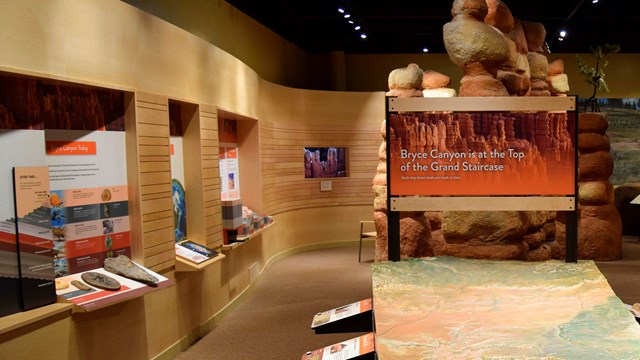
The new visitor center at Great Falls Tavern on the C&O Canal, which is currently in production, also features tactile components throughout the exhibit. There’s a topographic model of the Great Falls area with touch-sensitive geologic zones. A visitor can touch different geologic zones on the model to listen to an audio message. Each geologic zone is color-coded and features a different texture, which provides access to visitors who are blind or have low vision.

Another exhibit provides an olfactory experience, giving off smells of ginger punch and apple cider—two drinks that were once served at the tavern. There’s also an exhibit with touchable items permanently affixed to a table top. These items represent common cargo once carried by canal boats, including lumber, coal, and farm produce.

Touchable mannequins are used in another part of the Great Falls Tavern exhibit. The figures, who represent different canal people including a boat captain, his wife, a child, and a lock keeper, are cast in fiberglass resin. Visitors can touch the models, and also push a button to hear a story for each person.

Exhibits for the new Assateague Island National Seashore Visitor Center are still in the planning and design phase. But several tactile elements have been incorporated into the proposed new exhibits. There will be touchable models of native fish, a young horse (foal), and common crustaceans. The models are being built by Chase Studio, a subcontractor to Southern Custom Exhibits.

The Assateague Island exhibits will also feature “touch bins,” which park staff will fill with commonly occurring natural material. There will even be a small “touch tank” or aquarium where visitors can reach into the water and touch horseshoe crabs or other small creatures.

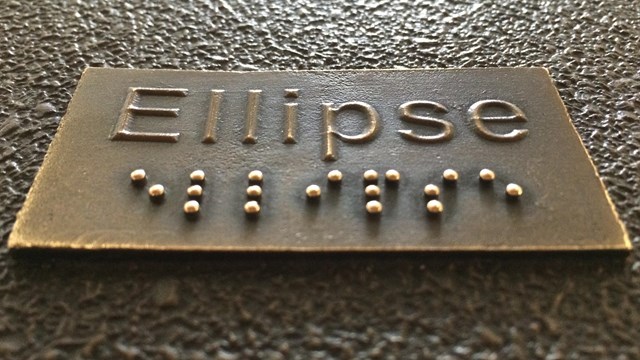
A large tabletop map of the park will feature an end panel with a tactile version of the park map and accompanying Braille. “This panel should provide visitors who are blind or have vision loss with a quick feel for the size and shape of the park,” says exhibit designer Chris Dearing. “We want them to be able to find their present location relative to the long, narrow barrier island.” The tactile panel will be fabricated from a durable fiberglass resin material.

Sennheiser guidePORT Audio description handset for exhibits at the Thaddeus Kosciuszko HouseVisitor uses assistive audio system in new exhibits at Fort Stanwix

Above: Sennheiser guidePORT wireless visitor information system. Center: Audio description handset for exhibits at the Thaddeus Kosciuszko House. Right: Visitor uses an assistive audio system in new exhibits at Fort Stanwix National Monument.

Audio Description

Exhibits in the Tavern Room at the Great Falls Tavern are equipped with push buttons to deliver audio description. Using directional speakers that focus sound down from the ceiling, all visitors can choose to listen to audio description of the exhibit they’re standing in front of. The push button boxes have small speakers that play soft music to draw the attention of visitors who are blind or have low vision. A Walker telephone handset will provide audio description for a silent canal video that plays in one of the exhibits.

At the Naval Live Oaks Visitor Center, Walker handsets are provided at all the primary exhibit structures. Each handset features a volume control and provides audio description for the adjacent exhibit. Similar handsets are also furnished for new exhibits at Edgar Allen Poe National Historic Site and Thaddeus Kosciuszko National Memorial, both in Philadelphia. Because Kosciuszko was a Polish freedom fighter, audio description is also provided in Polish.

Localized handsets and push buttons provide several advantages: anyone can listen to the audio, park staff don’t have to hand out devices at the front desk, and visitors with disabilities don’t have to identify themselves.

Inside the touchable tree model at Kings Mountain, an audio program plays in three distinct parts: an interpretive message, an overview of the exhibit theme, and verbatim audio description of the exhibit’s wall text. Visitors hear all three parts of the audio—there are no selection buttons that differentiate sighted visitors from those who are blind or have low vision. The park made this choice because they didn’t want to differentiate visitors based on any type of disability—they wanted every visitor to have access to the same audio experience.

One of the innovative new products Harpers Ferry Center has adopted for use in several recent NPS exhibits is the Sennheiser guidePORT™ system. This wireless visitor information system senses a visitor’s location and automatically delivers—via a wearable headset and receiving unit—audio that corresponds exactly to where the visitor is standing. Unlike other systems common to exhibit environments that require users to press buttons that correspond to their location, guidePORT is virtually hands-free.

An added benefit of guidePORT is that the system used for an exhibit area can also be used to deliver audio description or assistive listening in the visitor center theater. The visitor has additional flexibility with buttons on the unit that stop and restart the audio from the beginning of the last file played. Volume controls are also provided (see photo above).

GuidePORT can also be combined with an induction loop system. Visitors with T-coil compatible hearing aids can request a neck loop which picks up the Sennheiser audio signal and then transmits it to their T-coil compatible hearing aid. Alternately, an induction loop can be built right into the exhibit space, doing away with the need for a neck loop. Visitors which T-coil compatible hearing aids need only be alerted to flip a switch built into their hearing aid.

The guidePORT system does have some disadvantages. Visitors who are blind or have low vision, or who are deaf or have hearing loss, must request the device at the front desk. Park staff also have to collect the returned devices and make sure they’re properly stored in the furnished recharging rack. And cost for the guidePORT system is not cheap. HFC audiovisual technician Ed Boutte, who has installed a guidePORT system a Little Rock Central High School NHS, estimates hardware costs alone can total as much as $40,000.

The guidePORT system being developed for African Burial Ground National Monument in New York City will provide one channel for assistive listening and a second channel for audio description. People who have hearing loss, or who are blind or have low vision, will be able to request the guidePORT device at the front desk. The attendant can then set the device to the appropriate channel (1 or 2). GuidePORT is capable of hosting multiple channels, so a third channel, for instance, could be provided in the future for a language translation or an audio tour.

At the USS Arizona Memorial, the park’s cooperating association will offer a similar system.  The Arizona Memorial Museum Association is working with contractor Antenna Audio to develop a multi-channel program that will offer audio tours in multiple languages, plus audio description for people who are blind or have low vision, and assistive audio for people who have hearing loss.

The audio program will be a hybrid system that is activated automatically by Sennheiser infrared triggers or manually by selecting numbers from the Antenna Audio device’s keypad. Visitors who want a traditional audio tour experience can rent a device with the channel set to English or to one of several other languages. People with special needs can request the device for free with the channel set either to audio description or assistive audio. Neck collar induction loops will be available for people who have T-coil compatible hearing aids.

Thought, not Afterthought

Paskowsky stresses the importance of incorporating accessibility into all our media planning processes. “The guiding principle,” he says, “ is thought, not afterthought.” HFC experience has shown that retrofitting an exhibit for accessibility after the planning phase can easily add from 15-20 percent to the cost of the project. This can amount to several thousand additional dollars.

Anita Smith is adamant about providing all visitors with similar experiences. “If you can see something, but can’t hear it,” she says, “then you have to think of a way to make it audible so that someone who is blind or has low vision gets a similar benefit. It’s all about redundancy.”

Kovach-Hindsley is equally emphatic about accessibility and Universal Design. Provide multi-sensory experiences, which benefit all visitors. Provide information in numerous ways—redundancy can be very effective. Appeal to numerous learning styles, abilities, and interests. Focus on relevant, core messages.

Author: Rick Olivo, The Daily Press, Ashland, Wisconsin
Last Updated: Tuesday, 02-Jun-2009 11:19:51 Eastern Daylight Time
http://www.nps.gov/hfc/news-exhibit-access.htm