|

Movie captures beauty of the National Lakeshore
By Rick Olivo, The Daily Press, Ashland, Wisconsin,
January 5, 2003
BAYFIELD — The many moods of the Apostle Islands in all four
seasons of the year offer an ever-changing tapestry of beauty for
those who will take the time to experience what the islands have
to offer.
To capture the stunning beauty of water, land and sky, the pristine
wonder of the Apostles is a daunting task for any artist.
Taking on that task, a National Park Service crew of filmmakers
has labored for several years to produce a 20-minute film entitled
“On the Edge of Gichigami — Voice of the Apostle Islands.”
Assisted by many local volunteers, historic reenactors, Native
American artists, poets and others, National Park Service producer
and director Anne Tubiolo and cinematographer Steve Ruth produced
a four-season film bringing the voice of the islands to life.
The film interweaves breathtaking visuals of the islands and the
surrounding Lake Superior with haunting Native American music, and
the voices of over two dozen speakers talking about the history
of the islands, their spiritual qualities and awesome scenic beauty.
Bob Krumenaker, Superintendent of the Apostle islands National
Lakeshore said the film was “a work of art.”
“For many of you, it was a labor of love, but it is also
a huge and complicated undertaking.”
He said when the proposal to make a film about the Islands was
made to National Park Service officials, they unhesitatingly said
producer Anne Tubiolo was the only person who would be able to do
justice to the project. Krumenaker observed that Tubiolo and her
husband attended the premiere at their own expense, traveling from
their Virginia home for the event.
“Clearly it is a labor of love for them, as well,”
he said.
Krumenaker said Tubiolo was known for her “can do attitude,
her creative sense and her success at tackling park films in different
and non-traditional ways.”
He noted that Tubiolo had been present at every shoot and at every
interview .
“That was not only because she wanted to assure the quality
of the product, but because she truly loves the area and was fascinated
by every aspect,” she said.
Tubiolo acknowledged the contribution of local people in getting
the film made.
“It was a team effort, my crew and I could not have done
it without your help,” she said.
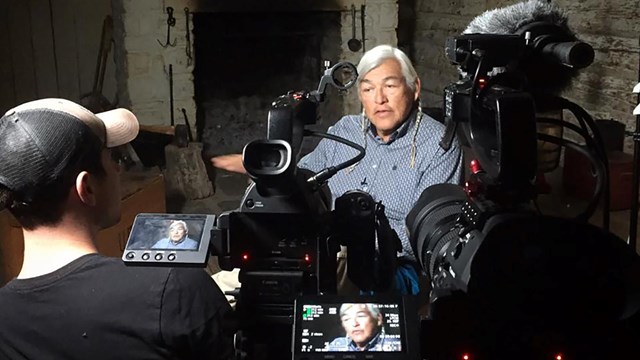
Tubiolo said when the project began it was decided to make a film
with very little narration, instead letting people who lived, worked
and visited in the Islands to be the voice of the film.
“Over the course of several years and five or six trips up,
we recorded about 20 hours of stories, thoughts and impressions.
When I began the editing process I listened again to all of the
audio and I was left humbled by what I heard,” she said. “Let
me tell you, it was hard choosing what went into the film. It was
agony reducing the 20 hours to 20 minutes.”
She said in showing the film to family members and co-workers,
they all, to a person, said they wanted to visit the Islands.
“This tells me your powerful, passionate and eloquent words
along with the images of this remarkable place have captured, at
least at some level, the essence of the Apostle Islands,”
Tubiolo said. “My hope is that this film will encourage people
to explore the islands , learn the history, meet the people and
come away with stories of their own.”
Following the showing, Tubiolo said the filming of “On the
Edge of Gichigami” was one of the most memorable of all of
her cinema projects for the National Park Service.
“I absolutely fell in love with this park. The fact that
we were here in every season increased my love for the area. Any
chance to get up here, I took,” she said.
She said that she and cinematographer Steve Ruth both began their
tenure with the National Park Service on the same day 17 years ago.
“We have sort of grown up in the audiovisual department and
we can go out to a location, and it’s sort of an unspoken
thing, he knows what I like. I give him direction on some shots
but left to his own devices I know I would get a great film,”
she said.
Tubiolo said she was glad the film was shot as a four-season piece.
“This is a place where you have to experience in all seasons
in order to really get an inkling of what it is like up here,”
she said. “There are things out there that are really subtle
and there are things that smack you in the face.”
She said when she got the project she was “a little spooked”
because of an inclination to seasickness.
“The magic of this place is such that I didn’t get
sick once,” she said. “It’s incredible”
Filming winter scenes on frozen Lake Superior also had an unnerving
quality, Tubiolo said.
“They gave me these two icepicks on a string to put around
my neck and they said ‘If you fall through the ice, just kind
of claw your way back up.” And I’m thinking, it ain’t
going to happen, I’m going to sink like a rock.”
Fortunately for film viewers, Tubiolo remained safely above the
surface of the ice. She even learned to appreciate the stark beauty
of the frozen lake.
“It was magical. When the sun hit that snow out there, it
sparkled like a field of diamonds. It was absolutely stunning,”
she said.
Tubiolo recalled one of her favorite memories, after a hot day
of filming, floating in the lake near Stockton Island .
“I was floating there, under the stars thinking this is so
cool, it’s just an amazing place. I have grown to love and
respect this park. I have worked in many, many parks, some renown
for natural beauty, some culturally significant, and every now and
then a park rises above the rest; and this for me is one of those.”
Anne Tubiolo produced, directed, and edited “On
the Edge of Gichigami, Voices of the Apostle Islands”, a 20
minute film produced by the National Park Service and a host of
Apostle Islands friends. The film had a premiere at the Apostle
Islands National Lakeshore Headquarters Visitor's Center in Bayfield,
Wisconsin on Saturday, Jan. 3, 2004. The film features cinema images
of the history and unique beauty of the Apostles, voices of individuals
intimately associated with the islands, and music of the region.
Copyright © 2003 The
Daily Press |