|
Contractors
> New Media Mapping Services & Digital Terrain Models > Solid Terrain Models |
Solid Terrain Models |
| |
|
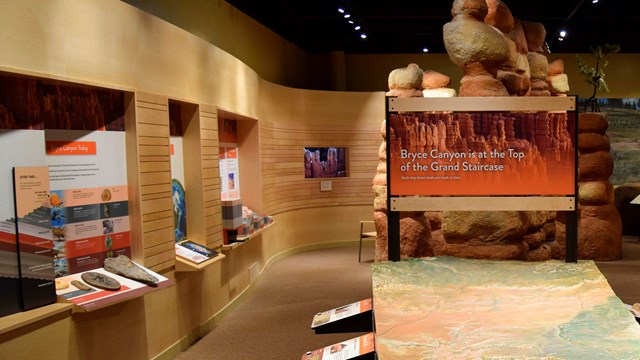
Ideal for visitor center exhibits, solid terrain models are actual physical models that people can gather around, view from any direction, and explore. The models are usually at least several square feet in size and are suitable for display on tabletops or walls. Watch a video about Solid Terrain Models »
Model Making Steps |
|
RELATED LINKS:
3D Maps »
Animated Maps »
Interactive Maps »
Solid Terrain Models Video » |
1. Data
Kenai Fjords National Park Unigrid map made from GIS and satellite sources. |
|
Solid terrain models derive from the same GIS data found at most parks and used by Harpers Ferry Center to produce brochure maps. The chances are good that the necessary data is readily available to produce a model of your park. Computer Numerically Controlled (CNC) routers reading Digital Elevation Models (DEMs) carve the terrain to accurate specifications. The information that prints on the terrain surface is entirely customizable – labels, roads, boundaries, satellite images, etc. – the choice is yours.
 |
|
2. Design
3D virtual model for viewing in a Web browser (right) or in a Quicktime movie (below).

View Quicktime Animation »
|
|
To help you visualize how the final model will look, you will receive virtual images of the proposed model seen from multiple viewing angles. The images are viewable in a web browser, or you can watch a QuickTime movie and circle around the model. The terrain, textures and colors, and labels on the virtual model will appear nearly identical to those printed on the actual solid terrain model.

|
|
3. Review
1-foot by 1-foot sample of the proposed model. |
|
In addition to reviewing virtual models, you will receive a 1’ x 1’ sample of the solid terrain model for review—and touching. You decide which portion of the landscape to receive as a sample. Confirming the amount of vertical exaggeration applied to the terrain is a critical decision at this stage.
 |
|
4. Fabrication
Labels and landcover textures printing on the carved terrain model. |
|
Solid Terrain Modeling, Inc. fabricates the model at their facility in Fillmore, California, and then crates and ships it to your site. This image shows an inkjet printer applying map labels and textures (right side) to the routed terrain surface (left side). They also apply a clear protective coating to the model surface.

|
|
5. Installation
Right: Model mounted on a custom table in the Exit Glacier Contact Station, Kenai Fjords National Park.
Below: Standard table available for solid terrain models.

View larger »
|
|
To display your solid terrain model, you can order a custom-sized table and have it shipped to your site. The wooden tables come in a variety of natural finishes and comply with ADA accessibility guidelines.
 |
|
| |
|
More about solid terrain models
- You can get multiple copies of a model. Each additional model costs one half the price of the original.
- Solid terrain models are made from blocks of high-density foam at sizes up to 4’ x 8’. By piecing multiple blocks together, very large models can be made (the seams are largely unnoticeable). Models can also be made at smaller sizes and with irregular shapes.
- The clear coating applied to the model surface is not enough to protect the model from continuous touching by visitors over long periods of time. The models are not suitable for outdoor exhibits.
- The terrain on most models requires at least some vertical exaggeration to look natural, which varies depending on the character of the land. High mountains require little or no vertical exaggeration, while very gentle terrain can require 200-percent vertical exaggeration, or even higher.
- Labels and lines (trails, roads, boundaries, etc.) positioned on very steep slopes tend to stretch and blur. It is advisable to place them elsewhere or leave them off the map entirely.
|
 |
 |
 |
 |
 |