My best advise for now is to develop a workflow that supports including Closed Captioning to your new on-line multimedia productions using one of the well documented standards for doing so.
Bruce Bailey
U.S. Access Board |
|
The following question was posed to the U.S. Access Board by HFC audiovisual producer Michele Hartley:
We recently received questions from a park regarding accessibility and video podcasts. The park would like to create a series of video podcasts that will be available on the park’s website and on iTunes. In this first batch, they see producing mini-interpretive programs/commercials about major park sites to give people a sense of what each place is like and why they might visit or use the podcast to augment a current visit to the park. While park brochures, wayside exhibits, formal interpretive tours, and informal interpretation with staff could provide some of this information to visitors with a wide variety of disabilities, none would be in the same exact format or necessarily have the same focus or intent.
The screens on video iPods and similar devices are very small, so providing captions within the programs seems unrealistic. But because these podcasts contain both video and audio, can you provide guidance with regards to requirements and/or what is being done with regards to captioning and audio description of podcasts?
Bruce Bailey, Accessibility IT Specialist with the U.S. Access Board, responded:
The accessibility standards for video podcasts are covered by Section 508 § 1194.24 Video and multimedia products. This should pretty well cover the materials posted to the park’s website. You seem to have a good handle on the requirements and challenges, but more information is available on the U.S. Access Board website »
The subject of the readability of captioning on small format players has been a discussion point at some recent advisory committee meetings (TEITAC, the group working on recommendations for refreshing the 508 standards). It turns out that Closed Captions are quite legible on small devices, and so providing them is realistic. With such products, CC text is the same quality (and mechanism) as used for generating the menus and other dynamic on-screen instructions. The legibility of open captioning (bit maps burned into the running video stream) are a different matter entirely, so you are quite correct to be concerned they would not be useable. There is enough interest in this subject matter that the National Center for Accessible Media (NCAM) has recently been awarded a $600,000 grant to research the issue.
Learn more on the NCAM website »
You will be interested to know that as November 5, 2007, iPods, QuickTime 7.5, and iTunes 7.4 all support Closed Captioning. You can find the option in the menus of these now. Unfortunately, I have not been able to track down details on how to exploit this new feature! I have found mention of Line 21 support for DVD Studio Pro 4 (part of Final Cut Studio 2), but no assurances that this carries over to other media. Learn more on the Final Cut Studio website »
Are you familiar with iTunes University? Is this how you will be distributing the content through the iTunes Media Store? Learn more about iTunes University »
My best advise for now is to develop a workflow that supports including Closed Captioning to your new on-line multimedia productions using one of the well documented standards for doing so. You can reasonably expect: (1) That anyone who needs the captioning on the Internet is using a player which will make said captions available; (2) That there will someday soon be a straightforward way to migrate Closed Captioned web content to iTMS.
A very good “Web Captioning Overview” can be found on the Web Accessibility in Mind website »
The best detailed resources that I know of are on the National Center for Accessible Media website »
U.S. Access Board disclaimer: Thank you for your questions concerning section 508 of the Rehabilitation Act Amendments of 1998. Section 508 authorizes the Access Board to provide technical assistance to individuals and Federal departments and agencies concerning the requirements of this section. This technical assistance is intended solely as informal guidance and is not a determination of the legal rights or responsibilities of entities subject to section 508.
|
|
EXAMPLES:
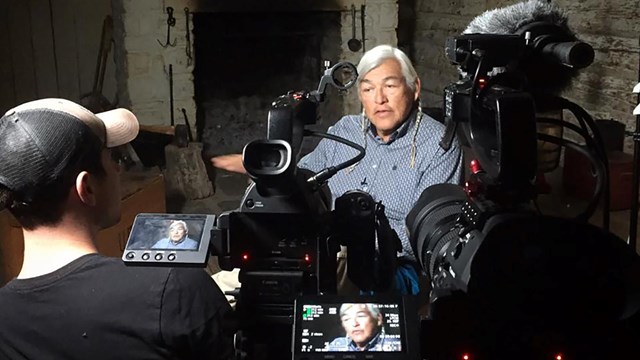
See examples of captioned videocasts
Best Practices for Wayside Exhibits »
Solid Terrain Models »
These examples use the free CC for Flash wrapper and MAGpie captioning software from the National Center for Accessible Media |