
Golden Gate NRA, Park Archives, Bradley Shelley Collection, GOGA-1766 
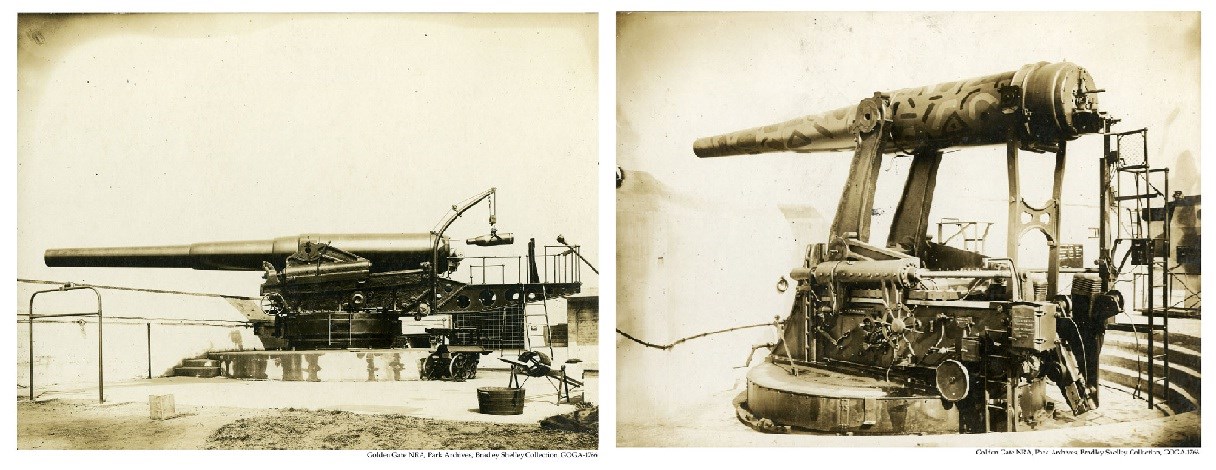
Golden Gate NRA, Park Archives, Bradley Shelley Collection, GOGA-1766 In February 1901, the previous organization for the U.S. Army artillery was replaced by a new system. This new system included 126 companies of heavy (coast) artillery and 30 companies of light (field) artillery and was established under the Army Reorganization Act. Field artillery batteries and coast artillery companies were separated into two distinct corps under the Army Reorganization Act, and the coast artillery assumed responsibility of coastal defenses and mine fields. In 1905, President Theodore Roosevelt appointed Secretary of War William Howard Taft to draft a review board and then make recommendations for improvement of the Coast Artillery Corps in light of lessons learned from the Spanish American War. As the use of coastal artillery became more prevalent, the U.S. Army realized men needed specialized training to adequately operate the artillery instruments. 
Golden Gate NRA, Park Archives, Bradley Shelley Collection, GOGA-1766 In 1907, field artillery batteries and coast artillery companies were separated into two distinct corps. The coast artillery assumed responsibility of coastal defenses and mine fields. Throughout the first decade of the 20th century, the Coast Artillery Corps implemented the Taft Board’s recommendations by building fortifications in newly acquired territories, such as Cuba, the Philippines, and Hawaii. They also built defenses in Panama under the authorization of the Spooner Act and upgraded domestic coastal fortifications from the 
Golden Gate NRA, Park Archives, Bradley Shelley Collection, GOGA-1766 One such beneficiary of improvements recommended by the Taft Board was Fort Winfield Scott, named for the first commander of the Union Army in the Civil War. Although the Presidio already had a coast artillery presence that began in approximately 1891, Fort Scott was formally established as headquarters of the Artillery District of San Francisco in June of 1912. Eventually, Fort Scott was designated as headquarters of the Coast Defenses in San Francisco in 1922. In 1910, Raymond Shelley was stationed at the Presidio of San Francisco with the 38th Company, Coast Artillery Corps. During subsequent processes of reorganization, the 38th was re-designated as the 4th Company, Coast Artillery, and in 1917 was re-designated as the 1st Company when it moved to Fort Macarthur. 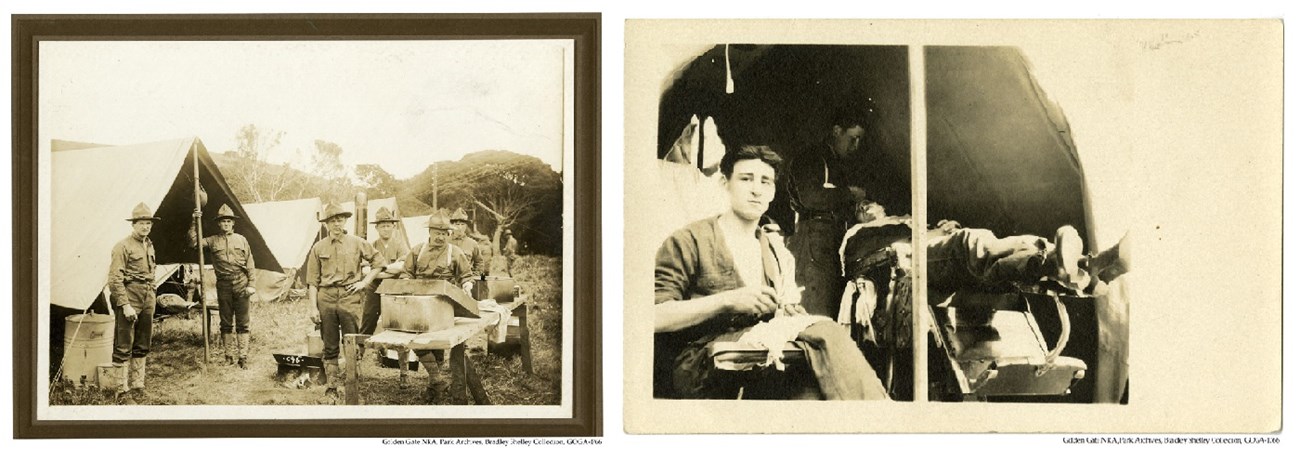
Golden Gate NRA, Park Archives, Bradley Shelley Collection, GOGA-1766 
Golden Gate NRA, Park Archives, Bradley Shelley Collection, GOGA-1766 While stationed on post, Shelley would have witnessed the emergence of a multi-faceted coastal defense system, renamed Harbor Defenses of San Francisco in 1925. The Harbor Defenses included areas at Forts Baker, Barry, Cronkhite, Miley, and Funston. Although an integral part of coastal defenses during World War II, Fort Scott was designated a sub-post of the Presidio at the end of the war. The U.S. Army's Coast Artillery School, which was only briefly on post, was transferred to Virginia. As technology continued to advance, the coast artillery system of harbor defenses was rendered obsolete with its duties absorbed into the regular Army in 1950. The collection was donated to the Presidio Army Museum by Bradley Shelley, Raymond's grandson, in 1973. For more information: Fort Scott Harbor Defenses and Coast Artillery Corps |
Last updated: February 28, 2015