
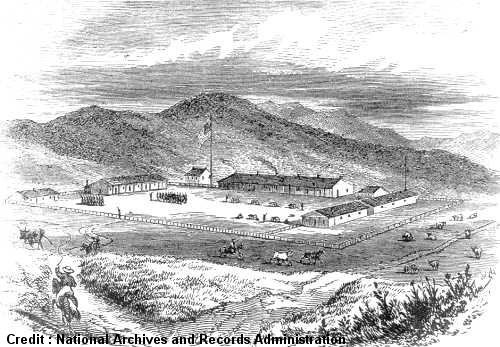
Image courtesy of the National Archives and Records Administration Pre-Civil War When American forces, represented by the New York Volunteers, occupied the Presidio in 1847, they moved into the adobe structures which had been erected by the Spanish. An officer visiting the Presidio wrote that all of the buildings were of no value, and the post would be improved by their removal. The structures of the Presidio were supported by old adobe walls that were dilapidated from age and ponderous leaky roofs. In fact the buildings were not much more than unsightly mud enclosures.1 In addition to the hardships posed by the poor condition of the Presidio's structures, the Americans encountered several other difficulties in the years following their occupation. Captain Keyes, who commanded the Presidio between 1849 and 1858, spent a large portion of his time dealing with the problems posed by desertion and squatters. When Company M, 3d artillery, arrived at the post in May of 1849, it counted 57 men among its ranks. Every man in the Company knew he could make more money in one day at the gold mines than in months in the Army, and for most of the men, the lure of riches proved to be too great. By the end of August, the Presidio's enlisted strength had dwindled down to 15 men. On one occasion, Keyes sent an officer and a detail in pursuit of absentees, but when the detail reached the party, they decided to abandon their posts and flee with the deserters.2 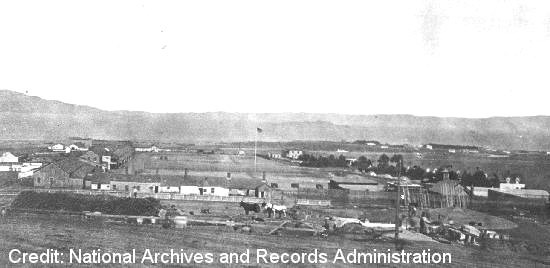
Photo courtesy of the National Archives and Records Administration Civil War Period With the onset of the Civil War, most of the Army's regular regiments in the west received orders transferring them east to the fighting fronts. Only units of the 9th Infantry remained on the West Coast -- stationed at the Presidio and at Fort Vancouver in Washington Territory. As the war progressed, companies of the 9th Infantry rotated among military posts, but nearly always they had the responsibility of defending the strategically important San Francisco Bay.3 The Civil War had brought significant developments to the Presidio of San Francisco. Its garrison, along with other military installations in the area, had maintained peace and order and assured the dominance of the Union's cause in northern California. The reservation itself grew from a small collection of adobe and temporary wood-frame structures into a substantial frontier/coastal army post capable of housing over 1,500 officers and men.4 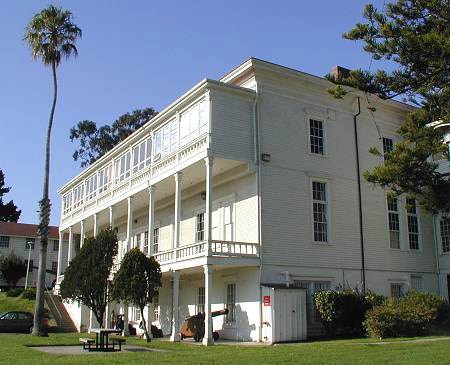
NPS photo Post-Civil War For the first several months following the war, the Presidio's strength figures varied greatly. The Army quickly mustered out the Volunteers, and regular regiments, arriving at San Francisco by steamer, paused briefly at the Presidio before moving on into the interior of the country. By 1867 the garrison had settled down to its permanent strength of 200 to 300 enlisted men, nearly all assigned to the 2d Artillery Regiment.3 In 1870 the citizens of San Francisco began a campaign to transfer the Presidio military reservation to the city, and thereby providing land for park, residential, and business construction. California's Senators quickly introduced bills in the U.S. Senate calling for such a transfer. A board of Army engineers in San Francisco responded by saying that plans had already been prepared for large earthen batteries along the ocean and bay sides of the Presidio (the future batteries East and West). Furthermore, they argued, that these works would have to be defended to the rear against an overland attack. It soon became apparent that the U.S. military still regarded the Presidio as a strategically important location, and any plans to transfer the property to the public were 1.Thompson, Erwin N. Defenders of the Gate: A History from 1846 to 1995. California: National Park Service, 1997. 2. Allen, R.W. March 15, 1855, to Maj. O. Cross, CCF, OQMG, RG 92, NA. 3. Thompson, Erwin N. and Woodbridge, Sally B. Presidio of San Francisco Special History Study: American Period, 1847 - 1990. California: National Park Service, 1991. 4. Schindler, Annual Inspection Report, June 30, 1865, and Annual report of Additions and Repairs, June 30, 1865, both in CCF, OQMG, RG 92, NA. |
Last updated: February 28, 2015