
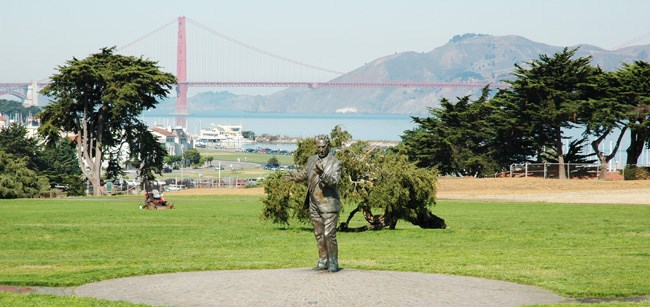
NPS Phil Burton was the most naturally gifted elected official or politician I have ever known or run across. All of his habits were tailor-made for politics. He had an appetite for detail beyond belief on every issue. He had an unlimited amount of energy. He had supreme confidence, and he was absolutely devoid of a need to be loved. I think Phil Burton believed that he could absolutely make a difference in any situation, and he usually did, and that drove him more than anything else. - California Assembly Speaker Willie Brown
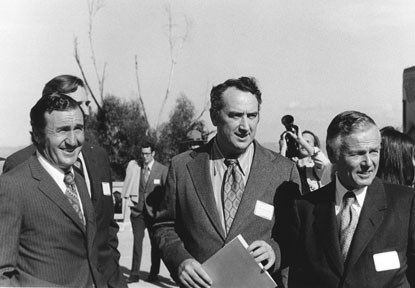
PARC, GGNRA His role in the creation of Golden Gate National Recreation Area Phillip Burton, a member of the U.S. House of Representatives from California from 1964 to 1983, was the powerful and charismatic politician behind the creation of Golden Gate National Recreation Area. His vision and his influence helped galvanize the growing conservation movement in the Bay Area during the late 1960s and early 1970s. As the chairman of the Subcommittee on National Parks, he battled boundary lines with the military, brazenly added more acreage of land to the bill than thought imaginable and pushed, and perhaps, bullied through the legislation that created the new urban park. His influence on the National Park Service As a champion of democracy and the “little guy”, Burton was adamant about America’s responsibility to provide national parks and local recreational opportunities to everyone, regardless of their socio-economic status. Throughout his career, he believed in the value of urban parks as “parks for the people, where the people are”. Burton fought continuously for the creation of new national parks that honored a wide variety of people and subjects. As part of the National Parks and Recreation Act of 1980, he created several new parks, including the Women’s Rights National Historic Park in Seneca Park, New York (celebrating the birthplace of women’s rights in the 19th century); the Mary McLeod Bethune Council House National Historic Site in Washington, DC (honoring the woman who educated African-American construction workers and founded the Bethune-Cookman College); and finally, the Martin Luther King, Jr. National Historic Site and Preservation District in Atlanta, Georgia (celebrating the great civil rights leader). With the creation of these new sites, he enhanced the park’s definition of American history; national historic sites were no longer just about the country’s past presidents, but could now be expanded to include the extraordinary histories of people who had been previously overlooked.
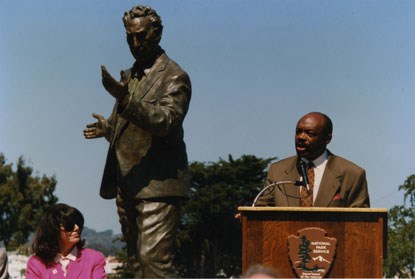
PARC, GGNRA For Further Readings: A Rage for Justice: The Passion and Politics of Phillip Burton. John Jacobs.University of California Press, Berkeley, California. 1995. New Guardians for the Golden Gate: How America got a Great National Park. Amy Meyer with Randolph Delehanty. University of California Press, Berkeley, California. 2006. The Park that Makes its Own Weather; An Administrative History of Golden Gate National Recreation Area. Hal K. Rothman, National Park Service, 2002. (for an on-line version of this document, please visit our Cultural Resource Publications page) |
Last updated: May 13, 2020