
-
Tunnel to Marin Headlands Closed
The tunnel on Bunker Road from Alexander Avenue in Sausalito towards the Marin Headlands is closed for construction. Please follow the detour signs to Conzelman Road (just above the north end of the Golden Gate Bridge) to go up over the hill. More »
-
Muir Beach (but not nearby Muir Woods) parking lot closed June-November 2013
Muir Beach parking lot will be closed from June-November 2013 due to construction. Restrooms or nearby parking will not be available at Muir Beach during this period. Pacific Way is closed except to residents. Check back for updates or call (415)561-3054 More »
-
CAUTION: Post Storm Damage to Coastal Trail
The Presidio Coastal Trail segment just north of the Pacific Overlook and adjacent to Lincoln Blvd remains CLOSED indefinitely. We have posted signage to alert bicyclists and hikers and with information for safe trail alternatives. More »
Buffalo Soldiers
Buffalo Soldiers in Yosemite
NPS
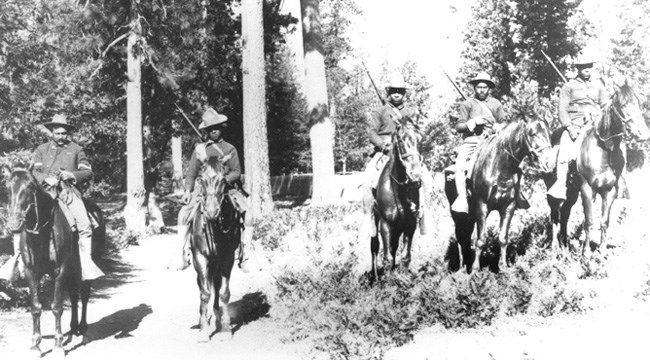
Before the establishment of the National Park Service in 1916, the U.S. Army was responsible for protecting our first national parks. Soldiers from the Presidio of San Francisco spent the summer months in Yosemite and Sequoia. Their tasks included blazing trails, constructing roads, creating maps, evicting grazing livestock, extinguishing fires, monitoring tourists, and keeping poachers and loggers at bay. Among the units that patrolled the parks were Buffalo Soldiers of the 24th Infantry and 9th Cavalry. These African American troopers were in the Sierra parks in 1899, 1903, and 1904. They played a crucial role in events and achievements that shaped the parks as well as the entire national park system. The stories of the Buffalo Soldiers span three different national parks. Learn more about their activities at each park.
Sequoia and Kings Canyon National Park
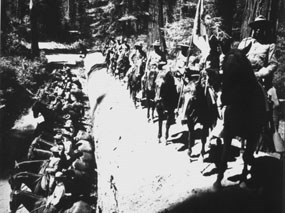
9th Cavalry soldiers on the Fallen Monarch in Yosemite's Mariposa Grove; photo circa 1904.
Yosemite Research Library
|
Did You Know?
The red dot on an adult gull’s lower mandible (beak) serves as a target for chicks to peck to inform their parent that they need feeding.