




Where is chert deposited? Chert is a sedimentary rock rich in silica. Franciscan chert is formed from the tiny silica shells (0.5-1 mm) of marine plankton called Radiolaria. Radiolarian chert forms where two conditions are met. First, a deep, open ocean setting is required where there is little continental mud or carbonate sediment to dilute the “rain” of dead radiolarian shells settling to the seafloor. Second, the upper ocean waters need to be relatively rich in nutrients in order for abundant Radiolaria to thrive.
How do geologists get the Radiolaria out of the chert? The beautiful and intricate Radiolaria tests can be extracted from the chert by crushing it into small pieces and then putting it in a solution of hydrofluoric acid. This is the same acid used to etch glass. The acid dissolves away the less durable rock matrix, leaving the exquisite three-dimensional shells exposed. The tests are then photographed using a scanning electron microscope. 
Microscope image: USGS What can the Radiolaria tell us? Radiolaria are still living in the oceans today. Different species live in tropical oceans versus temperate or cold ocean water. By comparing the types of Radiolaria in local chert with modern forms, we know that Franciscan chert contains some tropical and subtropical forms. Based on this observation, it appears that the sediments forming the local chert were deposited far to the south of their current location around San Francisco. Bay Area chert possibly came from the north equatorial upwelling zone, at the latitude of present-day southern Mexico.
Scientists also study the various species of Radiolaria that are present in chert deposited at different times in the past. Through these studies, they have developed an evolutionary sequence for different species in the rocks. This evolutionary sequence, or biostratigraphy, is then linked to radiometric dates obtained from associated volcanic rocks. Then geologists can determine the age of the chert. The radiolarian species in the Franciscan chert in the Marin Headlands lived and died to form the rocks during the period from about 200 million to 100 million years ago.
What makes the chert bedded? The prominent bedding seen in Franciscan chert leads to the name ribbon chert. The hard, silica-rich chert beds are separated by thin beds of soft, clay-rich shale. These dramatically alternating beds are the result of a process called diagenetic enhancement. When the chert-forming sediments were laid down, some levels had slightly more silica than others. When the sediments were transformed into rock in a process called diagenesis, the silica in the less silica-rich zones migrated into the more silica-rich zones, increasing the silica contrast between the levels and enhancing the bedding to form ribbon chert. 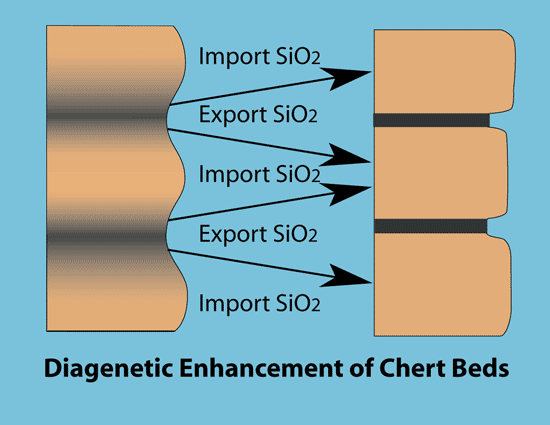
Why did some levels of chert-forming sediment have more silica than others? There are two theories for the original differences in silica levels that led to the formation of chert beds. The first theory is that silica levels were controlled by changes in the oceanographic process called upwelling, which brings nutrient-rich water to the ocean surface and allows the Radiolaria to thrive. Some evidence indicates that upwelling in the world’s oceans is cyclic and strongly controlled by the Earth’s orbital cycles. The second theory is that the silica-rich beds were deposited by small underwater landslides that sorted the fine clays out from the heavier radiolarian shells. There is some microscopic evidence of graded bedding that supports this possibility. Both processes, cyclical upwelling and underwater landslides, could have played a role in the formation of the Franciscan ribbon chert.
Why is chert different colors? Most local chert is red and less commonly green, but it may be a range of colors. The color reflects the amount of oxygen present in the sediment when it became rock. If oxygen is plentiful in the sediment, it oxidizes small amounts of iron present and the chert is red. If oxygen is scarce, the iron is reduced and the chert is green or black.
Why are the chert beds so bent and folded? Many Franciscan chert beds are highly folded and contorted, but within a short distance they often appear to be unfolded. Some scientists believe that this type of folding is the product of the slumping of the soft gelatinous silica-rich sediments, contorting them before they are fully hardened into rock. This slumping may have occurred on the flank of an oceanic mountain range as earthquakes shook the tectonically active mid-ocean ridge. Another theory is that the chert beds were folded by compressive forces developed as the Franciscan Complex was created by the scraping and addition of oceanic rocks to the western margin of North America. 
|
Last updated: February 28, 2015