
National Park Service LogoU.S. Department of the InteriorNational Park ServiceNational Park Service
National Park Service:  U.S. Department of the InteriorNational Park Service Arrowhead
Gettysburg National Military ParkVeterans return to Gettysburg.
view map
text size:largestlargernormal
printer friendly
Gettysburg National Military Park
Nonnative Species
 
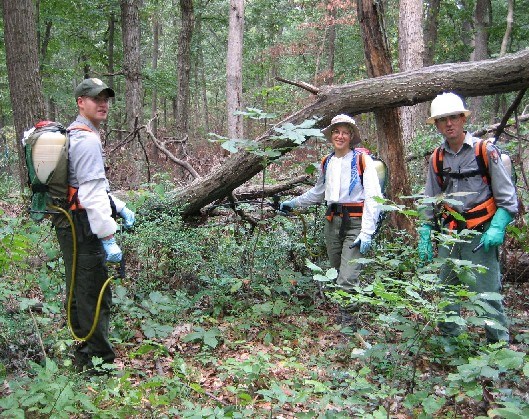
Spraying exotic species of plants.
(C. Davis, National Park Service)
National Park Service employees controlling exotic vegetation in the Big Round Top forest.
 

(Photo by C. Davis)

NPS employees controling exotic vegetation in the Big Round Top forest

Most non-native species of the park are in the form of plants in which 143 of the 553 plant species are non-native. Non-native invasive plant species can be threats to natural ecosystems and native flora of the park. These species often grow quickly and crowd out native plant species while providing limited habitat worth to park wildlife.

The Gettysburg NMP Natural Resources staff works to control non-native invasive vegetation to restore native vegetative communities.    Plants species that provide the biggest challenge to park staff are multiflora rose, Japanese barberry, Ailanthus, and Mile-a-minute weed. With the help from the Mid-Atlantic Plant Management Team, based out of Shenandoah National Park, efforts are combined to treat these exotic species by chemical methods, mechanical methods, and hand pulling.

There are also several non-native insects in the park that put stresses on the park’s native vegetation. An insect of concern is the Hemlock wooly adelgids, Adelges tsugae, a pest species that negatively impacts the growth of the Eastern Hemlock. “Hemlock wooly adelgids (HWA) is the single greatest threat to Hemlock health and sustainability…” USDA. HWA is believed to be an introduced species from Asia, first documented in the States around 1924. Currently there are no effective natural enemies known to keep the pests in balance. However, park staff annually monitors infestations on both the battleground and the Soldiers’ National Cemetery. When HWA populations are high approved chemical methods are used to protect the trees.

Cavalry on the road to Gettysburg.  

Did You Know?
The first shot of the Battle of Gettysburg was fired by an Illinois cavalry officer who used a carbine borrowed from his sergeant. He missed his target.

Last Updated: December 08, 2006 at 14:09 EST