
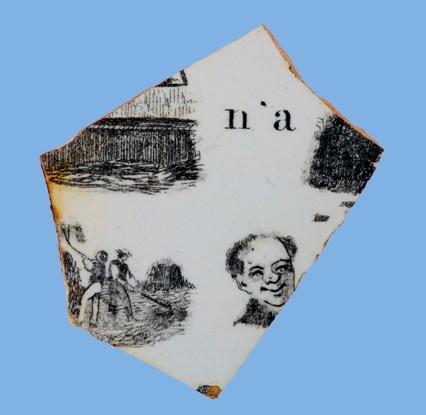
NPS PHOTO This ceramic sherd was archaeologically recovered from a privy associated with a sutler's store on the Vancouver Barracks post. The store was run by a civilian named Elijah Camp in the early 1850s, and was by all accounts a profitable enterprise until it mysteriously "blew up" one night in 1853. Ulysses S. Grant, then stationed here as a Captain in the Quartermaster Department, complained bitterly in letters about Camp disappearing and failing to repay Grant the money he had loaned him to set up the store. The sutler was one of the first local competitors of the Hudson's Bay Company, a powerful British fur trading company that had increasingly turned to retail operations as profits from the fur trade decreased. The HBC had enjoyed a near-monopoly for several decades, but its influence was waning in the new American territory. This transition in goods and suppliers can be seen in the archaeological record, one example being English and Chinese ceramics giving way to those made in the United States and France. The plate features a rebus, a puzzle composed of words and pictures that together form a phrase. This fragment, of a pattern dated 1844, has not been identified. Nor the puzzle solved. Maybe someday. -Tessa Langford, Curator |
Last updated: February 28, 2015