




Warriors of the Woods and Prairies Before the arrival of the Europeans, the Osage Indians roamed a vast domain in the heart of North America (Ancestral Lands Map). Although the Osage were a proud and powerful tribe, they could not withstand the pressure of European civilization. Soon after French fur trappers established contact with the Osages in the 1670s, their way of life began to change. Children of the Middle Waters A spiritual people, the Osage Indians were excellent hunters and fierce warriors. Their religious beliefs were based on Wah-kon-tah, the great mystery spirit or power. In one creation legend, the Osages believed that the People of the Sky (Tzi-sho) met with the People of the Earth (Hun-Kah) to form one tribe, the Children of the Middle Waters (Nee Oh-kah-shkahn). Living in semipermanent villages primarily along the Osage River, the Osage Indians roamed the land between three great rivers, the Missouri to the north, the Mississippi to the east, and the Arkansas to the south. Their western boundary stretched into the windswept plains where they hunted buffalo. 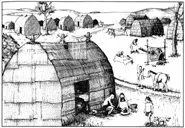
Osage Lifestyle Before Europeans came to the Americas, Osages obtained food by hunting, gathering, and farming. Osages hunted wild game such as bison, elk and deer. There were two bison hunts a year, one in the summer and one in the fall. The goal of the summer hunt was to obtain meat and fat. The purpose of the fall hunt was to obtain food, but also to get the thick winter coats of the bison for making robes, moccasins, leggings, breechcloths, and dresses. Although only the men hunted, the women did the work of butchering and preparing the meat, and tanning the hides. 
Descriptions of the Osages George Catlin The famous Indian artist, George Catlin, captured several Osage Indians on canvas at Fort Gibson in 1834. He stated: “The Osages have been formerly, and until quite recently, a powerful and warlike tribe: carrying all their arms fearlessly through to all these realms; and ready to cope with foes of any kind that they were liable to meet. At present, the case is quite different; they have been repeatedly moved and jostled along, …” He noted that despite their reduction in numbers caused by every tribal move, war and smallpox, the Osages waged war on the Pawnee and Comanche. Catlin believed the Osages “ to be the tallest race of men in North America, either red or white skins; there being few indeed of the men at their full growth, who are less than six feet in stature, and very many of them six and a half, and others seven feet.” Louis Cortambert In 1836, Louis Cortambert, a French writer, observed that the Osage men “ carefully pull the hairs from their faces, even their eyebrows, and shave their heads, leaving on the top a tuft of hair, which terminates in back in a pigtail.” Victor Tixier In 1840, a young Frenchman named Victor Tixier described the Osages: “The men are tall and perfectly proportioned. They have at the same time all the physical qualities which denote skill and strength combined with graceful movements.”The Osages loved to decorate themselves, often suspending beads and bones from their ears and tattooing their bodies, Tixler observed: “Their ears, slit by knives, grow to be enormous, and they hang low under the weight of the ornaments with which they are laden.”
Osage Relocation The ancestral home of the Osage was part of the immense Louisiana Purchase that the United States acquired in 1803. Missouri achieved statehood in 1821, and soon after over 5,000 Osage were removed west to the 'Indian Territory'. Other Native American tribes from the eastern U.S. were also relocated west of the Missouri and Arkansas boundaries. Federal troops were stationed in this “Permanent Indian Territory” to keep the peace. After Kansas opened for settlement in 1854, many Native American Tribes were again relocated. Like other tribes, their ancestral way of life was not compatible with the white man’s way of life. By 1872, encroachment from American settlers forced the Osage Tribe to relinquish most of their remaining ancestral homelands and relocate to their present reservation in Oklahoma (Ceded Lands Map). Suggested Reading
Related Sites |
 |
|
Last updated: May 25, 2022