

Tools or props which are used to fire artillery are:
Sponge-Rammer - one end contains a lambs wool sponge which is inserted by Cannoneer #1 for putting out embers from previous firings. The other end contains a wooden rammer which is used to place the artillery round all the way to the breech of the barrel.
Worm - a claw-like tool that was used to extract a faulty round if needed. It could also be used to remove fragments of the powder bag after firing, although this was not part of the routine drill.
Hand Spike - a wooden spike attached to the trail for moving the gun horizontally.
Gauntlets - worn by Cannoneers #1 and #2 for safety while handling the artillery round.
Gunner's Haversack - worn by Cannoneer #5 to carry the artillery round from the limber to Cannoneer #2.
Sponge Bucket - contains water which is used to dampen the sponge prior to inserting it in the barrel by #1.
Thumbstall - worn by Cannoneer #3 for plugging the vent hole to create a vacuum for #1 while sponging out the gun and ramming home the charge.
Priming Wire - used by Cannoneer #3 for opening up the black powder charge thus exposing it to the detonating device. 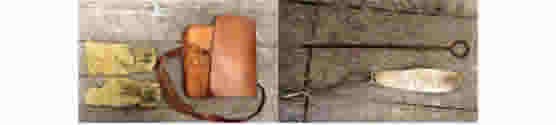
Tube pouch - worn by Cannoneer #4, it contains the lanyard and friction primers. Lanyard - hook, rope, and wooden handle which is used to pull the friction primer to ignite the charge.
Friction primer - a copper tube with a serrated wire running through it at a right angle. Inside the tube is gunpowder which is held in place with beeswax at the bottom of the tube. Where the wire contacts the tube historically contained fulminate of mercury, similar to a match head. When the wire is pulled, friction ignites the gunpowder which shoots down to the main charge of blackpowder in the artillery tube which sends the round propelling through the barrel.
Prolong - a heavy rope which is held on the trail of the gun which could be used to pull the cannon. 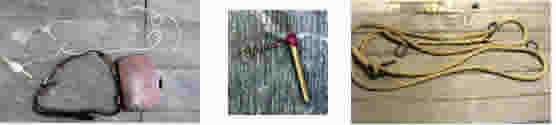
|
Last updated: July 30, 2016