

NPS Photo Positioned at the crossroads of the Sonoran and Chihuahuan Deserts and Rocky and Sierra Madre Mountains, Fort Bowie exhibits extraordinary floral variety. Over 600 plant species have been documented at the site. Four plant communities dominate the Fort Bowie: Semi-desert Grassland, Chihuahuan Desert Scrub, Interior Southwest Riparian Deciduous Forest, and Madrean Evergreen Forest and Woodland. Active springs, granitic and limestone substrate, and biogeographic diversity each contribute to the ecological richness of the region. Trails within the NHS allow visitors to explore portions of all four plants communities. Velvet mesquite, acacia, turpentine bush, snakeweed, yucca, and agave thrive in the scrub and grassland communities while oak, juniper, and pinyon prefer the higher slopes. The Apache Spring riparian corridor gives rise to an overstory of netleaf hackberry, bumelia, and velvet ash, below thick-leaved evergreens of silk tassel, manzanita, and desert sumac create a thicket of green. A stroll in Siphon Canyon in spring offers visitors an opportunity to delight in the beauty of the flowering desert willow. Arizona walnut trees can be found interspersed among the willows. Typically, walnuts mature in late summer providing food for wildlife. Exposed hillsides within and around Fort Bowie NHS are abundant in ocotillo and prickly pear. The prickly pear fruit is eaten by mammals, birds, insects, and rodents, including rabbits, javelina, deer, squirrel, fox, and mice. In years of ample winter precipitation and summer rain, seasonal wildflowers brighten the hillsides and meadows with a rainbow of color. 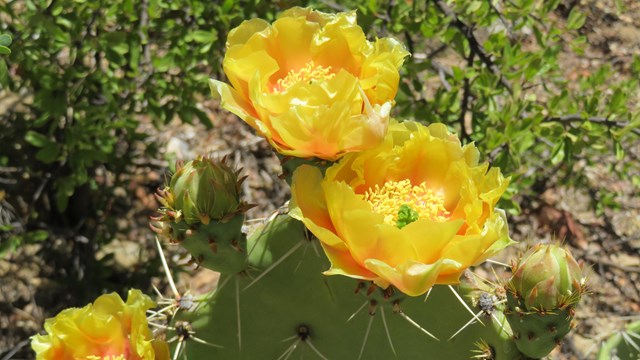
Plant Photo Gallery
Yellow flowers in bloom on cacti. 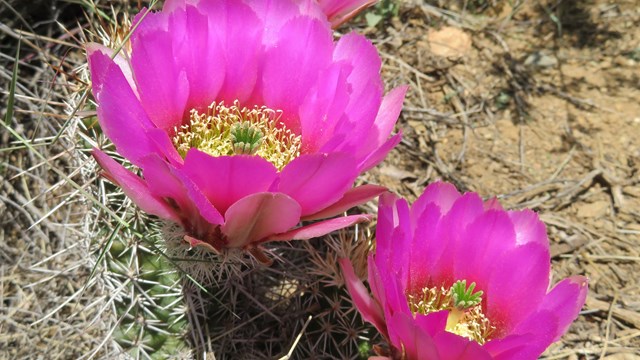
SEINet Checklist
Pink flowers bloom on a cactus. |
 |
|
Last updated: February 4, 2022