NPS Fire Management Program
Fire Program Education Public and Media Career Development Employment
Public and Media, Fire Stories Fire Stories Public and Media
Home
About the Fire & Aviation Program
Contact Us
Search NPS Fire
2009
2008
2007
2006
2005
2004
2003
2002

2006

Horseshoe Bend National Military Park
Horseshoe Bend Implements Prescribed Fire Program

On April 10, 2006, Horseshoe Bend National Military Park's implemented their first prescribed burn. The park's prescribed fire program was initiated in 2002 by the park's previous Superintendent Mark Lewis. Superintendent Lewis authored the park's first Fire Management Plan, which was finalized in March of 2003. A fire break was constructed along the entire park boundary in FY-04, paid for by National Fire Plan hazard fuel reduction funds. In FY-05, a burn plan was contracted and approved. Weather conditions caused rescheduling of the burn until FY-06.

As the 2006 burn window approached, Horseshoe Bend's burn plan garnered interest from Auburn University's College of Forestry. The University had been conducting baseline studies on native Mountain Longleaf Pine at Horseshoe Bend. Questions arose about the effects of fire on longleaf pine in a fire deprived environment. Little research had been done on this subject, and Auburn Researchers Dr. Sharon Herman and Dr. John Kush were interested in studying how fire would effect the regeneration of a native longleaf pine population. In particular, with excessive duff and forest litter, mountain longleaf feeder roots rise to the surface subjecting the roots to fire damage. Discussions between Auburn and the Southeast Regional Fire Ecologist, Caroline Noble, yielded a slightly modified burn plan. The plan called for reducing fuel loads while prudently removing duff layers surrounding longleaf pine stands.

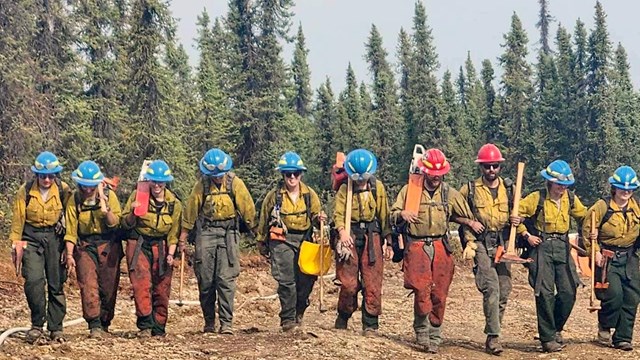
The actual burn was conducted in mid-April. The Cumberland Gap and Great Smoky Mountains Fire Use Modules, along with an engine crew from Kings Mountain National Military Park and local Rural Fire Assistance (RFA) cooperators worked together to successfully treat 285 acres with prescribed fire.

Left: The grass stage of a longleaf pine was protected during fuel reduction. Middle: Fire moves through litter layer along park boundary. Right: The Cumberland Gap Fire Module assisted with Horseshoe Bend’s prescribed burn.

With the continued cooperation of the fire and academic community, Horseshoe Bend is looking forward to a successful fire management program that will reduce fuels build-up while allowing for the natural re-generation of a the longleaf pine--a species that is important enough to be the “State Tree” of Alabama.

Contact: Jim Cahill, Chief Ranger
Phone: (256) 234-7111

Mallard's nest with eggs near prescribed fire.

Knife River Indian Villages NHS
by John Moeykens

Horseshoe Bend National Military Park
Park profile pages
visit website

utility links
Home page. National Park Service Fire ResourcesInformation TechnologyNational Interagency Fire CenterPrivacy PolicyDisclaimer USA.govInsideNPS Fire