NPS Fire Management Program
Fire Program Education Public and Media Career Development Employment
Public and Media, Fire Stories Fire Stories Public and Media
Home
About the Fire & Aviation Program
Contact Us
Search NPS Fire
2009
2008
2007
2006
2005
2004
2003
2002

2006

Denali National Park and Preserve
Did AK NPS Fire Management Reduce the Wildland Fire Risk at Denali National Park and Preserve Headquarters?

The island of Denali National Park and Preserve (NP/Pr) headquarters is surrounded by a sea of boreal forest. The highly flammable black spruce and tall white spruce significantly complicate the ability of firefighters to safely control a wildland fire and protect structures. In preparation for a wildland fire event, the park created defensible space around the headquarters structures in order to reduce the risk of property damage and improve safety for employees, visitors and fire suppression crews. Prior to the 2004 hazard fuels reduction project, Alaska (AK) National Park Service (NPS) Regional Fire Ecologist and AK NPS Western Area Fire Management (WAFM) through a series of conversations began asking, “Based on the project prescription, will we reduce the wildland fire risk to Denali NP/Pr headquarters?”

Photos: Vegetation before (left) and after (right) hazard fuels reduction project.

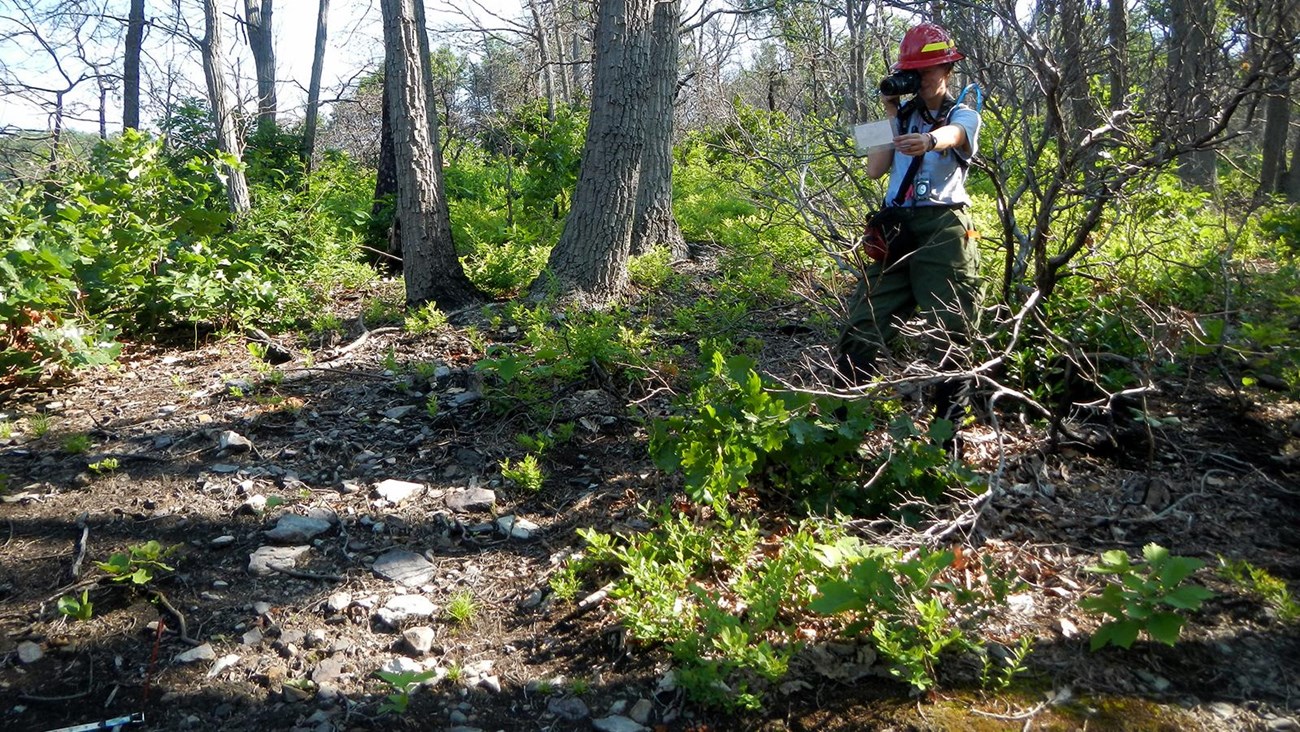
A unique approach to monitoring the effects of hazard fuels reduction around frontcountry structures at Denali NP/Pr developed as a result of the question asked. Collaboratively the Regional Fire Ecologist, Fire Management Officer and Fuels Technician determined the primary objectives for the monitoring project. The objectives are to:
  • Evaluate the implementation of the hazard fuels prescription
  • Monitor the effects of fuels treatments on vegetation and identify short and long-term treatment effects on vegetation, fuels and soil (permafrost)
  • Model the effects of fuels treatments on fire behavior

Photo: Eddie Jordan, WAFM employee at hazard fuels plot holding sign.

In order to achieve the objectives, the Regional Fire Ecologist designed the hazard fuels plots to accurately measure the objectives. Twenty-seven plots, relatively rapid to install (~1-2 hrs with 2 people/plot), were focused in three main study areas, Denali NP/Pr headquarters, Visitor Center and C-Camp housing. The hazard fuels prescription called for the removal and limbing of vegetation in 3 treatment zones within these study areas. Zone 2 included an area 30 feet out from the structure in which combustible vegetation such as trees were removed. Zone 3 extends a minimum of 70 feet from zone 2 for a minimum distance of 100 feet from each structure. Fuel was thinned out and limbed up to 6 feet in zone 3. Nine plots were randomly selected within zone 2 and zone 3 treatment areas and the control area buffer zone adjacent to the treatment area.

Fire Management installed and monitored 27 plots in 2003, prior to the hazard fuels reduction project, and in 2005, one year after the project. Over the course of two seasons, they collected data such as species cover and composition, tree density, height, diameter and limb (ladder fuel) height, the depth of the permafrost and duff. Data was entered into a database specifically created for the project. The Regional Fire Ecologist summarized outputs from the database and plans to import them into Fuels Management Analyst Plus, a fire behavior software program, which models the vegetation and subsequent fire behavior based on the plots. The models will assess changes in fire behavior and spread as a result of fuels treatments. Additional data will be summarized to show changes in the vegetation before and after thinning.

Fire behavior models help Fire Management understand fire’s potential behavior in the treatment areas. Fire Management will evaluate the fire behavior models outputs for rate of spread, tree crowning potential, heat generated by a flaming front and flame lengths. This monitoring project is the first step towards determining the most appropriate monitoring parameters and methodology as well as the effectiveness of treatments for reducing the wildland fire threat to Denali frontcountry structures.

Preliminary data from the study has already proven useful. For instance, WAFM used data to accurately calculate tree density in the hazard fuels reduction project area when concerns over the tree density were questioned. When NPS residents expressed concerns about the project being a clear cut, WAFM used Stand Vegetative Simulator modeling in fire education PowerPoint presentations to create a realistic picture of Denali NP/Pr headquarters post hazard fuels project.

Images: Pre and Post Treatment vegetative simulations.

In the spring of 2006 a final report showing the fire behavior model outputs will be completed. At that time, the adaptive management nature of this monitoring project will be evident. For instance, information gained from the monitoring will be used to determine best methods for hazard fuels reduction projects at Alaskan NPS backcountry cabins and other areas with infrastructure. Information will also be used to determine what type of return interval is needed for hazard fuels reduction. If the monitoring determines that a more effective hazard fuels reduction prescription exists, that information will provide guidance for management decisions. Management tactics may be adapted so that Fire Management is one step closer to stating, "Yes, the wildland fire risk was reduced at Denali NP/Pr headquarters."

Contact: Morgan Miller, Regional Fire Education, Prevention and Information Specialist
Phone: (907) 683-6423

Mallard's nest with eggs near prescribed fire.

Knife River Indian Villages NHS
by John Moeykens

Denali National Park & Preserve
park profile pages
visit website

utility links
Home page. National Park Service Fire ResourcesInformation TechnologyNational Interagency Fire CenterPrivacy PolicyDisclaimer USA.govInsideNPS Fire