|
An overview of 2005, looking at wildland fire, prescribed fire, fuel reduction, Rural Fire Assistance, fire ecology, and more.
FIRE MANAGEMENT OFFICER, LEON KONZ, RETIRES: After a career spanning 29 years and seven parks, Leon Konz retired this past January 3. Leon arrived at the park in 1991 and oversaw the development of the first Fire Management Plan for this park; a plan that included managing lightning-caused fires for resource benefits. Leon implemented the first wildland urban interface projects in the mid 1990s and conducted the first prescribed fires in the Great Smokies history. One personal objective that he had was to implement a prescribed fire program that also had a fire effects monitoring program from the very beginning. His desire was fulfilled as the program developed with a Fire Effects Monitoring Team, the first in the Eastern US. A dream of his in the early years was to have a Fire Ecologist on staff to help guide the program and that too was realized. He was instrumental in getting the Fire Use Module program established in the Southeast Region. One of things that brought Leon the most satisfaction was working with his coworkers and interagency cooperators. Today Leon says that he feels very fortunate because he is still able to enjoy those rewarding relationships as he works full-time in the fire management field as a contractor.
WILDLAND FIRES (HUMAN AND LIGHTNING-CAUSED): A relatively wet year contributed to a light wildland fire load in the park. There were four wildland fires this past year. One was an interagency fire that originated on the Eastern Band of the Cherokee Indian reservation. Others involved car fires and one started from a power line.

PRESCRIBED FIRES AND FUTURE PLANNING: The Park completed five prescribed fires for a total of 2,440 acres this year. The burn units included fields in Cades Cove and the Hatcher Mountain unit between Cooper Road and Abrams Creek. Prep for the Hatcher Mountain burn was begun last fall by Great Smoky Mountains National Park Fire personnel and a contract crew was utilized in March to complete the prep on Hatcher Mountain. The contract crew also began prep on the Gregory Ridge burn unit. Great Smoky Mountains National Park Fire Cache personnel oversaw the operations of the contract crew.
Ignition on Hatcher Mountain occurred on April 10 and was completed on the April 11. Although burning conditions were less than desirable on the 11th, when the majority of the unit was burned, this was a very successful prescribed fire in many aspects. At 2,300 acres, this was the largest burn to have been undertaken in the park. It was the second time a helicopter was used for aerial ignition. Ecologically the initial reports are that we were successful in meeting our objectives of reducing fuel loads and beginning to restore pine communities with fire.

Four fields were burned in Cades Cove for a total of 142 acres. These burns are conducted to reduce woody stem encroachment into the fields and to assist with the propagation of native grass species. A U.S. Forest Service employee was detailed in this spring to assist with burn plan writing. A more comprehensive plan for the fields in Cades Cove was completed.

Cultural compliance began on the Hannah Mountain burn unit this past spring. Funding to complete this is expected this coming fiscal year.
PLANNING/PREPAREDNESS ACTIVITIES: The Fire Cache staff conducted six annual fire refreshers. A beginner firefighter class was taught adding another 28 firefighters to the fire service. Staff also conducted a chainsaw safety class for Gatlinburg Fire and Ambulance.
The Fire Planning Analysis (FPA) continues to develop. This is an interagency budgeting and planning system that is being used for future allocation of fire management resources among the land management agencies. The park is included in the largest Fire Planning Unit in the southern area. Our partners include the Eastern Band of the Cherokee, Blue Ridge Parkway, Cherokee NF, Chattahoochee Oconee NF, Nantahala NF, Pisgah NF, and Francis Marion NF and Sumter NF. This process has required a lot of time from resource management and fire managers through all the agencies.
A Student Conservation Association Fire Education Crew was hosted by the park this summer. This team was composed of one team leader and four crewmembers. Their task was to perform hazard assessments of structures adjacent to the park boundary. A program known as WHAM (Wildland Hazard Assessment Methodology) was utilized to assess the risk to a structure from a wildfire based on the topography, adjacent fuels, housing construction and materials. The last boundary assessment was performed in the mid-1990’s. Since that time, there has been an increase in the amount of development around the park’s boundary. This assessment was conducted primarily in Sevier County with more than 1,000 structure assessments performed. The results will assist us in planning future fuels treatments along the park boundary.
RURAL FIRE ASSISTANCE PROGRAM (RFA): This is the park’s fifth year working with the RFA program. A total of $51,870 was dispersed to 10 fire departments. Wildland fire equipment and supplies will be purchased with these funds to augment the departments’ fire fighting capabilities.
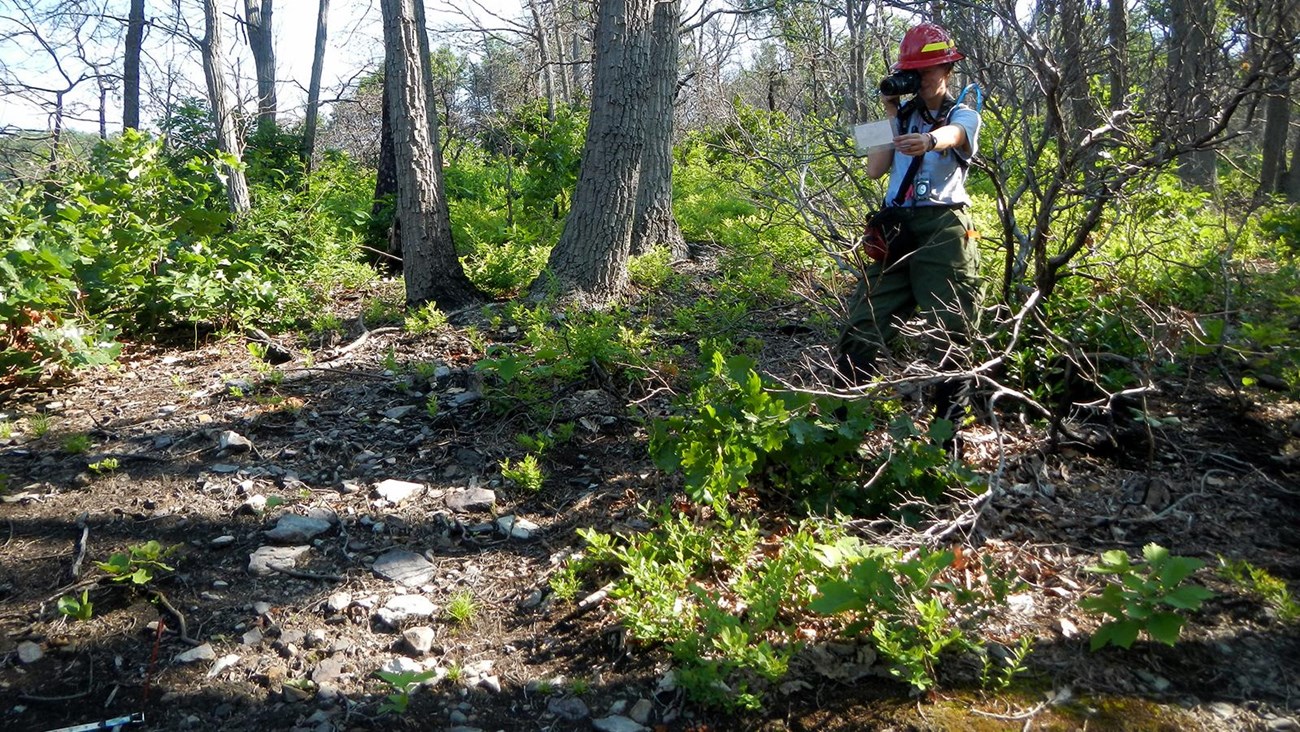
SOUTHERN APPALACHIAN FIRE ECOLOGY/FIRE EFFECTS: The Southern Appalachians Fire Ecology and Fire Effects Program is based out of Great Smoky Mountains National Park, and provide support for a number of parks throughout the Southeast Region. The primary function of the Fire Effects team is to conduct long-term monitoring of prescribed burning throughout the region. Vegetation and fuels data are collected prior to and at specific intervals following prescribed burns to determine if fire management projects are meeting the stated objectives. Other responsibilities include providing Fire Ecology expertise for planning purposes, assisting with prescribed burns, data management, and reporting monitoring results to Resource and Fire Managers. The program currently has monitoring plot networks at Great Smoky Mountains National Park, Big South Fork NRRA, Cumberland Gap NHS, King’s Mountain NMP, and Congaree Swamp NP.
Over 70 plot visits were completed during FY05, including pre-burn, immediate post-burn, year one and year two post-burn reads at all of the parks listed above. Much of the data collected has been entered into the Fire Effects database, and reports summarizing the findings will be prepared over the coming winter. Data from monitoring at Great Smoky Mountains National Park was presented at several regional conferences including Southern Appalachian Man-and-the-Biosphere (SAMAB), Discover Life in America (DLIA), and a Fire Ecology Conference hosted by the Western North Carolina Alliance (WNCA) in Asheville, North Carolina. Some of the interesting findings from Great Smoky Mountains National Park prescribed burns include a mean fuel reduction of 37% and a 63% reduction in mid-story stem density in the pine forest type. These changes are coupled with substantial increases in herbaceous plant cover (107%) and density of yellow pine seedlings (nearly 600%). Indications at this time are that the Great Smoky Mountains National Park prescribed burn program is helping the park achieve its goal of preserving natural diversity and forest health.
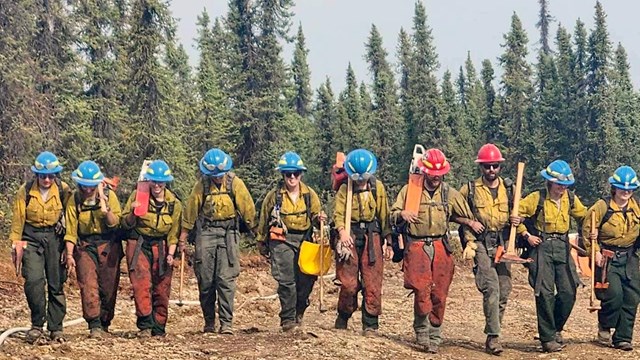
FIRE USE MODULE (FUM): This was the eighth year of the Great Smoky Mountains Fire Use Module. Most of the projects were completed within six of the Southeastern parks, accomplishing 4,350 acres on 12 burns. Many of these were performed with mutual support of the Cumberland Gap Fire Use Module, Great Smoky Mountains NP fire staff, Mammoth Cave NP staff and Job Corps students, and Kings Mountain NMP staff.
We ran with a six-person crew this year. Mark Taylor detailed into the FMO position at Great Smoky Mountains National Park, Susan Ross detailed into the module lead position with Jennifer Ward as acting assistant. The vacant FUM clerk position was filled in December with Sherry Clopton. All crewmembers are expected to return for FY06.
Two detailers worked with the FUM this season, one from North Cascades NP and the other from the Klamath NF.
Crewmembers took assignments at the Great Teton NP, with the Mesa Verde Helitack and with the Bitterroot Heli-Rappel crew.
Task books completed this year were Fire Effects Monitor (FEMO), Firefighter Type 1 (FFT1), and Ignition Specialist Type II (RXI2).
KNOXVILLE TANKER BASE (KTB): The Knoxville Air Tanker Base (KTB) hosted three heavy air tankers this year. During the spring fire season, tankers 22 and 23, both Aero Union's Lockheed P-3's were in service at the KTB. The spring fire season was inactive throughout the region and there were only four missions flown. Fires flown occurred on the Cherokee NF and the Daniel Boone NF.
Base staff, ATBM Doug Ivey and AATBM Will Headrick accepted assignments to manage Air Tanker Bases in other parts of the country this summer. Doug Ivey spent most of the summer in Mesa, Arizona, managing the Williams-Gateway Air Tanker Base. Will Headrick accepted one assignment to Williams-Gateway as Mixmaster.
Doug Ivey also was assigned to the Air Operations Branch of the Marietta MOB Center during Hurricane Katrina relief efforts. During this assignment, wildfire activity picked up once again in the West. Doug was re-assigned to Ft. Smith, Arkansas, to manage the air tanker base there. Doug spent 21 days on this assignment, when due to Hurricane Rita; the Ft. Smith ATB was evacuated back to Knoxville ATB. As of this writing, the Knoxville ATB is once again open for the fall fire season, hosting Aero Union's Tanker 20 and ASM B-2. So far, during the fall season, T-20 has flown seven missions, providing initial attack on fires on the Cherokee NF.
The move of the tanker operation to the Chattanooga airport is still pending.
DISPATCHING/FIRES AND HURRICANES: A relatively mild western fire season saw few park employees heading out west, but the record hurricane season required filling many resource orders in support of clean up operations. The park sent a 20-person crew to Louisiana shortly after Hurricane Katrina. Most of their work involved handing out food, water and ice to impacted residents. Other employees were dispatched to perform trade skills (carpentry, electrical, heavy equipment operators). Several park employees served on NPS Incident Management Teams who assisted the affected NPS units and their employees. Most resources were dispatched utilizing the Resource Ordering and Status System (ROSS). This program allows personnel and resources to be tracked while on assignments. Non-fire personnel had to be entered into ROSS in order to dispatch them to an incident.
This was the second year that the Incident Qualification Certification System (IQCS) was in place. IQCS tracks an employee’s experiences and qualifications. This requires that the information be manually entered into the IQCS program. With assistance from Fire Use Module members, the park’s IQCS is up-to-date. IQCS and ROSS interface to ensure qualified personnel are dispatched to incidents.
DIGITAL RADIOS: New radios were purchased last year for the Fire Management Branch. As with a lot of new technology, there were many problems with these radios. A FUM crewmember spent a significant portion of the season working with the vendor’s technicians, the park’s radio technician and personnel from the National Interagency Fire Center in Boise to try to correct the problems. Testing is on-going at this time.
RESEARCH: The Park participated in a Joint Fire Science Program project measuring fuel moistures, primarily focusing on mountain laurel and rhododendron. The results of which should make us aware of the point when these two fuels would contribute to increased fire behavior. This would assist us with preparedness staffing and suppression responses and within the prescribed fire program as we routinely utilize drainages with rhododendron as firebreaks. We are hopeful this project will be funded again this year.
Contact: Mark Taylor, Acting Fire Management Officer
Phone: (865) 436-1247
|