| On March
25, 2004, Kings Mountain National Military Park and
Kings Mountain State Park conducted their first-ever
collaborative prescribed burn. The Partner Burn treated
477 total acres (119 Kings Mountain National Military
Park acres + 358 Kings Mountain State Park acres). The
project was a continuation of the prescribed fire program
that was initiated at Kings Mountain National Military
Park in 2000, and is part of the overall management
goal to restore native vegetation and the historic landscape
and to reduce hazardous fuels along the Park’s
boundary.
This collaborative project was a direct
result of the dedication and initiative of Kings Mountain
National Military Park Collateral Duty Fire Management
Officer Chris Revels, working in cooperation with Kings
Mountain State Park. The federal and state park share
a boundary (KIMO_map), as well as an interconnected
network of trails and roads. In planning the burn, the
agencies recognized the advantage of utilizing the trails
and roads as fuel breaks along the perimeter of the
fire. This facilitated a safe burn that minimized impacts
to park resources and helped both parks meet their management
objectives.

The morning of the burn, firefighters
used drip torches to ignite fuels along the Main Park
Drive to the east and along the horse trail to the south.
They proceeded to ignite along the road and trail as
they crossed onto state park land, and completed ignition
of the fire perimeter between the road and the trail
along Apple Road. Once the perimeter had been secured,
a helicopter from the Carolina Sandhills National Wildlife
Refuge assisted with aerial ignition.

In the planning effort for the burn, firefighters stated
the following goals: reduction of mid-story density
to encourage regeneration of shortleaf pine and oak
species; thinning both understory and mid-story strata
to reduce future risk of ladder fuels; perpetuating
the oak-pine forest by reducing fire-sensitive pole
tree and sapling hardwood density; and enhancing the
habitat for the smooth coneflower, eastern needles grass,
and other fire-adapted species. In addition, this collaborative
effort enabled both agencies to work together to use
prescribed fire as a management tool to help prevent
the potential for large wildland fires by reducing heavy
fuels loads along park boundaries that exist as a result
of insect damage, winter storm damage, and years of
fuels accumulation
Overall in 2004, through local and
regional collaboration, Kings Mountain National Military
Park treated 1,188 acres, including four prescribed
fires (1,085 acres) and five mechanical projects (103
acres).
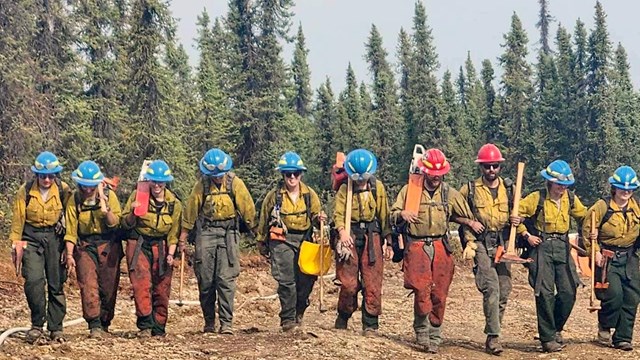
The Park also works closely with three
volunteer fire departments and has provided training,
personal protective equipment (PPE), and hand tools
to these departments over the past four years through
the Rural Fire Assistance (RFA) program. The RFA program
has enabled Kings Mountain National Military Park, the
York County Fire Prevention Office and the South Carolina
Forestry Commission to establish a 10-person initial
attack crew for the county. The result has been an increased
level of safety for firefighters and stronger collaborative
ties within fire agencies and communities served.
Another example of collaborative
success is the purchase and retrofitting of the Park’s
first wildland fire engine. The Park purchased the vehicle
with normal regional equipment replacement funds, and
built the engine in Park with the assistance one of
the Park’s RFA partners, the York County Fire
Prevention Office. The Fire Prevention Office offered
the services of their fabrication shop to customize
and mount tool boxes, and to add striping, a light bar,
radio, and other electrical equipment.


|