|
|
 |
 |
 |
 |
 |
|
2002
|
 |
|
Yosemite National Park
Yosemite National Park Successfully Completes Prescribed Burns in the Wawona Wildland Urban Interface
|
 |
|
By M. Beasley 6/24/02
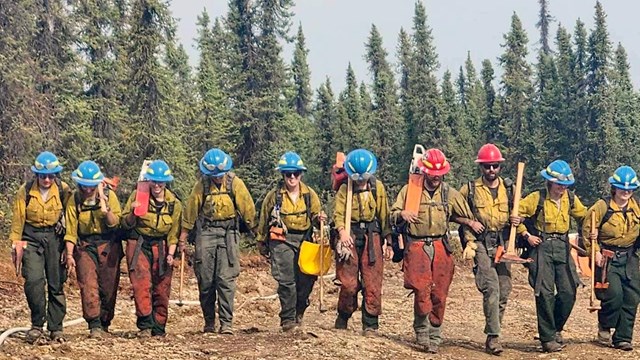
After the severe fire season of 2000, the National Fire Plan was released and directed federal land management agencies to concentrate fuel management efforts in and around communities at risk from unwanted wildland fire. Yosemite National Park has responded to that directive by conducting extensive thinning, pile burning, and prescribed burning to protect the communities within the park. This valuable work has also helped restore fire-adapted ecosystems in the parks mid-elevation mixed conifer vegetation considered most at risk from decades of effective fire suppression. Yosemites Crew 7, led by seven-year crew veteran Jeff Hinson, has conducted the bulk of this work. This crew is funded entirely from hazard fuel reduction money, and currently has 19 total crewmembers. Other park suppression crews have also assisted in this work.
Yosemite National Park conducted a series of successful prescribed burns this spring in the Wawona wildland urban interface zone totaling 267 acres shown on the map below.
|
 |
|

|
 |
|
Fuels treated varied from bear clover with open stands of brush, oak, and ponderosa pine on the southwest aspects to dense mixed conifer with heavy regeneration and surface fuels on the north aspects. Some of these pockets of heavy fuels had been thinned during the 2001 field season, with the piles burned this past winter, while others areas had not been pretreated. The southwest aspect became available for burning earlier in the season and represents a park area now in a maintenance burning cycle, while the north aspects were mostly entry burns, having never burned in the parks history. Nearly half of the acreage treated this spring was identified in the parks recent fire return interval departure (FRID) analysis(1) as having missed more than four fire return intervals. This FRID analysis will be a crucial tool in setting priorities for future fuel treatments at Yosemite National Park and is central to the parks new draft Fire Management Plan Environmental Impact Statement, which is currently open for comment. For more information about this ongoing planning effort click here.
As can be seen from the map, most of the treated acres to the east lie within the Yosemite Wilderness, so vehicle access was excluded in this area. The units were bisected by Studhorse Ridge. Burn units on the south side of Studhorse Ridge were immediately adjacent to one of the parks busiest traffic corridors connecting the Fresno area with Yosemite Valley. Most visitors arriving from Southern California enter the park by this route. Burn units on the north side of Studhorse Ridge were immediately adjacent to private homes and a large church camp containing dozens of structures, many with shake shingle roofs. Because of the proximity to major roads and residences, smoke management was a major contribution to the success of these projects. Burns were started early to limit the amount of residual evening smoke, which invariably headed downslope each evening into the community. Park fire managers collaborated closely with the Mariposa County Air Pollution Control District in determination of burn days and made many pre-burn public notifications through press releases, posting of notices, and door-to-door public contact. Maps and other information were disseminated at meetings of the Wawona Area Property Owners Association (WAPOA). Area property owners were, for the most part, very supportive of the park efforts to conduct fuel treatments.
|
 |
| 
|
 |
|
The net result was a very successful spring burn season in the Wawona area. Treatment of areas identified in the FRID analysis represents a major step in achieving ecosystem restoration targets. Similarly, completion of these projects, virtually on the doorsteps of many Wawona property owners, will offer protection to the community from the threat of unwanted wildland fires.
|
 |
|
1 van Wagtendonk, J.W., K.A. van Wagtendonk, J.B. Meyer, and K. Paintner. 2002. The Use of Geographic Information for Fire Management Planning in Yosemite National Park. The George Wright Forum 19:1, 19-39.
|
 |
|
 |
 |
 |
 |
|
|