NPS Fire Management Program
Fire Program Education Public and Media Career Development Employment
Public and Media, Fire Stories Fire Stories Public and Media
Home
About the Fire & Aviation Program
Contact Us
Search NPS Fire
2009
2008
2007
2006
2005
2004
2003
2002

2002

Sequoia and Kings Canyon National Parks
A New Way of Doing Business

For over three decades Sequoia and Kings Canyon National Parks (SEKI) have reduced hazardous fuels through the use of prescribed fire and mechanical reduction projects. In the early years of this program, locations for projects were chosen based on local knowledge and experience. While this was adequate for many years, the complexity of today's fire management work has outgrown this method.

Beginning in 1996, the parks began using Geographic Information Systems (GIS) to analyze fire information such as historic fires, vegetation, fuels, topography, location of infrastructure, etc. Using GIS data, SEKI fire managers developed models for analyzing complex issues such as hazard, risk, and value (both social and ecological). Managers use these analyses as decision tools for identifying the most appropriate fuel treatment areas. For instance, what area has a need for restoration, with high social value (perhaps near a community) but is an acceptable location in terms of firefighter safety (steepness, etc.)? Based on chosen parameters, GIS specialists display information graphically to help managers make better decisions for the resources and personnel.

Beginning in 1999, SEKI and local partner agencies began adopting a landscape approach for identifying and prioritizing hazardous fuels projects. With increasing emphasis on interagency partnerships, SEKI and other local fire agencies needed a common planning method, especially in areas that were close to different agency boundaries. The interagency partners established the Southern Sierra Geographic Information Cooperative (SSGIC). All participating agencies jointly developed and adopted the same hazard, risk, and value analysis models. As a result, land managers for over 4.7 million acres in the southern Sierra are using common data, analysis models, and mapping delivery systems. Using this unified planning approach, SEKI and the other fire agencies recently identified 91,000 acres of hazardous fuels that will be collaboratively treated by local agencies.

Map of the SSGIC by management agency and ownership.

This new interagency approach to hazardous fuels planning will result in cost savings and more effective treatment of hazardous areas.

The SSGIC partners include: Sequoia National Forest, Sequoia and Kings Canyon National Parks, BLM Bakersfield office, BIA Tule Reservation, private lands managed by the California Department of Forestry and Fire Protection (CDF), and Kern County.

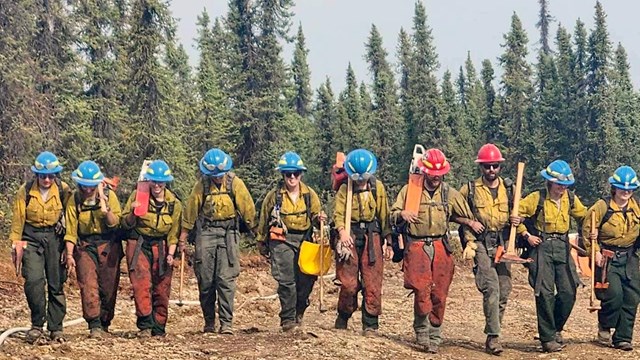
Firefighters using shovels to put out fire.

Sequoia and Kings Canyon
National Parks

park profile pages
visit website

Southern Sierra Geographic Information Cooperative
learn more
visit website

utility links
Home page. National Park Service Fire ResourcesInformation TechnologyNational Interagency Fire CenterPrivacy PolicyDisclaimer USA.govInsideNPS Fire