NPS Fire Management Program
Fire Program Education Public and Media Career Development Employment
Public and Media, Fire Stories Fire Stories Public and Media
Home
About the Fire & Aviation Program
Contact Us
Search NPS Fire
2009
2008
2007
2006
2005
2004
2003
2002

2002

Lassen Volcanic National Park
Hole Prescribed Fire

Lassen Volcanic National Park Fire Management Personnel successfully completed the park's first major prescribed burn since 1999 in early November. The burn was located in a low-lying basin of mixed conifer timber in the northwest section of the park, northeast of Raker Peak.

Fire exclusion in this area of the park has contributed to high fuel loading and a change in the forest structure. The goals of the Hole RX were to reduce fuel loading, and restore fire's natural role in fire-dependent conifer stands.

The project, categorized as a complex burn by park fire managers, was implemented Nov. 1–6, 2002 by over 70 individuals from Lassen Volcanic National Park, five other National Park units, BLM, USFS, and the BIA. Fire camp was established at the Manzanita Lake Campground, where the temperatures dropped as low as 12 degrees Fahrenheit in the mornings. To help ward off the cold the firefighters were fed hot breakfasts in camp and hot dinners on the fireline. Meals were provided by local restaurants and delivered to the field by NPS logistics personnel.

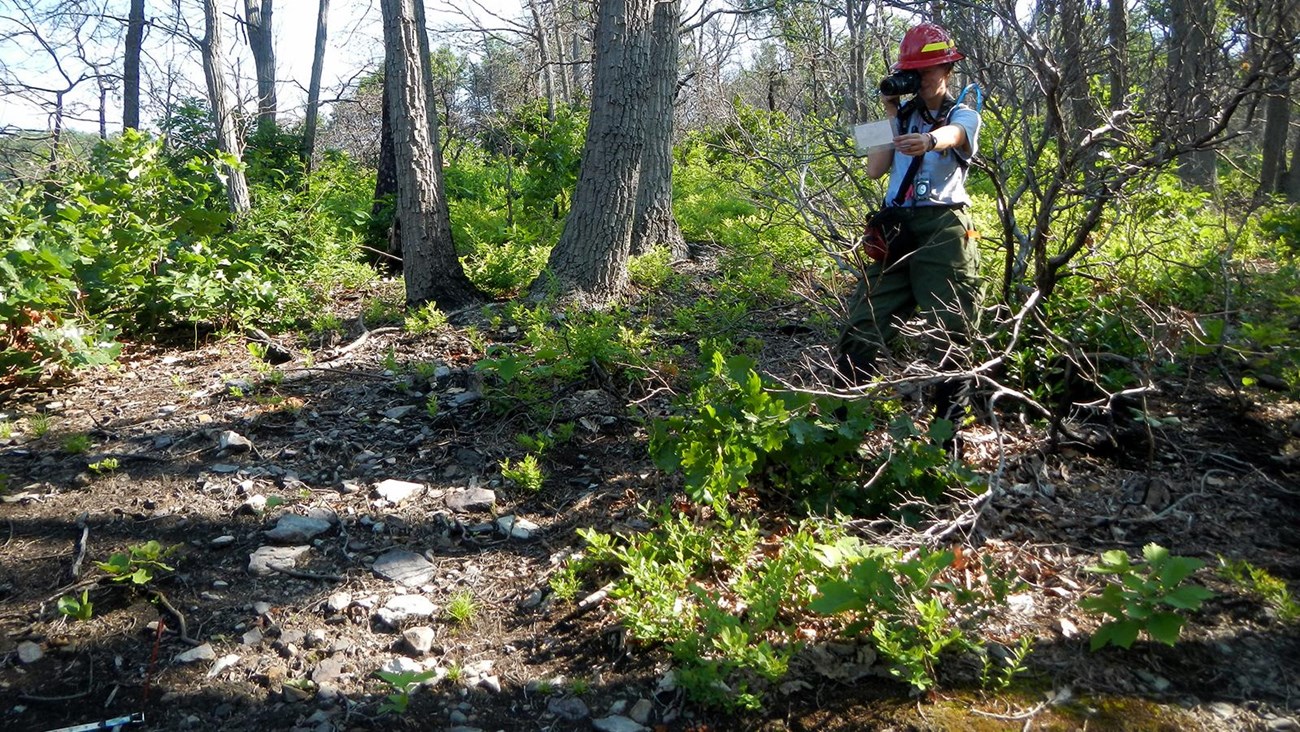
Much of the pre-burn preparation on the unit was completed during three previous seasons. This included the preparation of four miles of fireline that involved the thinning of vegetation 100 feet in from the perimeter. Monitoring plots were established in the burn unit and will be evaluated in the future to measure the fire’s effects and determine if pre-burn goals and objectives were met.

photo 1: Smoke rising from a prescribed burn.  Photo 2: Firefighters monitoring the fire.

Once all the weather and vegetation conditions were within pre-determined prescription parameters, ignition of the unit began. Execution of this burn proved difficult as a significant portion of the ignition operations were performed in the evening and into the night to reduce spotting potential. During the first two nights of initial burning, three ignition teams had blacklined the north, east and south boundary of the unit.

During the afternoon of the second day a section along the eastern interior was ignited by helicopter utilizing a Plastic Sphere Dispenser (PSD) machine. The PSD operation was suspended early in the day because the fire was burning more intensely than desired and crews were concerned it might spot outside the lines. That evening crews concentrated on deepening the blackline, which was completed about 2200hrs. The more secure blackline allowed for unit completion the following day using the PSD machine.

Holding crews and engines were stationed at critical points along the boundaries to ensure the fire stayed within the unit. Fire Monitors were also stationed at various points near the burn to measure fire’s effects and to provide updated weather conditions.

This burn is one of a series of projects scheduled for the next several years along the park’s northern boundary. The completion of these projects will enable fire staff to manage natural ignitions in the park’s interior fire-dependent conifer stands for maximum resource benefits.

Fire information activities greatly contributed to the success of the Hole RX.

photo 1: Fire at night.  Photo 2: Night ignition of prescribed fire.

Local businesses and park inholders having property adjacent to the unit were notified before, during and after with phone calls and letters. Fire Information/Education Specialists Scott Isaacson (LAVO) and Jennifer Chapman (PORE) managed the public relations effort, which included press releases from the Superintendent's office, sent to local media, federal and local government officials, park concessionaire and the NPCA.

The 1995 Federal Wildland Fire Policy mandates federal land management agencies within fire dependent communities to reintroduce and maintain fire as part of ecosystem management. Prescribed fire projects are to be conducted in a manner consistent with land and resource management plans, public health considerations, and approved prescribed fire plans. The policy of using fire as a tool will help decrease risks to life, property and resources and will help perpetuate the values for which Lassen Volcanic National Park was established.

Firefighters using shovels to put out fire.

Lassen Volcanic National Park
park profile pages
visit website

utility links
Home page. National Park Service Fire ResourcesInformation TechnologyNational Interagency Fire CenterPrivacy PolicyDisclaimer USA.govInsideNPS Fire