|
|
 |
 |
 |
 |
 |
|
2002 |
 |
|
John Day Fossil Beds National Monument
Two Prescribed Burns Achieve Hazard Fuels Reduction
on NPS and BLM Lands
|
 |
|
John Day Fossil Beds National Monument (JODA), with the assistance of multiple partners, staff from other NPS units, and favorable weather, completed two prescribed fires for hazardous fuels reduction in September 2002.
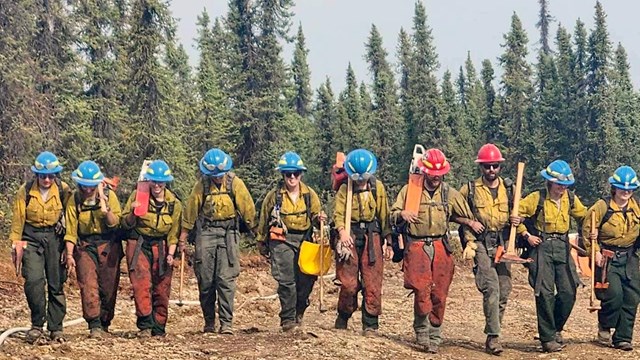
The acreage treated included not only National Park Service lands, but also lands managed by the Bureau of Land Management (BLM) and adjacent private lands. The Sand Mountain Prescribed Fire took place in a large portion of the Painted Hills Unit of the park. This was a true partnership, as BLM completed the majority of the planning with input and special considerations covered by NPS staff. When the day of the burn arrived, NPS staff from John Day Fossil Beds as well as the Buffalo National River Fire Use Module assisted with blacklining and holding the fire. Two days later the aerial ignition of the interior of the burn unit was completed by a BLM helicopter. The acreage treated on NPS lands was 1,780 acres, and 3,520 acres on BLM lands.
|
 |
|

|
 |
|
The Middle Mountain Prescribed Fire occurred in the Sheep Rock Unit of the monument and on the adjoining private and BLM lands. Safe and manageable perimeter lines were in place through the use of a remote access road, a ranch road, the John Day River, an agricultural field, and a highway. JODA staff completed the planning for this burn and the Buffalo National River Fire Use Module worked for a week prior to the burn reducing fuel amounts in critical areas around the perimeter. Over six miles of blacklining occurred during the early part of the burn, including protecting two private residences, a NPS trailhead, and public use area. A BLM helicopter completed the aerial ignition with the assistance of NPS personnel. 1,120 acres of National Park Service land and 2,260 acres of Bureau of Land Management lands were treated during the Middle Mountain Prescribed Burn for a total of 3,380 acres.
Overall, the reduction of 8,680 acres of hazardous fuels on both National Park Service and Bureau of Land Management Lands benefitted both agency partners. Another objective achieved by the prescribed fires was the reduction in juniper encroachment and sagebrush densities allowing other native species to benefit in the area.
|
 |
|
 |
 |
 |
 |
|
|