|
The lavas still flowing down Holei Pali, advancing about 600 feet a day. Its 2100 degrees Fahrenheit. Some of the molten rock is ponding and some of its creeping through groves of `ohi`a and kukui. Whether flowing in open brush or under forest canopy, the lava's smoke signals serve to remind that the threat of another lava-ignited wildfire remains.
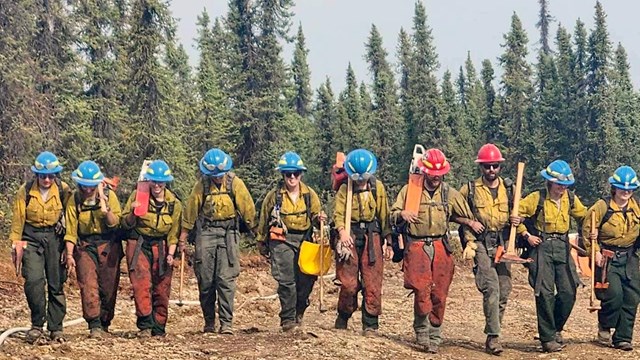
Forty-five firefighters answered the 6:00 a.m. roll call at the parks fire cache. Its Day 11 of the Kupukupu Fire. Admittedly, some of the firefighters are a little tired, but theyre still smiling. Everyone's encouraged by the past weeks successes.
Its sunny, its hot. Winds are blowing from the east at 28 mph. Resource advisors counsel the parks fire operation planners that the weather is favorable for a firing operation. The days mission is to use fire as a tool to create a 100-foot wide control line, running mauka-makai, west of the lavas flowfront. This blackline should help stop a lava-ignited fire from spreading into native woodland.
Today, the firefighters are equipped with a new array of fire fighting tools. Theyre packing drip torches, flappers, and fedcos. Theyre using the torches to deliberately set fire to pockets of alien plants known to carry fire; theyre burning out Christmasberry, scaly swordfern, and red top grass.
Some of the firefighters follow with flappers. They move these fire swatters in a swabbing motion to smother the flames. They lightly pat and rub along the blackline. Firefighters with fedcos (a backpack water pump) patrol the burn. Their spray of water rapidly cools the hot line.
Four helicopters ferry firefighters and supplies to remote helispots. They extinguish hot spots with foam and soak the vegetation west of the blackline with buckets of seawater.
|