|
Background
Back in 1976, after more than 80 years of aggressive fire suppression, a prescribed fire program was initiated at Crater Lake National Park to restore approximately 42,500 acres of mixed-conifer forests. The objectives were to favor retention of large ponderosa pine over shade-tolerant species and to create conditions that enhance ponderosa pine regeneration. Studies were undertaken in conjunction with the prescribed burning program to examine the effects of the management-ignited fires. Unexpected mortality of large ponderosa pine occurred during the ten-year program of prescribed fires that treated more than 650 acres.
It was determined that the prescribed fires had burned too hot and too much duff was removed, thus weakening trees and increasing the probability of attack by bark beetles. Recommendations were made to conduct multiple hazard-reduction burns at lower fire intensities, rather than a single burn, and for burns to be done earlier in the spring when duff moisture was higher. There was limited information available to park managers on the effects of carrying out these recommendations, however, and prescribed burning was discontinued after 1987. The recommendations were never tested, until now.
Solving the Problem
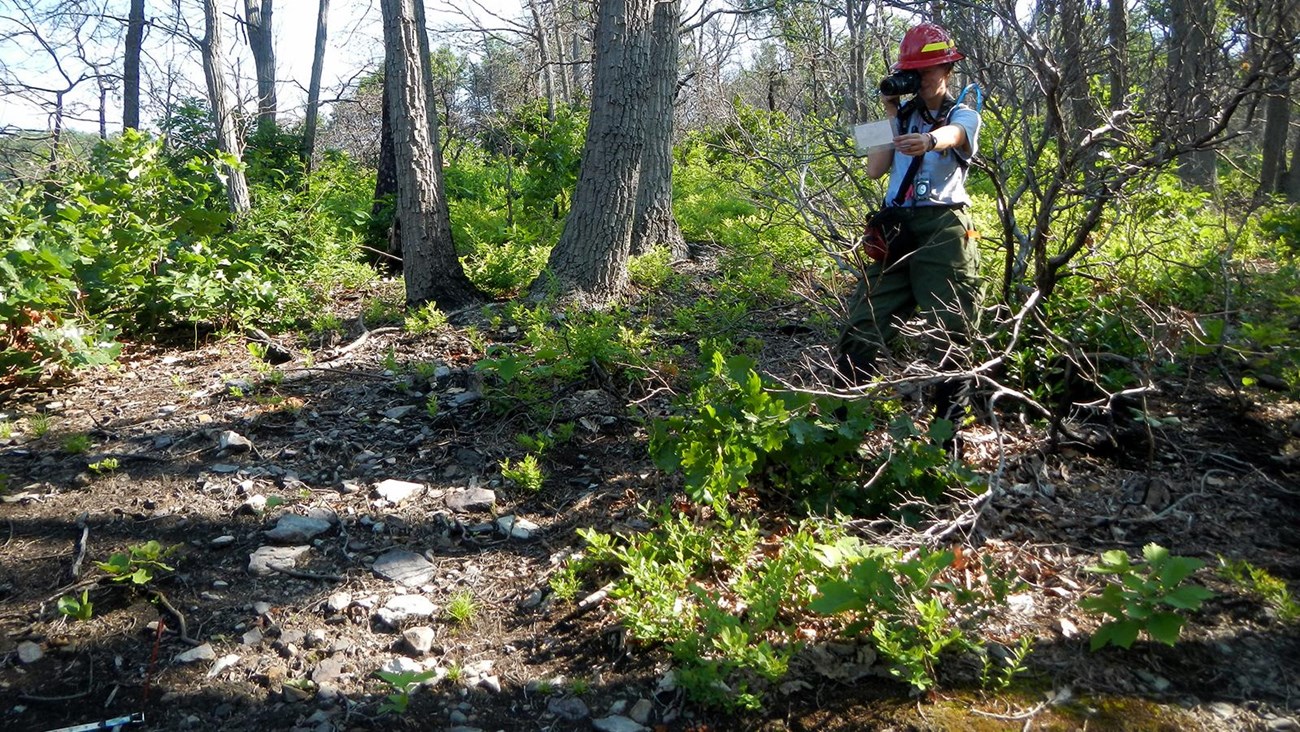
Thanks to research funding from the Joint Fire Science Program, resource and fire staff are collaborating with scientists from the University of Washington to determine the best time to reduce hazardous fuels and restore the fire-adapted mixed-conifer forests at Crater Lake National Park. The collaborative project involves collecting research data from a series of management-ignited fires conducted on National Park Service property.
The project area consists of 200 acres divided into 24 treatment units (8 spring, 8 fall, and 8 unburned control units) in the southern portion of the park. As a typical mixed-conifer forest, it has a ponderosa pine overstory with a multi-layered white fir understory and occasional presence of other tree species (e.g. sugar pine, lodgepole pine, Shasta red fir).
The project objectives are to: quantify the effects of spring versus fall burning on standard fire response variables such as fuel consumption and understory vegetation effects under varying duff moisture conditions; and to quantify the effects of such fires on vigor and mortality of large ponderosa pine which are the most important structural element in these mixed-conifer forests.
|