
-
More Park Facilities Reopen During May 2013
Watch Hill and Sailors Haven marinas open May 10. Limited ferry service from Sayville to Sailors Haven resumes May 13 and ferries from Patchogue to Watch Hill start on May 18. Remaining park facilities to reopen by May 25, 2013. More »
Water Quality
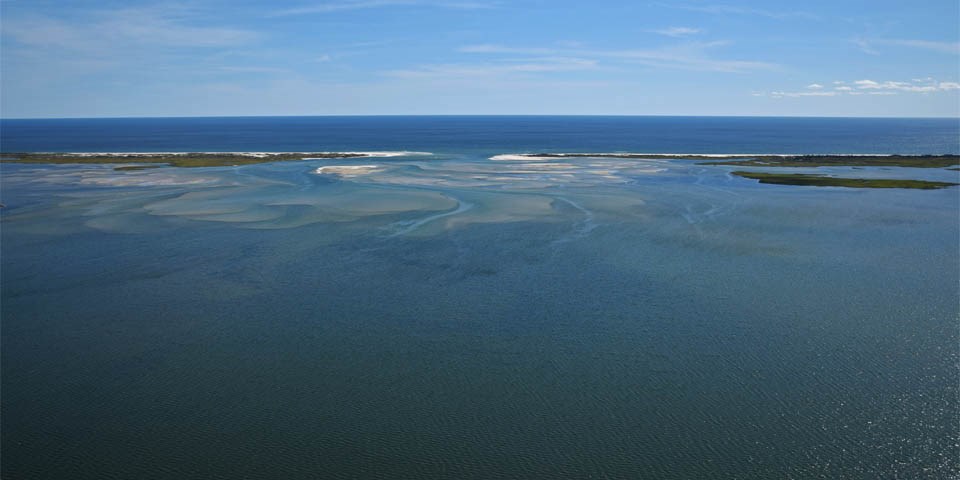
Within the boundaries of Fire Island National Seashore there are almost 15,000 acres of open water. More than three-quarters of Fire Island National Seashore is marine or estuarine habitat. Of the 19,580 acres within the park's designated boundaries, approximately 14,664 acres are open water. The Seashore boundary extends 1,000 feet into the Atlantic Ocean from Moriches Inlet to Robert Moses State Park, and up to 4,000 feet into the Great South Bay, and Bellport, Narrow and Moriches bays. Aquatic ecosystems are highly sensitive to changes in water quality, so this is a resource that the National Park Service monitors and helps protect. Water quality concerns for Fire Island National Seashore involve both surface- and groundwater resources, and marine, estuarine and fresh water. The park is within the Southern Long Island Watershed in New York. A variety of factors influence water quality in the ocean and bays surrounding Fire Island, and this affects the habitat for the plants and animals that live here (including us!). Clean, safe water for recreation is an important resource. Drinking water for the south shore of Long Island comes from sources deep within the aquifers beneath the surface of Fire Island. As a typical East Coast barrier island-lagoon system, circulation of higher salinity water from the Atlantic Ocean-flushing regularly through inlets on each end of Fire Island-is commingled in the estuary with fresh water from mainland Long Island and to a lesser degree from Fire Island. Salinity and water temperature primarily affect the biology of the waters around Fire Island, but nutrients and turbidity also affect where plants and animals can survive. The chemicals and organisms in the water can also affect human health and safety. A Fire Island National Seashore summer water quality monitoring program has been conducted through a cooperative agreement with Dowling College. Other federal, New York State, and Suffolk County agencies also conduct research and water quality monitoring programs within the boundaries of Fire Island National Seashore or adjacent waters. Fire Island Water Quality Parameters Measured:
The National Park Service (NPS) has created a protocol to monitor estuarine nutrient enrichment for its Vital Signs Monitoring Program of the Northeast Coastal and Barrier Network, using the following variables: Estuarine Nutrient Enrichment: Water Quality
Historic Quality of Shore Shore Waters: Fire Island National Seashore's Final Environmental Statement from 1977 provided the following description of water quality more than thirty years ago: Atlantic Ocean
Great South Bay and Moriches Bay
Additional water quality studies have been conducted over the past three decades. A series of Science Synthesis Papers was published in 2005 to support the preparation of a General Management Plan for Fire Island National Seashore, and includes the following report:
The U.S. Geological Survey (USGS) National Water-Quality Assessment Program (NAWQA) provides an understanding of water-quality conditions and how those conditions may vary locally, regionally, and nationally; whether conditions are getting better or worse over time; and how natural features and human activities affect those conditions. USGS Water Resources Divsion has conducted a number of studies on Fire Island and in the Great South Bay. Most of the drinking water on Fire Island is now provided through Suffolk County Water Authority (SCWA), which supplies water to the majority of people in Suffolk County. Their drinking water supplies are tested to ensure that federal, state and local water quality standards are met. A detailed annual report is available on the SCWA's web site. The U. S. Environmental Protection Agency (EPA) and New York State Health Department prescribe regulations that limit the amount of certain contaminants in drinking water provided in public water systems. Suffolk County Department of Health Services (SCDHS) Office of Ecology also conducts water quality testing within the boundaries of Fire Island National Seashore, and monitors public bathing beaches to ensure that bacterial levels do not exceed State criteria. Learn More Suffolk County Water Authority's Education Page includes a link to its "Water Cycle on Long Island" Demo. For More Information National Park Service Water Resources NPS Northeast Coastal Barrier Network (NCBN) United States Geological Survey (USGS) New York State South Shore Estuary Reserve Environmental Protection Agency Office of Water |
Did You Know?
Whales and other marine mammals live in the ocean south of Fire Island. Occasionally, they are can be spotted from shore, and rarely a dead whale will wash ashore. More...