
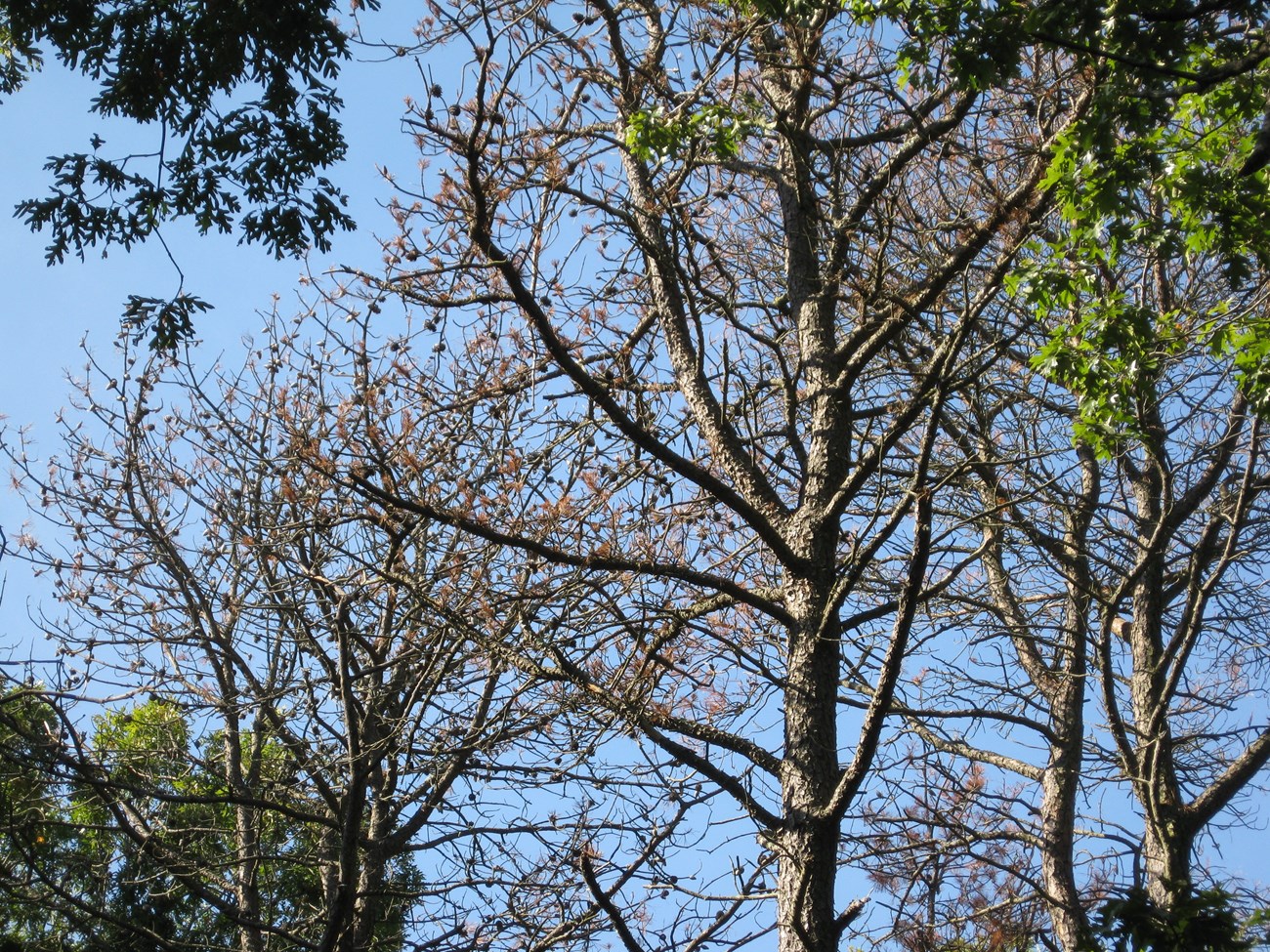
An invasive plant mapping project in 2002 found fifteen invasive plant species on Fire Island and seven at the William Floyd Estate. Funding for continued inventory and mapping was obtained in 2007 and 2008, and an invasive species control program was initiated for Fire Island National Seashore in 2008.
The most prominent invasive plant species on Fire Island include:
- Japanese Black Pine (Pinus thunbergiana)
- Autumn Olive (Eleagnus umbellata)
- Mugwort (Artemesia vulgaris)
Other invasive plants of concern include:
- Garlic Mustard (Alliaria petiolata)
- Oriental Bittersweet (Celastrus orbiculatus)
- Spotted Knapweed (Centaurea maculosa)
- Japanese Honeysuckle (Lonicera japonicus)
- Multiflora Rose (Rosa multiflora)
- Common Mullein (Verbascum thapsus)
- Lesser Celandine (Ranunculus ficaria)
- Japanese Knotweed (Polygonum cuspidatum)
- Tree of Heaven (Ailanthus altissima)
- Canada Thistle (Cirsium arvense)
- Chinese Lespedeza (Lespedeza cuneata)
- Chinese/Japanese Wisteria (Wisteria ssp.)
- Nodding Thistle (Carduus nutans)
- Japanese Barberry (Berberis thunbergii)
- Bamboo (Phyllostachys spp.)
- Pampas Grass (Cortaderia spp.)
- White Poplar (Populus alba)
The common reed (Phragmites australis) is very extensive on Fire Island, especially on the eastern end of the wilderness area. This plant, which can grow up to 20 feet high, forms dense stands by a network of roots and rhizomes. One plant can spread more than 10 feet in a single growing season. However, there may also be a native genotype of this species (Phragmites australis americana) on Fire Island, which would need to be identified and protected. Fire Island National Seashore has not yet implemented an inventory and management program for invasive common reed.