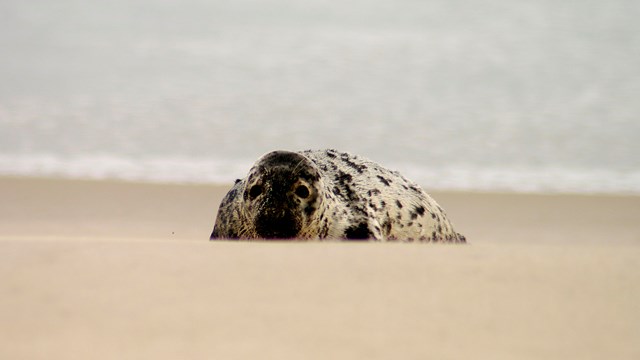
More than 30 species of mammals either visit or live within the boundaries of Fire Island National Seashore. These mammals range in size from finback whales and other whales—which occasionally swim close to shore or wash up on the beach—to white-tailed deer, red fox, and the tiny masked shrew, which are very common throughout the island.
Since the establishment of Fire Island National Seashore, there have been shifts in the number and type of mammal species observed. While native to the Northeastern United States and Atlantic barrier islands, deer were not numerous on Fire Island in 1964 when the park was established. Their numbers have increased dramatically since that time due to abundant food sources and a lack of natural predators.
In a 1974 mammal survey, 17 species of terrestrial mammals were identified on Fire Island. In the mid-1970s, eastern cottontail rabbits were abundant throughout the Seashore. Red fox were very common. Raccoons were far less numerous. The white-footed deer mouse and meadow voles were abundant, and muskrats and Norway rats were numerous on both Fire Island and on the mainland at the William Floyd Estate. These mammals are still common. Squirrels were restricted to the mainland at the time of the 1974 survey, but are now common on Fire Island.
Other common species identified in the survey which can still found today include the masked shrew (Sorex cinereus) and the short-tailed shrew (Blarina brevicauda). Weasels and mink were secretive but locally common predators throughout the seashore in the mid-1970s, but have not been observed in recent years.
The little brown bat was one of two bat species identified on Fire Island in 1974, while eight species were recorded at the William Floyd Estate. Today, five bat species can now be found on Fire Island and at the William Floyd Estate, one of which is classified as a threatened species. The Northern long-eared bat has been recorded with high activity at the William Floyd Estate, a unit of the Seashore located on Long Island.
Feral cats and dogs have been added to the list of mammals on Fire Island. Their impact on native wildlife is considered to be significant.
Marine Mammals
Nineteen species of marine mammals—whales, porpoises and dolphins, and seals—have been recorded within the boundaries of Fire Island National Seashore. The harbor seal is a regular winter visitor at both Fire Island inlets.
Three species of endangered whales may occur in the waters offshore of Fire Island: fin whale (Balaenoptera physalus), humpback whale (Megaptera novaeangliae) and northern right whale (Eubalaena glacialis).