



Last updated: September 5, 2023
Place
David Berger National Memorial
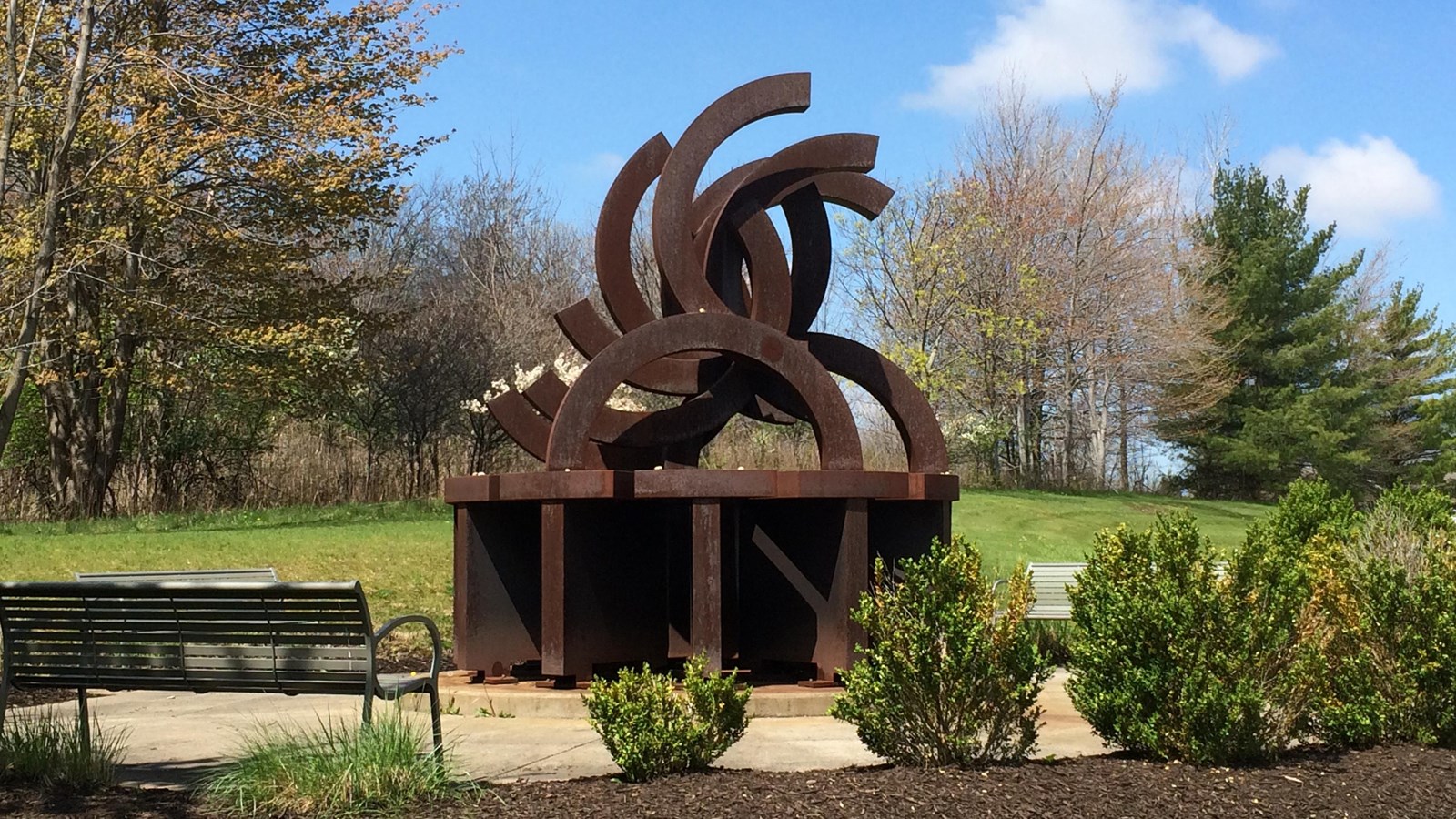
NPS / Beth Rush
Quick Facts
Location:
Beachwood, Ohio
Significance:
The David Berger National Memorial is a sculpture that honors the memory of David Berger, an American/Israeli citizen who was one of the 11 Israeli athletes murdered at the 1972 Olympic Games in Munich, Germany.
Designation:
National Memorial
MANAGED BY:
The David Berger National Memorial is a sculpture that was created to honor the memory of David Berger, an American/Israeli citizen who was one of the 11 Israeli athletes murdered at the 1972 Olympic Games in Munich, Germany. The Memorial is managed by the Mandel Jewish Community Center of Cleveland. For information on site hours, Passport stamp, and more, please contact the Mandel Jewish Community Center of Cleveland.
David Mark Berger was born in Shaker Heights, Ohio. He attended Tulane University from 1962 to 1966 where he was a weightlifter and honor student. While at Tulane, he won the NCAA weightlifting title and earned a Bachelor's in Psychology. He went on to earn a Master of Business Administration degree and a Doctor of Laws degree from Columbia University. During his education endeavors he continued to train and compete in weightlifting events. In the early 1970s, David emigrated to Israel, where he met and became engaged to an Israeli student. Continuing weightlifting competitions, he won a silver medal at the 1971 Asian Games and made the 1972 Israeli Olympic team. In late August of that year, he flew to Munich with his teammates. On September 2, 1972, David competed, but was eliminated in an early round. He was killed during the hostage taking of Israeli athletes at the Olympics.
The sculpture was created by the late David E. Davis, an internationally renowned Cleveland sculptor. It was commissioned and paid for by a group of eight families, all personal friends of David's parents, Dr. Benjamin and Dorothy Berger.
Through the efforts of former Ohio Senator Howard Metzenbaum, who was also a longtime friend of David's father, Congress authorized the David Berger National Memorial on March 5, 1980 (Public Law 96-199). The sculpture is affiliated with the National Park Service.
The David Berger National Memorial is nearly 14' high, 11' wide, and weighs 6000 pounds. It is made of Cor-Ten™ steel, a type of steel alloy which oxidizes naturally over time to yield a rich rust coloring and granular texture. The sculpture depicts the five Olympic rings broken in half, symbolizing the interruption and cancellation of the Munich games by the tragic events, and the 11 segments on which the rings rest represent each athlete whose life was taken. One of the segments is slightly different from the rest to symbolize the unique events in David's life that led him to the Israel Olympic Team and to his death. But there is an upward motion in the broken rings to suggest the peaceful intent of the Olympics, a search for understanding, and hope for the future.
The David Berger National Memorial's first home was on the grounds of the Jewish Community Center in Cleveland Heights. When the facility closed in 2005, arrangements were made to store and restore the sculpture at the McKay Lodge Fine Arts Conservation Laboratory, in Oberlin, Ohio. While in storage the sculpture was cleaned of all existing corrosion and an application of a corrosion inhibitor was applied. In addition, one section of the sculpture required welding reinforcement.
The David Berger Memorial was relocated to the grounds of the Mandel Jewish Community Center in Cleveland, in the fall of 2006.