



Last updated: May 19, 2023
Place
Fort Mahan
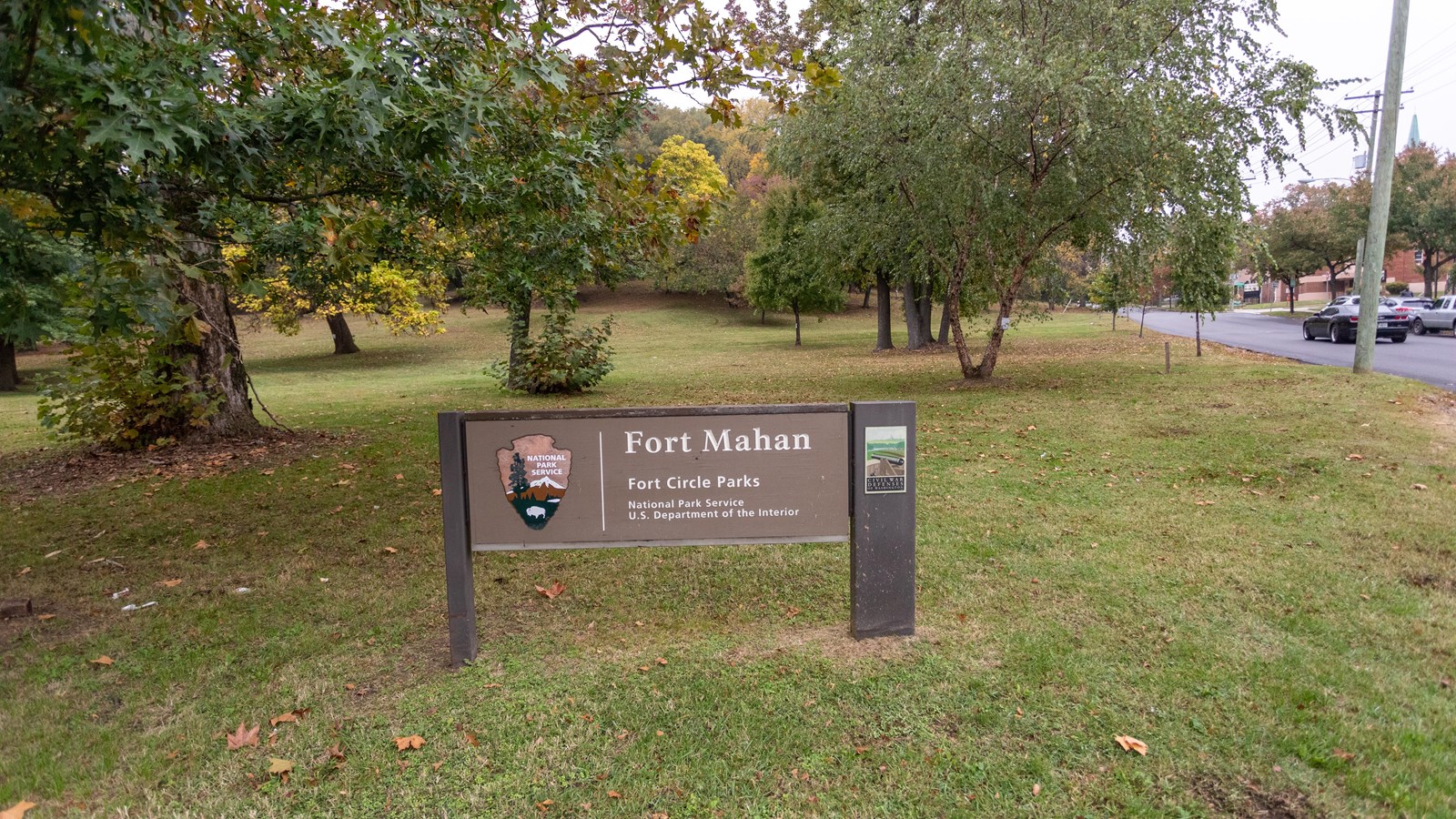
NPS / Claire Hassler
Quick Facts
Location:
Washington, DC
Significance:
Civil War Fort
Designation:
National Park
Amenities
1 listed
Historical/Interpretive Information/Exhibits
Fort Mahan was constructed at part of the Eastern Branch Defenses (Anacostia River). The earthwork was built to guard the approaches to Benning's Bridge, which crosses the Anacostia River.
Fort Mahan was irregularly shaped with nine sides, and a perimeter of 354 yards. This fort was located less than mile east of Benning's Bridge and commanded the approaches to the bridge from Bladensburg via the Eastern Branch Road, and from Upper Marlboro by way of Benning Road.
Over the next four years it underwent extensive repair and modification. The major problem with the fort was that it sat atop a rounded hill, and approaches to it were not visible from the parapet. To fix this problem 400 yards of rifle pits were constructed to cover its approaches. Structures were built that would provide a full range on which to attack oncoming troops (bastionets). These structures were projected from three angles of the exterior slope of the ditch (counterscarp) to provide reverse and covering fire for the exterior slopes. After Early's raid in 1864, the engineers laid abatis and constructed rifle trenches toward Anacostia River in order to prevent a flanking movement from that side.
Fort Mahan was one of the later forts to be abandoned. At the end of the Civil War, Fort Mahan was named among the 11 works that occupied commanding positions and should be retained for a skeleton defense of the city. However, it was abandoned and reverted back to the Manning family. Mary Manning claimed damages in 1864, and in 1865 bought the abatis around the fort for $31 at public auction.
Structures that were built at Fort Mahan included a guard house, at least two barracks, officers' quarters, a mess house, stables and some sheds.
Fort Mahan was named after Dennis Hart Mahan. who was an American soldier and educator. In 1824, he graduated from West Point. He taught taught civil and military engineering at the Military Academy, and became an authority on military engineering. His works include: Complete Treatise on Field Fortifications (1836), Summary on the Cause of Permanent Fortifications and of the Attack and Defense of Permanent Works (1850), and An Elementary Course of Military Engineering (2 vol., 1866–67).
Visit our keyboard shortcuts docs for details
- Duration:
- 2 minutes, 5 seconds
An overview of the Civil War Defenses of Washington, the roles of Fort Stevens and other forts in the Civil War, and how park visitors can experience these places today.