



Last updated: May 19, 2023
Place
Fort Chaplin
NPS / Claire Hassler
Quick Facts
Location:
Washington, DC
Significance:
Civil War Fort
Designation:
National Park
Amenities
1 listed
Historical/Interpretive Information/Exhibits
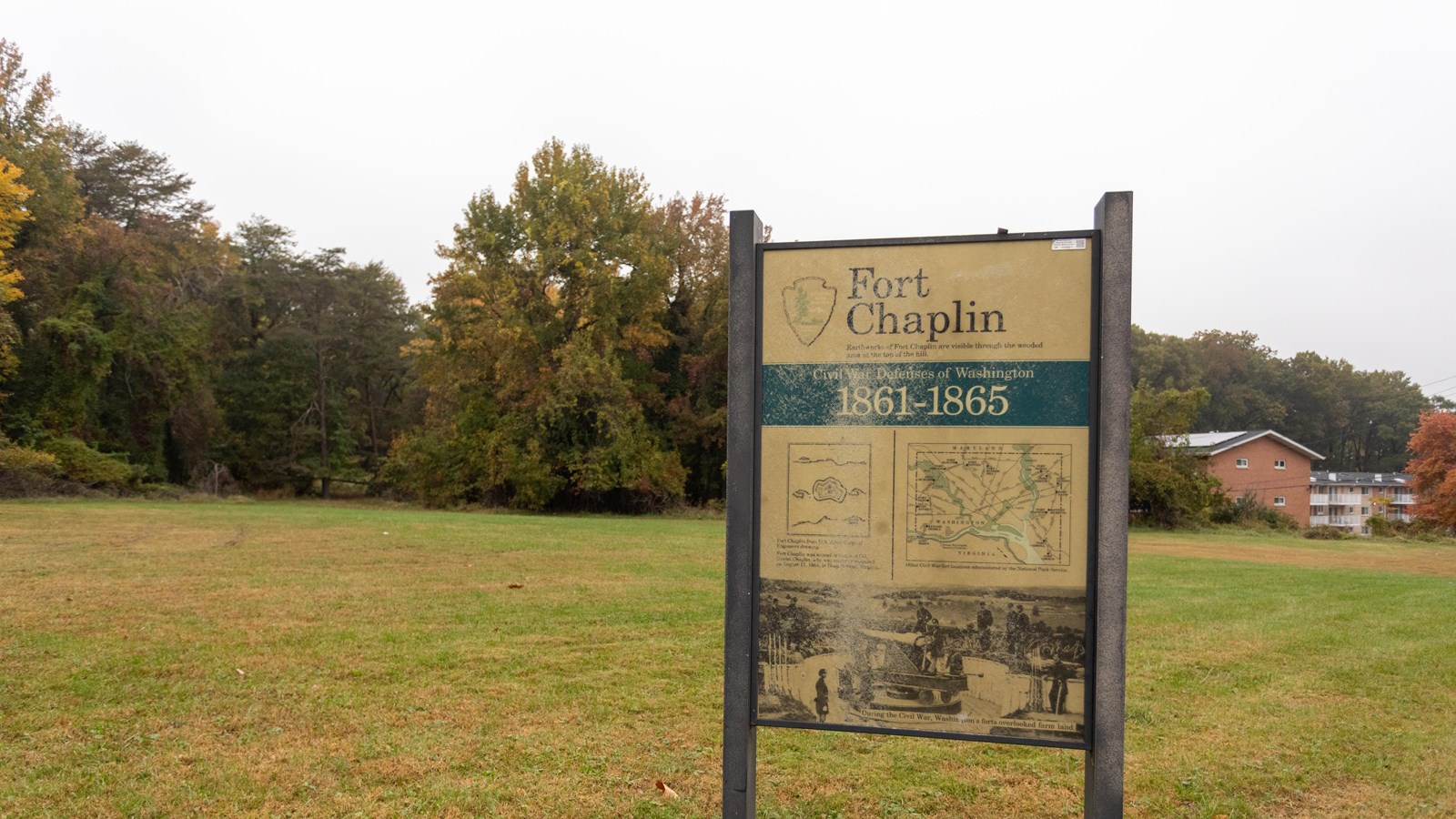
Fort Chaplin was a late-war earthwork. It was constructed by the 1st Maine Heavy Artillery in early 1864. Its function was to cover the flank of Fort Mahan, and to force enemies to detour around Fort Meigs by prolonging the obstructed line to that fortification.
The fort was never fully armed nor was it garrisoned, but it was a relatively important fortification. Colonel Barton S. Alexander, Chief Engineer of the Defenses of Washington, placed it among the second class of fortifications for purposes of retention in 1865. He believed that it occupied a position, "Which must be held when the city is threatened by a land attack."
The work was completed in 1864 and had 12 gun emplacements. Eleven of them were empty, and a single 24-pounder siege gun mounted and set in position (en barbette) was the fort's sole armament.
Fort Chaplin had a perimeter of about 225 yards, and was built at the altitude of approximately 180 feet. There were no buildings at the site when the army turned it over to the original land owner, Selby B. Scaggs, in the summer of 1865.
Fort Chaplin is named after Col. Daniel Chaplin. He was commander of the 1st Maine Heavy Artillery when he was struck down by a bullet from a Confederate sharpshooter at Deep Bottom, Virginia, on August 17, 1864. He died from his wound three days later, August 20.
Visit our keyboard shortcuts docs for details
- Duration:
- 2 minutes, 5 seconds
An overview of the Civil War Defenses of Washington, the roles of Fort Stevens and other forts in the Civil War, and how park visitors can experience these places today.