
Library of Congress
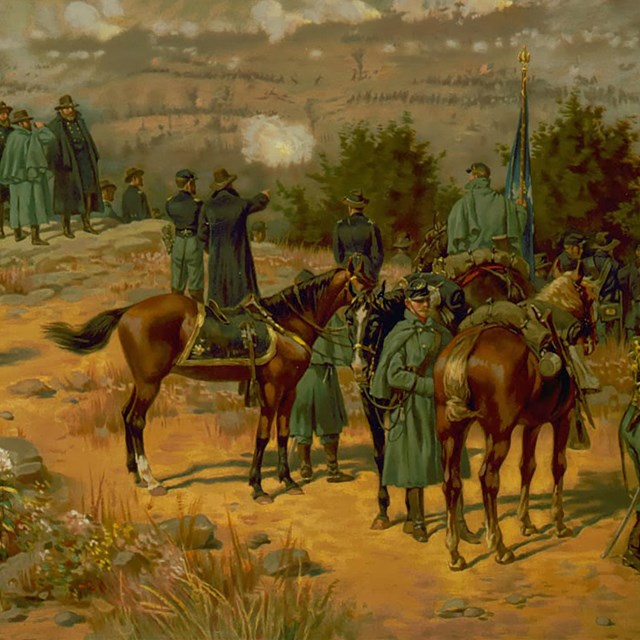
Union Soldiers near Chattanooga, TN
On these fields and hills, Union and Confederate armies clashed during the fall of 1863 in some of the hardest fighting of the Civil War. The prize was Chattanooga, key rail center and gateway to the heart of the Confederacy. The campaign that brought the armies here began late in June 1863 when General William S. Rosecrans' Army of the Cumberland, almost 60,000 strong, moved from Murfreesboro, Tennessee against General Braxton Bragg's 43,000 Confederates dug in 20 miles to the southwest defending the road to Chattanooga.
Six months earlier, these same armies had clashed at Stone River where, after a 3-day struggle, the Confederates had retreated. Now, once more, through a series of skillful marches, Rosecrans forced the Southerns to withdraw into Chattanooga. There Bragg dug in again, guarding the Tennessee River crossings northeast of the city, where he expected Rosecrans to attack. But early in September the Federals crossed the Tennessee well below Chattanooga and again Bragg had to withdraw southward.
Eluding his Federal pursuers, Bragg concentrated his forces at LaFayette, Georgia (26 miles) south of Chattanooga. Here reinforcements from East Tennessee, Virginia, and Mississippi swelled his ranks to more than 66,000 men. Twice he tried unsuccessfully to destroy isolated segments of Rosecrans' army. Then, on September 18, hoping to wedge his troops between the Federals and Chattanooga, Bragg posted his army on the west bank of Chickamauga Creek along a line from Reed's Bridge to just opposite Lee and Gordon's Mill.
Fighting began shortly after dawn on September 19 when Union infantry encountered Confederate cavalry at Jay's Mill. This brought on a general battle that spread south for nearly 4 miles. The armies fought desperately all day, often hand-to-hand, and gradually the Confederates pushed the Federals back to LaFayatte Road. On September 20, Bragg again tried to drive between the Union force and Chattanooga, but failed to dislodge Rosecrans' line. Then a gap opened in the Federal ranks, and General James Longstreet's Confederates smashed through the hole, routing Rosecrans and half his army. General George H. Thomas took command of the remaining Federals and formed a new battleline on Snodgrass Hill. Here his men held their ground against repeated assaults, earning for Thomas the nickname "Rock of Chickamauga." After dark, Thomas withdrew his men from the field. The defeat forced the Union troops to retreat into Chattanooga. The Confederates pursued, occupying Missionary Ridge, LookoutMountain, and ChattanoogaValley. By placing artillery on the heights overlooking the river and blocking the roads and rail lines, the Southerners prevented Federal supplies from entering the city. Unless something was done to break the Confederate stranglehold, Rosecrans' army must surrender or starve.
Aware of Rosecrans' plight, Union authorities in Washington ordered reinforcements to his relief. General Joseph Hooker came from Virginia late in October with 20,000 men and General William T. Sherman brought in 16,000 more from Mississippi in mid-November. Thomas replaced Rosecrans as head of Army of the Cumberland and General Ulysses S. Grant assumed overall command.