
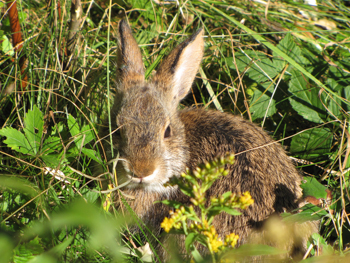
 Mammals have been and continue to be important both culturally and ecologically on Cape Cod. Historically, mammals were essential to the survival of local Native American and European settlers. From an ecological perspective, the mammals of Cape Cod play a number of significant roles. They contribute to the overall diversity of species present, each playing a different role, and making for more complex species interactions. The park's many species of small mammals are important in the flow of energy through the ecosystem: they feed on plants and invertebrates and in turn serve as prey items for a number of species of snakes, birds of prey, and small to mid-sized carnivorous mammals. Through these activities, small mammals may directly influence the speed of forest succession and species composition of developing forests. For example, meadow voles (our 2nd most common small mammal) in grassy habitats eat tree seedlings, and when the voles are abundant, few tree seedlings survive and the field is maintained. However, because they do not like to eat certain tree species, such as white pine and red oak, a forest dominated by those two tree species may eventually develop. The white-footed mouse, our most common small mammal, feeds heavily on seeds, acorns, and numerous insects in forest habitats. They serve as a check on the population of gypsy moths, an alien species of insect that can defoliate stands of oak trees. Research has shown that populations of white-footed mice crash following crashes in acorn production and, without these mice to regulate the gypsy moth population, "outbreaks" tend to follow. Small mammals may also control the abundance of their predators: years when meadow voles are abundant tend to be good years for hawks that feed heavily on them, such as the Northern Harrier, a hawk of grassland/heathland habitats. Generally not thought of when we speak of "small mammals," bats here are nonetheless important predators of night flying insects, using echo-location to catch their prey. Medium and large mammals may also shape plant and animal communities. Deer graze on woody plants, and in areas where deer have become overabundant due to a lack of predators, their grazing can inhibit regrowth of the native forest and favor invasive alien plants. Fortunately, at Cape Cod National Seashore, deer are common, but not overabundant. |
 |
|
Last updated: September 26, 2018