|
Several of Boston’s
most prominent African American activists resided at 81 Joy Street (originally 8, then 4 Belknap Street)
in the early 19th century.
David Walker, one of America’s
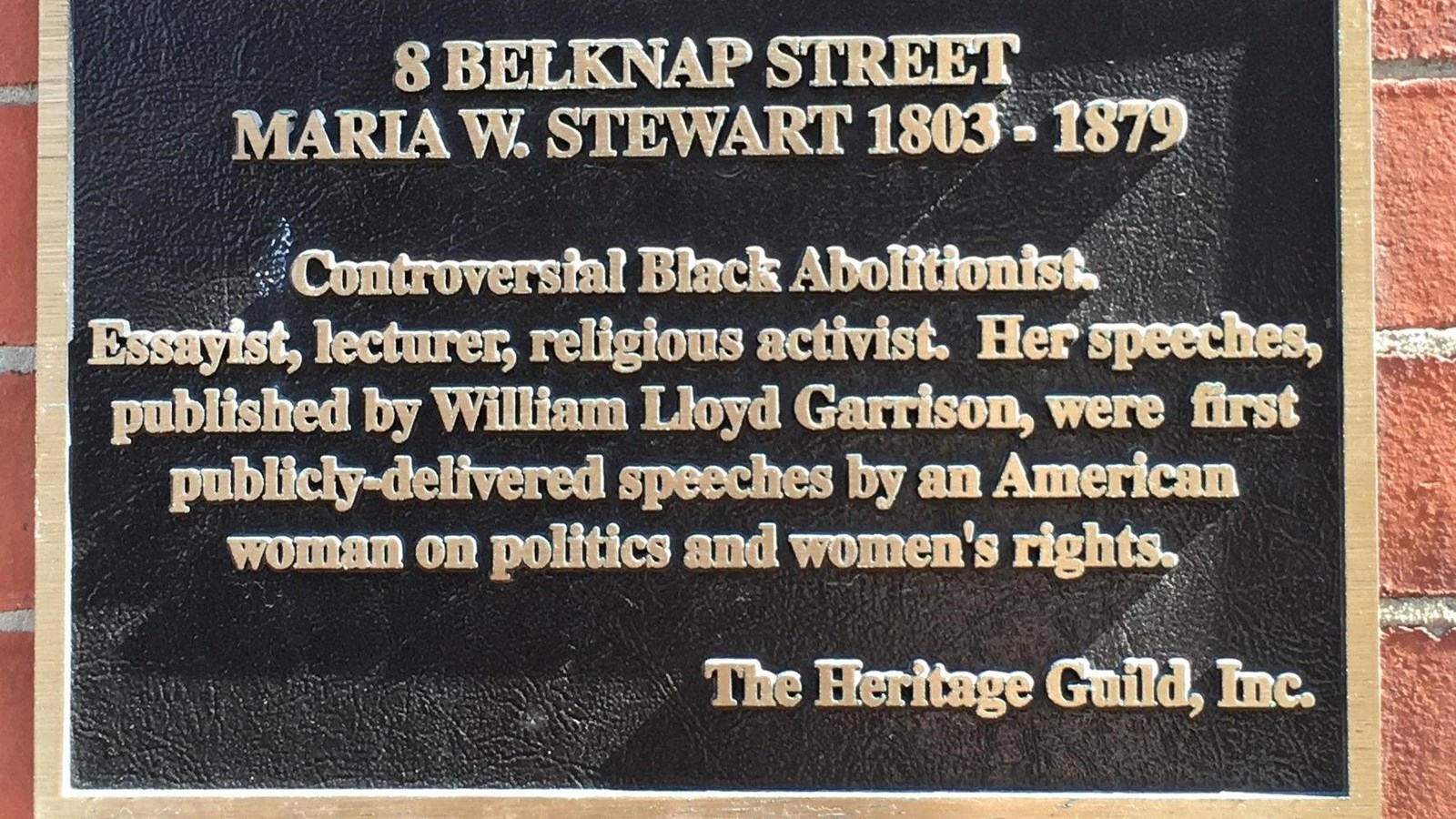
earliest abolitionist authors, and Maria Stewart, the first woman to speak
publicly for abolitionism and women’s rights, both resided there. A three-and-one-half-story brick home was
built on this site in 1825; it was replaced around 1902 with the current
building.
David Walker was born in Wilmington,
NC and moved to Boston around 1825. He ran a used clothing shop in the city. By February 1826, Walker had married a local woman named Eliza
Butler. From 1827 to 1829 David and
Eliza were tenants at 81 Joy
Street. He
was a member of the Prince Hall Masons, the Rev. Snowden’s Methodist Church,
and the Massachusetts General Colored Association, the first abolitionist
organization in Boston. Walker
was also an active supporter of Freedom’s
Journal, the first newspaper owned and operated by an African
American. Walker
became one of the earliest and most forceful abolitionist authors with his Appeal to the Coloured Citizens of the World
and Expressly to the Coloured Citizens of the United States. The Appeal enumerated the sufferings of
black men and women, but it also demanded that African Americans fight for
change. In one of many vivid and
forceful pronouncements, the Appeal states:
Remember Americans, that we must and
shall be free and enlightened as you are, will you wait until we shall, under
God, obtain our liberty by the crushing arm of power? Will it not be dreadful for you? I speak America
for your good. We must and shall be free
I say, in spite of you. You may do your
best to keep us in wretchedness and misery, to enrich you and your children;
but God will deliver us from under you.
And wo, wo will be to you if we have to obtain our freedom by fighting.
After David and Eliza Walker relocated to Bridge Street, James and Maria Stewart
moved into 81 Joy Street. The Stewarts were admirers of David Walker
and James Stewart, who was a mariner, may have helped to distribute copies of Walker’s Appeal in the south. In September 1832, Maria Stewart gave her
first public speech to a group of men and women at the African Meeting House;
yet this was not solely her first speech.
This is the first recorded occurrence of an American born woman, of any
race, speaking publicly on a political issue.
Stewart, throughout her years in Boston,
continued to write and speak for women’s rights and against slavery. She also published some religious meditations
in 1832. Now widowed, Maria Stewart
moved to New York
in 1834.
The Rev. George H. Black, one of the founders of Twelfth Baptist
Church, and Leonard Black, a
self-emancipated freedman from Maryland,
resided at 81 Joy in the late 1830s and early 1840s. The lives of these two men are discussed in
the Life and Sufferings of Leonard Black,
A Fugitive from Slavery. Written by Himself (1848).
Note: The David Walker and Maria Stewart House is a
private residence and is not open to the public.
Sources:
Hinks, Peter P., ed. David Walker’s Appeal to the Coloured
Citizens of World. University Park, PA: Pennsylvania State University
Press, 2000.
Richardson, Marilyn, ed.
Maria W. Stewart, America’s
First Black Woman Political Writer;
Essays and Speeches. Bloomington, IN: Indiana
University Press, 1987.
“Historic Resource Study Boston African American National Historic Site” by Kathryn Grover and Janine V. da
Silva
|