
National Park Service LogoU.S. Department of the InteriorNational Park ServiceNational Park Service
National Park Service:  U.S. Department of the InteriorNational Park Service Arrowhead
Blackstone River Valley National Heritage Corridordetail of historic image of Pawtucket, RI
view map
text size:largestlargernormal
printer friendly
Blackstone River Valley National Heritage Corridor
April 2008 Newsletter
undefined
 
 
Jan Reitsma

Executive Director's Message

Greetings,

It has been a very busy and challenging time at the Corridor. As some of you experienced, our quiet “Depot” was transformed into a functioning train station in the fictional town of Bedridge. It is amazing to see how greatly Hollywood can transform our corner of Woonsocket and I thank you all for your patience as the filming of “Hachiko: A Dog Story” concludes this season.

At the end of February several commissioners and I traveled to Washington, D.C. to meet with our Congressional delegation and their staff. We face a very difficult budget cycle and it was heartening to hear that our elected officials are behind us 100%. The President’s budget for FY 2009 proposes to cut funding for National Heritage Areas to less than half. The Commission is working with our Congressional delegation as well as the National Park Service to build more support for this program and hopefully restore funding to a level that allows the ever increasing number of heritage areas to do what Congress asked them to do.

We have a great deal to accomplish under our reauthorization mandate including the Special Resource Study (see article below), updating our management plan and conducting a boundary study. In addition, we must develop a long term funding and fundraising strategy, so the Corridor can continue its role as a catalyst for partnerships and collaborative projects. Our future is very much at stake, and we hope that, as stakeholders in that future, you will provide us with your input and suggestions.

Please also be sure to mark your calendars for RALLY ‘ROUND THE BARN, our annual meeting (that will be much more than just a meeting) to be held at River Bend Farm in Uxbridge, Massachusetts on May 16th. There is more information below and your invitation will be arriving in the mail shortly. Don’t miss it; we all, staff and Commissioners, look forward to talking with our partners and friends, making plans for the future and, as importantly, having a good time.

Happy Spring!

Top                                        Page 2

 
Barn at River Bend Farm

Rally 'Round the Barn! Plan to Attend the Annual Meeting on May 16
Join the commissioners and friends at River Bend Farm Visitors Center for a unique Annual Meeting experience! Hosted by Massachusetts' Division of Conservation and Recreation at the Blackstone River and Canal Heritage State Park in Uxbridge, we'll be "Rallying 'Round the Barn" for our annual celebration and we want you to join us!

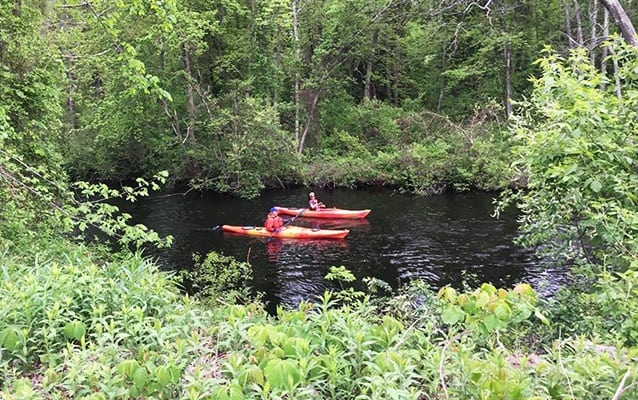
Come early and take a paddle; stay late and talk into the evening. Re-connect, enjoy a delicious dinner and cheer the presentation of the Chafee Heritage Awards and all that the Corridor stands for - and more! Partners at Work 3:00 p.m.; Annual Meeting at 4:30 p.m. and our Cookout & Chill Out starts at 5:30 p.m. For tickets ($20 each) and more information e-mail e-mail us or call 401-762-0250.

Top                                           Page 2

 
Visiting Scholars in Whitinsville

Six Out of Six Experts Agree: The Blackstone Valley’s Significance is Undeniable
In February, the Corridor Commission and the National Park Service’s (NPS) Northeast Regional Office hosted a group of six nationally-renowned historians for three days of site visits and moderated discussion as part of the Blackstone River Valley Special Resource Study process. The scholars provided insight into current perspectives on industrialization in America and were asked to consider what important historic themes are evident in the Blackstone Valley. At a public forum on February 16, each scholar presented his or her findings – and all agreed that the Blackstone Valley’s national significance is indisputable.

The scholars concluded that the type of industrialization that occurred in the Blackstone Valley, with small-scale industries employing entire families, had an enormous impact on the industrialization of the United States as a whole. This approach gave rise to the mill village, a model that was replicated across the country but nowhere as intensely as the Blackstone Valley. The scholars could not think of another place in America with such a high concentration of mill villages, and were struck by the fact that many continued to function as “company towns” well into the 20th century. The scholars also examined the engineering of the Blackstone River and its tributaries, the relationship between agricultural and industrialized landscapes, and the impact of deindustrialization on the Valley.

Our thanks go to the scholars who shared their expertise with us: Alison (Kim) Hoagland, Professor of History and Historic Preservation, Michigan Technological University; Gary Kulik, scholar of early American industrial history and former curator, Slater Mill; Gabrielle M. Lanier, Associate Professor of History, James Madison University; Walter Licht, Professor of History, University of Pennsylvania; David Meyer, Professor of Sociology, Brown University; and Jonathan Prude, Associate Professor of History, Emory University.

The scholars’ findings will be incorporated into the Blackstone River Valley Special Resource Study (SRS). Managed by staff from the NPS Northeast Regional Office, the SRS will explore the potential for a permanent NPS presence in the Valley. For more information, see special-resource-study or contact Joanna Doherty, Community Planner at the Corridor Commission, at 401-762-0250 or e-mail us.

Top                                          Page 2

John Slater House, Slatersville, RI  

Did You Know?
After opening America's first successful textile mill, Samuel Slater also helped establish America's first mill village. Slatersville, in North Smithfield, RI, began operations in 1807. His brother John Slater, who lived in the white house seen here, ran the village for almost 40 years.

Last Updated: April 11, 2008 at 15:39 EST