
• The Florida panther's watchful gaze- Courtesy- Ralph Arwood

    Big Cypress

    National Preserve Florida

There are park alerts in effect.
show Alerts »
  • Annual 60-Day ORV Closure for Wheeled Vehicles

    Beginning at 12:01 am Monday, June 3, the annual 60-day recreational ORV closure for all units of the Preserve that allow for wheeled ORV access will begin. The closure will be lifted on Friday, August 2. More »

  • Campground Closures

    Beginning Monday, May 13 through Friday, August 16 camping will be available at the Midway Campground and the “loop” in the Bear Island Campground within Big Cypress National Preserve. All other established campgrounds will be closed. More »

  • Interstate 75 Mile Marker 63 Closure

    Beginning summer of 2013 the rest area and backcountry access at mile marker 63 will be closed due to construction. More »

Fire Regime

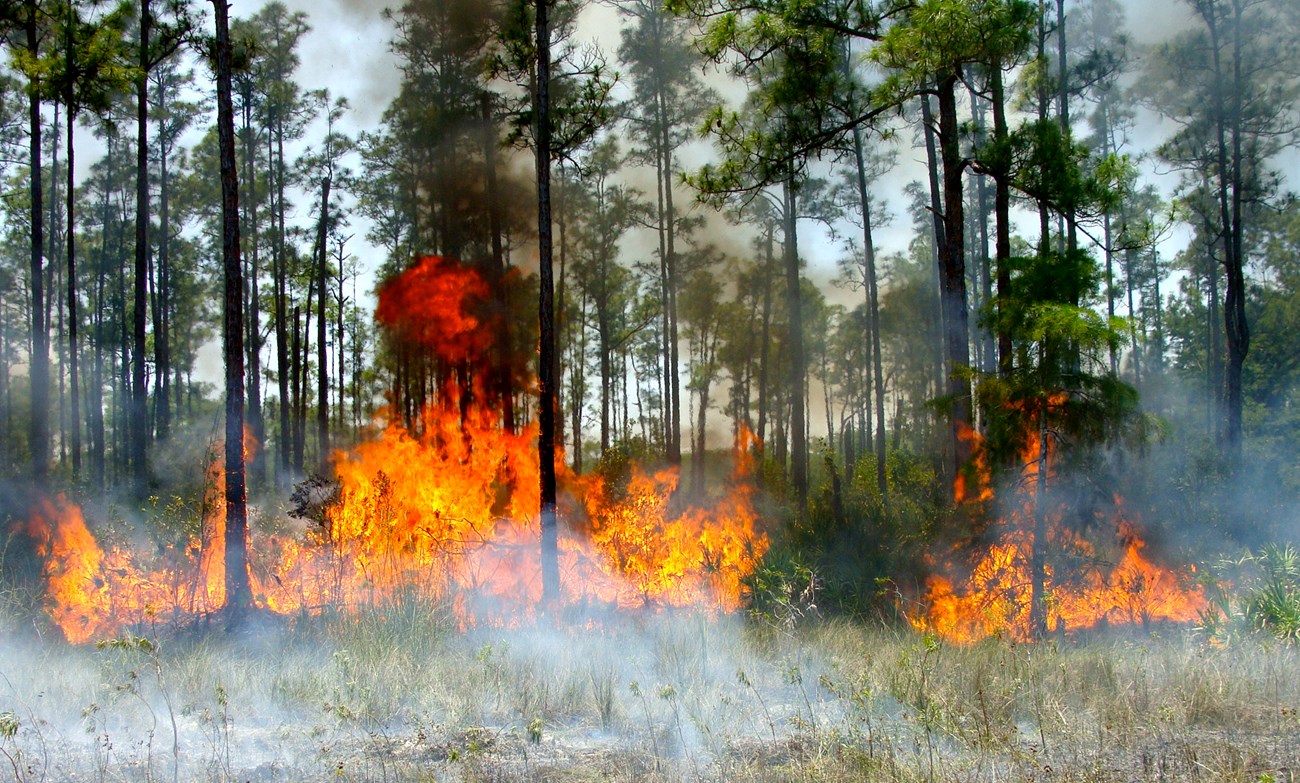
Fire in pine stand
Fire in a pine stand
COURTESY/CHRISTOPHER DERMAN
 

Wildfire as a Natural Process

Wildfire is one of the most powerful and creative natural processes on our planet. For thousands of years, this force has been shaping the environment on a large and widespread scale. Plants and animals have evolved with, and many depend on, the role fire plays in creating a diversity of habitats.

In the past, natural fires swept through plant communities at intervals that provided conditions for many plant species to regenerate. Wildfire thins competing species, recycles nutrients into the soil and opens holes in the forest canopy for sunlight to enter. All of these are critical to forest health and natural cycles of growth and decomposition. Wildfires also benefit many animal species. With the increased forage that results after a fire, many animals low on the food chain experience increases in their populations; therefore species above them on the food chain also benefit.

Despite the evidence that fire is a necessary element in many forest ecosystems, over most of the past century people have feared and suppressed it whenever possible. The accumulation of dead and downed fuels during that time now presents extreme hazards to the health of the trees, soil, wildlife, to humans living in these areas, and to the taxpayer who has to fund the fighting of catastrophic wildfires.

Click here for more information about fire management at Big Cypress National Preserve.

Did You Know?

Alligator in the swamp.

Within the preserve, the HP Williams and Oasis Wildlife Viewing Platforms are popular areas to see alligators. The best time to see large congregations of alligators is typically from January through May. Remeber not to feed or approach these dangerous animals.