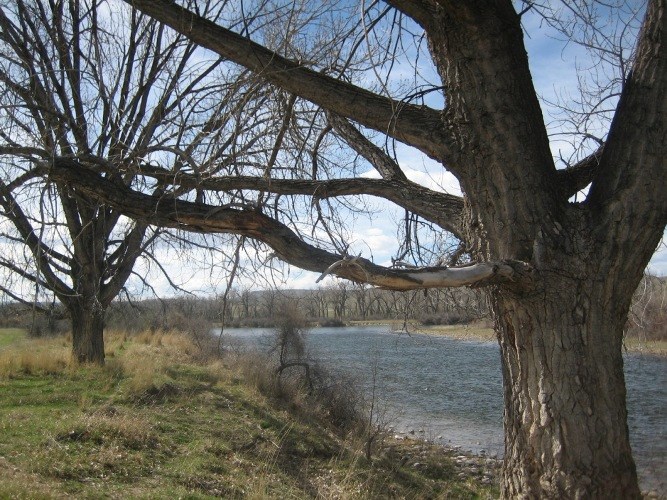
The plains cottonwood, (Populus deltoides), dominates the stream banks along the Bighorn River below the mouth of Bighorn Canyon.
"Cotton" Floating On The Breeze
These poplars, members of the willow family, reach heights of 60 to 90 feet. The thick, grayish bark is deeply furrowed. In the spring, the female cottonwoods flower in drooping, sticky catkins and produce seeds covered with silky hairs, the “cotton” seen floating on the breeze.
The leaves are triangular to heart shaped with coarsely toothed margins. Their leaf stems are flattened lengthwise so the leaves flutter in the breeze like those of the related quaking aspen. The leaves turn yellow in the fall providing most of the autumn color in the valley.
Flood-driven
In the western United States, cottonwood establishment is flood-driven. Flooding removes competing vegetation, deposits fresh sediment which provide essential seed germination sites, and temporarily raises the water table. Trees established by these periodic episodes tend to occur along stream channels. The cottonwood has many diverse uses including:
- shelter
- timber
- firewood
- forage
- wildlife habitat.