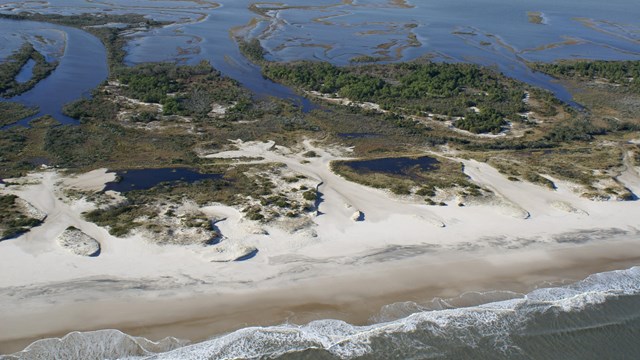
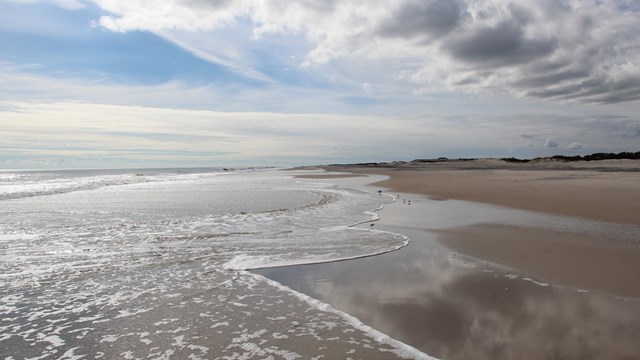
Despite its relatively small size, less than 18,000 acres, a surprising array of habitats and natural features can be found on Assateague Island. Assateague stretches for 37 miles along the coasts of Maryland and Virginia, bordered by the Atlantic Ocean to the east and the Sinepuxent and Chincoteague Bays to the west. Differences in elevation (up to 16 meters in some places) and in the proximity to surrounding water bodies give various areas of the island distinctly different plant populations. Along the seaward side, sandy beaches extend the length of the island. Beyond the beach, natural and human-made dunes protect inland habitats from salt spray and ocean waves, allowing shrub thickets and pine forests to thrive. During periods of rain, many freshwater pools form in depressions in these areas. Some are small and temporary, losing their water to the coarse, sandy soil or evaporation during the spring months. Other, larger ponds provide water for wildlife well into the dry summer months.
From beach to bay, Assateague Island holds a wealth of habitats and natural features. Forests, marshes, beaches, shrublands, grasslands, and dunes, can all be found within the Seashore’s boundaries.