|
|||||||||||
|
Public access Other than a loan program, there are several other ways a repository can make its collections accessible to the public. These are through exhibition, which now includes both the traditional museum exhibit, as well as through television programming, video, and exhibits on the Internet. Another means is by using various objects and documents in public and educational programs. Also, some repositories are beginning to provide access to particular ethnographic and/or archeological objects for culturally-significant activities by small groups of people, such as religious or sacred rites. All of these issues are discussed below. As well, direct access to objects and documents in storage is not usually given to the general public, but is restricted to those with legitimate research, interpretive, cultural, or educational interests. However, as new repositories are built or renovated, there is a movement to make the preparation and/or storage of some materials visible to the visiting public, such as at the Arkansas Archeological Survey and at Fort Vancouver (Bush 1996).
Exhibition Exhibits are one of the most common ways that the public interacts with and learns from objects and documents in a repository. They are important because the physical presence of a variety of items convey different, and, often, more types of information than interpretations of them in books or articles. Some of the strengths of exhibits involve the use of different senses by the visitor and the intimate interaction between the visitor and the exhibit. As we noted before, however, not every repository with archeological collections engages in exhibits. They may not have the space, staff, or mission to host displays. Not all archeological material is appropriate for display, as well. Bags of potsherds and debitage usually do not make a very interesting exhibit, unless it is specifically about archeological fieldwork. Exhibits about archeological materials or themes come in all shapes and sizes. They generally vary depending on staff expertise, space, collections, and the information that a repository wants to convey. Types of exhibits include:
Regardless of type, all exhibits involve interpretation. This may be interpretation of an object or document, interpretation of the culture that made particular objects and/or documents, or interpretation of the exhibit itself. The information that an archeological collection materials may convey is potentially wide-ranging. In general, the materials may be viewed as artifacts or documents, signs and symbols, or meaning. Most exhibits contain a combination of these theoretical and interpretive stances (Pearce 1996). Showcasing archeological materials as artifacts or documents is probably the most common form. Archeological materials are displayed as the physical results of craft techniques, subsistence strategies, technological change, etc. Sometimes these exhibits incorporate or present the profession of archeology itself. This may be accomplished by showing the application of and/or results of professional and scientific activities, such as dating techniques, excavation, classification, and analysis. Exhibits may also be designed to emphasize the symbolic or "meaningful" aspects of archeological materials. They may showcase particular items, such as weaponry, jewelry, or specialized paraphernalia, as "messages" that carry social or religious distinctions. Or they may be used to reveal how political or economic power has been manipulated or emphasized. Items that are interpreted as physical embodiments of ideology often have been presented in an emotive manner based on aesthetics, so that the items are showcased as "art" (Pearce 1996). Public Programming and Education
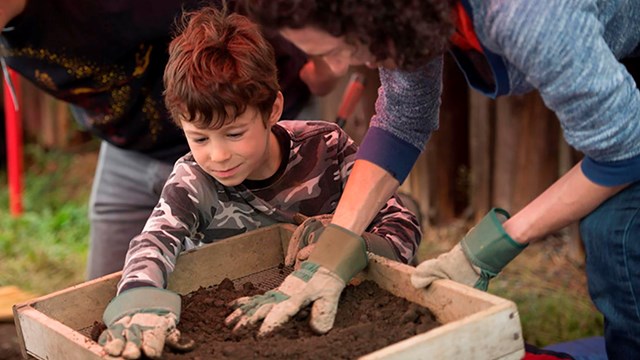
Public programming and education is another important means of providing the public with knowledge about past cultures through access to archeological collections. For years, public programming was largely ignored by archeologists who were primarily focused on scholarly work and university teaching. Recent initiatives by a wide variety of archeological professionals now promote public education through on-site interpretation and hands-on activities, especially with local community groups, as well as workshops, school group programs, and lecture and film series. State archeology weeks and months comprise a huge effort at archeological public education in the U.S. with over forty states currently participating. What types of public programming and education activities a repository sponsors depends on its size, staff, mission, and whether it is public or private. Publicly funded repositories with education as part of their mission (as opposed to the care and management of collections only) have a greater responsibility for public education. An increasing number of archeologists view such public education initiatives as a justification and necessary outgrowth of the public money that is spent on archeology. All repositories should have policy and procedures governing their educational and public programs, especially in regard to the use and handling of objects and documents from the collections. Often, certain aspects of public programs run counter to proper collections management procedures. Some considerations that help define appropriate public education policy and procedures are:
Cultural Heritage Activities and Considerations Access to and use of certain objects, documents, or collections may be influenced or governed by cultural considerations. Many items in repository collections may have sacred or religious meaning to present-day culture groups. Other items might have significant value for purposes of cultural heritage and group identity. Many culture groups, especially indigenous peoples, have concerns about how their cultural heritage material is accessed and used, both by others and members of their own community. There is currently widespread debate about indigenous rights to culture. There is often a wide difference between indigenous views of culture, rights, and ownership, and the views manifested in western laws and practices. Some indigenous groups feel that their rights to cultural heritage should be unlimited and should cover some intangible properties as well. These differences in viewpoints and the values placed on cultural heritage may mean that some culture groups have valid concerns about the access, use, representation, and documentation of items and information of cultural heritage value in a repository, museum exhibit, or scholarly setting. Repositories, realizing their responsibility to work with culture groups who value archeological collections as part of their heritage, now try to store, exhibit, and use these materials in culturally appropriate ways to the extent allowed by law.
NAGPRA has had a significant influence on access and use of Native American objects across the U.S. (see Section III). The law itself mandates the inventory of human remains and specific types of objects, study of objects or human remains to determine cultural or lineal affiliation, and consultation with tribes to determine disposition of human remains and specific objects. Such processes involve different types of access to and use of these collections and specific items in the collections, which may be determined by repository policy or on a case-by-case basis. Native American tribes may also request consideration of differential access to or use of objects and records that remain in repositories, although this may be difficult to achieve in public repositories where, by law, access must be provided to all. Certain items may have cultural restrictions on who can see or handle them (e.g., no menstruating women; no uninitiated men; no children). Others may have cultural restrictions on where specific objects are placed or stored (e.g., not in the same cabinet with other, culturally differentiated objects; in a space that allows them to "breathe"). Cultural considerations may also involve allowing culturally affiliated group members to perform rituals with or use objects in a collection. These rituals may involve access, handling, and use that is not normally allowed in the repository due to potential risks from handling or pests. A good example of this is allowing the placement of foodstuffs with an object or subjecting an object to smoke. Culturally affiliated groups are increasingly involved in and concerned with the recovery of and then the long-term management, use, and disposition of archeological objects and records, whether documents, photographs, tape recordings, video, or collected data. Consequently, whenever possible, it is important that archeologists involve appropriate, culturally affiliated groups in a project from its inception. This should not only involve active interaction, but be based on informed consent and a signed permission form for any photographs, tape recordings, or videos made. Once a collection is created, the managing or owning repository should continue active involvement with the group(s), as discussed above.
|
|
||||||||||||
MJB/EJL