[NPS Arrowhead]
U.S. Dept. of Interior National Park Service Archeology Program
  Features
* Sitemap * Home
ARCHEOLOGY FOR INTERPRETERS
A Guide to Knowledge of the Resource
3. WHAT ARE ARCHEOLOGICAL RESOURCES?

Introduction

(photo)

Balcony House at Mesa Verde National Park is an archeological resource. (NPS)


Archeological resources are the physical evidences of past human activity, including evidences of the effects of that activity on the environment. What makes archeological resources significant is their identity, age and context in conjunction with their capacity to reveal information through the investigatory research designs, methods, and techniques used by archeologists (NPS 1997:67).

Archeological resources occur in virtually every unit of the national park system. They are critical to understanding and interpreting American prehistory and history. They include prehistoric and historic period sites, materials found in museum collections, the records associated with these sites and materials, and interpretive media such as museum exhibits, web sites, public programs, and publications. They are often fragile and may be easily destroyed unless proper attention is paid to their management (National Park Service [NPS] 1997:67).


(photo)

An archeologist evaluates the battleship USS Arizona, an underwater archeological resource at Pearl Harbor National Historic Landmark, Hawaii. (Southeast Archeological Center, NPS)


Archeological resources represent both prehistoric and historic time periods. They are found above and below ground and under water. Examples of prehistoric archeological resources include:
- cliff dwellings
- Indian mounds
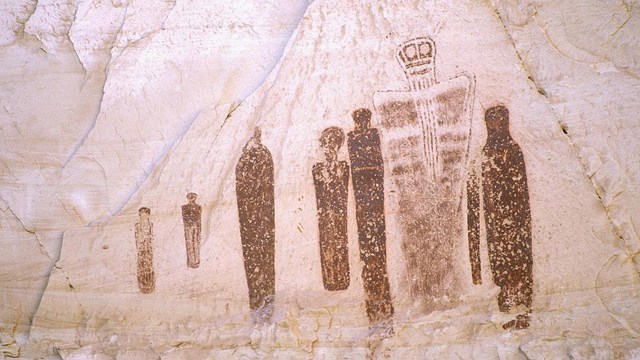
- petroglyphs
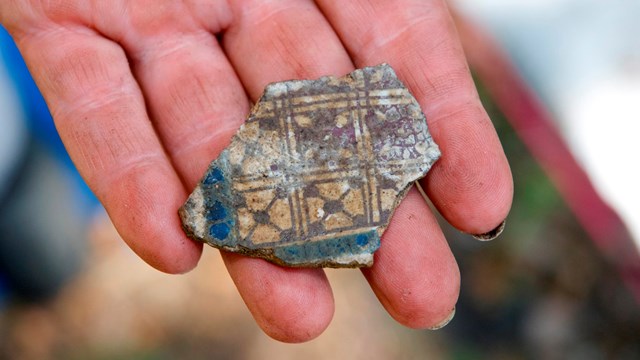
- surface scatters of pottery fragments and chipped stone
- campsites, and
- villages.

Examples of historic archeological resources include:
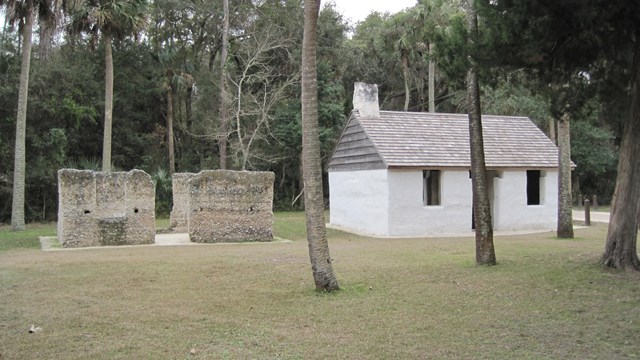
- archeological components of historic structures
- battlefields
- mining camps
- forts
- shipwrecks, and
- similar historic properties.


(photo)

Archeologists examine the Spanish Chapel's "footprint" at the Presidio of San Francisco, Golden Gate National Recreation Area. (Will Elder)


A historic period house, for example, may have a broad variety of material culture associated with it (e.g., in construction trenches and trash pits) that can be examined effectively using archeological techniques. The remains of historic properties or of resource types not typically included in the historical record-such as prehistoric rock paintings or undocumented dwellings-will have archeological value when they can reveal significant information. Examples of submerged archeological resources include sunken ships and aircraft and inundated prehistoric campsites and historic forts.

Archeological remains in collections and the records that document them and sites from which they were recovered are also considered archeological resources and must be managed accordingly (NPS 1997:67-68).

FUN FACT

(photo) George Washington's birthplace  

George Washington was born at a prehistoric site? Many national parks represent cultures other than those for which the park is known. At George Washington Birthplace National Monument, Native American sites were discovered in the early 1990s, including Woodland Indian shell mounds. Check with your park or regional archeologist to find out if your park contains "unexpected" archeological sites.

The footprint of George Washington's birth home in Colonial Beach, Virginia. (Stan George)


What difference does it make if the artifacts get moved?

Archeological Context

Archeological context refers to the arrangement or position of archeological data within the soil matrix, and associations with other artifacts and ecofacts. Archeological context provides important clues regarding past human behaviors. When a park visitor removes an artifact from a site, that artifact loses its value because it has been removed from its context. Context-or provenience-is the most important aspect of an artifact. It allows the archeologist to study the artifact in relation to its stratigraphy, natural environment, cultural environment, and surrounding artifacts.

CASE STUDY

Archeology at the Battle of the Little Bighorn-Methods


This web site describes how important artifact provenience was when archeologists recovered evidence for the movement of individual firearms over the battlefield, verified cavalry positions, and defined previously unknown Indian fighting areas. (4/30/01)


(photo)

Emancipation Day Parade 1905 in Downtown Jackson Ward, now the site of Maggie L. Walker National Historic Site. (NPS)


Social Context

Every objects exist in many relative dimensions at once. Around it is a rich network of associations and contrasts that can be followed through to interpret its meaning. An artifact's social context encompasses interpretations of its technical production and use, its values to the people who made and used it, and perhaps how and if the object symbolized their ideology. If an artifact's archeological context is lost, its social context is also lost unless otherwise recorded.


CASE STUDY

Archeology at Maggie L. Walker National Historic Site

This web site illustrates how archeology revealed personal esthetics and daily practices of turn-of-the-century African American tenants of Richmond, Virginia's Jackson Ward. Highly recommended. (4/30/01)

How does all that stuff get underground?

Site Formation

Before archeologists can meaningfully encounter the archeological record, they must understand the important transformations that have moved the objects, features, and residues from their behavioral interactions and deposited them into the sites we investigate today. Archeological sites are formed through transformations that include deposition, reclamation, and disturbance.

(image) Drawing demonstraiting the cultural  deposition of artifacts.


Cultural deposition processes are the main factor in archeological site formation. A cultural deposition transforms materials from a systematic context-that is, used by people in a behavioral system-to an archeological context. For example, when a dish is broken and discarded on a trash heap, it has ceased to function in a behavioral system and becomes incorporated in its new archeological context (Thomas 1998:264).

(image) Drawing showing a person picking up a culturally deposited artifact.


Reclamation processes transfer materials from the archeological context back into the systematic context. Examples include the reuse of scavenged artifacts such as bricks from an abandoned structure or a discarded projectile point being found and reused, and archeological excavation itself (Thomas 1998:265).

(image) Drawing showing a bulldozer disturbing an archeological site.


Disturbance processes transform materials within the archeological and systematic contexts. Disturbance changes the contexts of materials within the site itself, moving and mixing materials from and between strata. Examples of disturbance are farming, heavy construction, rodent burrowing, and natural forces such as floods.


TRY IT YOURSELF

Stratification


This web site illustrates initial site formation with an on-screen movie. (4/30/01)

Quick Time Playerİ required.


What can damage archeological resources?

(photo)

Portions of a 2,900-year-old pack basket found in a snowfield at Olympic National Park. Archeologists must assess mechanical, biological, and chemical artifact damage when designing a preservation plan. (NPS)


Sites continue to be effected by these processes and by their physical surroundings. The degree to which archeological materials are preserved will vary greatly. Physical decay effects archeological materials exposed to elements such as extremes of hot or cold, wind, rain, snow, water, ice, or seismic activity (McIntosh 1999:88). Mechanical deterioration due to climate and human and animal activity determines material preservation, as do chemical processes. Soil composition can spur material decomposition. Biological deterioration results from the action of plants and animals, insects, fungus, and other microorganisms (Hester et al. 1997:134).

Mechanical Effects
Mechanical deterioration includes breakage, abrasion, and disassembly resulting from ground pressure, frost wedging, and even careless archeology (Hester et al. 1997:134). Climatic conditions such as extremes of hot and cold, wind, rain, snow, water or ice and seismic activity affect material preservation. Material decomposition is most rapid in tropical climates and less a factor in arid or frozen climates. Human activities, including construction, artifact reuse and careless archeology also break and otherwise damage archeological materials.


FOR YOUR INFORMATION

Soil Science

This web site offers an in-depth look at how the study of soils in their present stage reveals processes and the history of soil development. (4/30/01)

Chemical Effects
Chemical deterioration occurs as the result of various amounts of moisture, acids, and bases in the soil (Hester et al. 1997:134). Soil composition-particularly the amounts of acid and alkaline-greatly affects the condition of material remains, not only at an archeological site but also in the laboratory and storage facility. Bone and glass are poorly preserved in acidic soils, yet some organic remains may be preserved therein. In alkaline soils, organic remains decay rapidly, although bone is preserved and may become semifossilized. Insoluble salts encrusted on pottery, bone, stone and metals may damage them. Wood may be preserved in alkaline waterlogged conditions and seawater (McIntosh 1999:88). Proximity to copper, though, helps preserve organic materials.

FOR YOUR INFORMATION

Agents of Deterioration, Enemies of Preservation

This web site describes and pictures agents of deterioration- different things that can harm or degrade an object. (4/30/01)


(photo)

Fragments of a deteriorated textile uncovered at Canyon de Chelly National Monument show signs of biological deterioration. (Harpers Ferry Center, NPS)


Biological Effects
Biological deterioration results from the action of plants and animals, insects, fungus, and other microorganisms. Organic materials such as soils, plants, wood, bone, leather, shell, and stone are broken down over time. Sometimes archeologists cannot tell whether materials were damaged by humans, animals, or natural forces.

FUN FACT

(photo) Prairie dogs.Archeologists working at Wyoming's Warren Air Force Base estimate that burrowing rodents and squirrels turn over 15-20 percent of the surface soil in a single season. More deeply burrowing rodents are estimated to bring 7,200-14,000 kg/ha of subsoil to the surface annually. These activities have a significant effect on smaller archeological objects, displacing them from their stratigraphic contexts. (4/30/01)


Prairie dogs at Wind Cave National Park (NPS)

(photo) Park ranger hat.

USE WHAT YOU KNOW: ASSESS YOUR KNOWLEDGE

— What kinds of factors impact the preservation and maintenance of archeological contexts?

— What can't archeology tell us, and why might this information be important for your visitors to understand?

— What is archeological context? Why is it important?

— Where would you find examples of archeological resources in your park (don't forget collections!)?


Suggested reading

Deetz, James
1996     In Small Things Forgotten: An Archaeology of Early American Life, Revised Edition. Doubleday Press, New York. Hester,

Thomas, Harry J. Shafer, and Kenneth L. Feder
1997     Field Methods in Archaeology, Seventh Edition. Mayfield Publishing Company, Mountain View, CA.

Hodder, Ian
1995     Reading the Past: Current Approaches to Interpretation in Archaeology, Second Edition. Cambridge University Press.

McIntosh, Jane
1999     The Practical Archaeologist: How We Know What We Know About the Past, Second Edition. Checkmark Books, New York.

Schiffer, Michael Brian
1996     Behavioral Archaeology: First Principles. University of Utah Press, Salt Lake City, Utah.

Thomas, David Hurst
1998     Archaeology, Third Edition. Harcourt Brace College Publishers, Fort Worth, TX.

References

Sections of this chapter were taken from:

Hester, Thomas, Harry J. Shafer, and Kenneth L. Feder
1997     Field Methods in Archaeology, Seventh Edition. Mayfield Publishing Company, Mountain View, CA.

McIntosh, Jane
1999     The Practical Archaeologist: How We Know What We Know About the Past, Second Edition. Checkmark Books, New York.

National Park Service
1997     Cultural Resource Management Guidelines, Release N. 5. U.S. Department of the Interior, National Park Service, Washington D.C.

Thomas, David Hurst
1998     Archaeology, Third Edition. Harcourt Brace College Publishers, Fort Worth, TX.

MJB/MDC