[NPS Arrowhead]
U.S. Dept. of Interior National Park Service Archeology Program
  Features
* Sitemap * Home
ARCHEOLOGY FOR INTERPRETERS
A Guide to Knowledge of the Resource
6. WHAT ARE OUR PERSONAL AND PROFESSIONAL RESPONSIBILITIES?

Introduction

(photo)

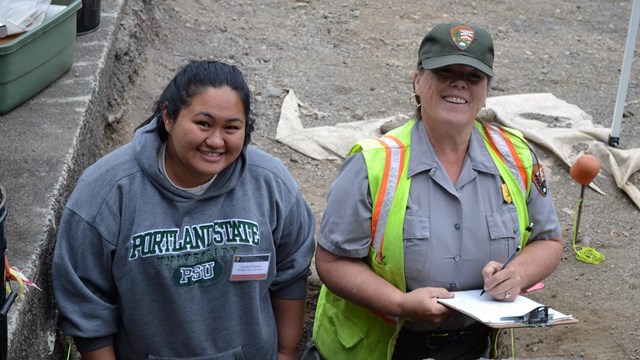
A park interpreter and archeologist discuss excavated units at Fort Vancouver National Historic Site. (NPS)


Both interpreters and archeologists should be aware of the range of our responsibilities to visitors, associated communities, and the resources themselves. Interpreters know how important it is to consider the audience and how best to communicate. Archeologists are aware of the demanding ethical standards of their profession. Together, they can design effective interpretation that promotes stewardship and reaches all parts of the interested public.


Archeologist's professional ethics

Archeologists have ethical responsibilities regarding the treatment of Native Americans and their cultural remains, professional research standards, dissemination of research, and resource management. As an established profession, archeology maintains ethical standards by which its members must adhere. Such standards ensure that archeologists maintain a high level of professionalism as they conduct research and share it with the public.


FOR YOUR INFORMATION

Click on the following links to access information about professional archeological organizations and their ethics and conduct codes:

The Register of Professional Archaeologists (RPA)

RPA Code of Conduct and Standards of Research Performance


The Society for American Archaeology (SAA)

SAA Principles of Archaeological Ethics


The Society for Historical Archaeology (SHA)

SHA Ethics Statement


The Archaeological Institute of America (AIA)

AIA Code of Ethics

(5/30/01)


Promoting archeological stewardship

Among interpreters' and archeologists' greatest professional and personal responsibilities is ensuring public support for the protection of irreplaceable archeological resources. Interpreters may foster resource protection by explaining to the public legislation-such as the Archeological Resources Protection Act of 1979 and Section 106 of the National Historic Preservation Act of 1966, as amended-passed in the last century to protect archeological resources (see the Cultural Resource Management (CRM) (internal link) section of this guide for further information). Through interpretive and education programs archeologists and interpreters should develop strong public support and stewardship for increased protection of archeological resources nationwide. The goals of such public outreach in the parks are to:

(photo)

Archeologists and interpreters talk with the public at Harpers Ferry National Historic Park. (Paul A. Shackel, University of Maryland)


- foster a feeling of ownership of and responsibility for our common heritage
- increase public understanding of archeology
- enhance public awareness of the current problem involving archeological resources such as looting
- increase understanding of how the public's actions affect archeological resources, and
- increase public involvement in legitimate archeological activities.

Several successful park programs exist to meet these goals, such as Glen Canyon National Recreation Area's brochure, House Rules for Visiting Archeological Sites, and their Cultural Site Steward Program. Arizona's award-winning Public Archaeology Program is an example of a successful effort to win the public's interest, support, and participation in preserving our archeological heritage at the state level.

Providing opportunities for appropriate public enjoyment is an important part of a park's mission. National Park Service Management Policies make it clear that the Service encourages visitor activities that can be sustained without causing unacceptable impacts to park resources or values. However, the NPS won't allow activities that impair those resources. In some cases, this may mean that some archeological sites, for example, may be placed off-limits to visitation in order to protect them. Such restrictions present an interpretative opportunity to explain reasons for the restrictions to visitors and to the public. The message of stewardship and long-term preservation of important places can be imparted where off-site interpretations are the only option. In such cases, classroom or virtual visits may provide excellent alternatives for communicating the value of endangered sites.

In some cases, the location, or other information, about archeological sites may be kept confidential and not shared with visitors or the public. There is legal support in both the National Historic Preservation Act and the Archaeological Resources Protection Act for restricting information about archeological sites if releasing that information would cause a significant invasion of privacy; risk harm to the resource; or impede the use of a traditional religious site by practitioners.

CASE STUDY

House Rules for Visiting Archeological Sites

At this web site find Glen Canyon National Recreation Area's creative solution to educating visitors about the proper treatment of archeological sites. Highly recommended. (5/3/01)


FOR YOUR INFORMATION

Strategies for Protecting Archeological Sites on Private Lands

Strategies serves as a guide to the wide variety of tools available for protecting archeological sites on private lands. It contains information on strategies that are currently being used throughout the country, contact information and other resources. Highly recommended. (4/30/01)

Protecting the Past

This online book presents some of the current thinking and ongoing work in the field of archeological resource protection. Highly recommended. (5/3/01)

Arizona Archaeology Week: Promoting the Past to the Public

This Technical Brief describes how Arizona's innovative Archaeology Week program was developed. (5/3/01)


Making jargon-free archeology presentations

Stratigraphy, GIS, STP, assemblage, phytoliths…archeology has a unique vocabulary that can be incomprehensible to the untrained ear. While many park visitors are interested in learning about archeology and the methods that archeologists use, the jargon they encounter at archeological sites or in archeological publications may overwhelm and intimidate them.

Archeologists and interpreters should identify visitors' level of archeological understanding and tailor verbal and media presentations accordingly. Archeological terms and methods can be described using familiar words, concepts, and illustrations when possible. While archeologists and interpreters should not avoid using technical archeological terms during a presentation to a lay audience, they should immediately define the term or concept to ensure visitor understanding.


Identifying educational components in archeological research

Archeologists seek to answer some of the most basic questions people have about past cultures, family groups, and individuals. An archeological research design includes questions that, if answered, will allow the archeologists to interpret data and its meaning. Research designs may identify educational components that address interpreters' and the public's basic questions about how archeology is done and what it means.

Five Simple Educational Concepts
Whether the interpreter or archeologist presents archeological information to park visitors at a battlefield, pueblo, historic house or exhibit, he or she may wish to design the presentation around five simple concepts (Ellick 2000:187-188):

What is archeology?
This topic should include discussions of archeology, archeological sites, features, artifacts and collections, and behavioral inferences

What is culture?
Archeologists study the past by systematically recording and analyzing their material remains to determine how people met biological, social, political, economic, technological, and psychological needs.

Where and how did people live?
This leads to discussion of human needs for food, water, shelter, as well as resource use at the site. This also leads to discussions about group dynamics, ethnicity, gender, and power resistance.

What are the steps of the archeological process?
This leads to a discussion of how archeologists recover, analyze and share information about a site, from initial research to artifact analysis to report writing. It may also include discussions about working with other professional specialists, such as geologists, soil scientists, materials scientists, educators, curators, and conservators.

Preservation
Visitors should leave every interpretive program inspired to protect and preserve archeological resources.

FOR YOUR INFORMATION

Educational Resources for Archaeologists and Educators

This web site accesses resources recommended by the Society for American Archaeology's Public Education Committee and the Task Force on Curriculum. Highly recommended. (5/3/01)


Using multiple interpretive methods

A growing percentage of visitors come to national parks with clearly defined learning objectives. Whether a fifth grade class, an Elderhostel program, or a scout group, they desire a ranger-led program on- or off-site to fit into a structured plan for learning. In essence, these visitors have a curriculum. All interpreters must be able to serve the needs of these audiences by integrating their interpretive services with the learner's curriculum. A curriculum-based interpretive program connects the educational objectives of the group with the park's resources through a variety of personal services, nonpersonal services and media, outreach and heritage education services, and interpretation for special populations. The management and interpretive plans and documents for each park establish a balance of interpretive services based upon criteria such as level of visitor use, the nature of the park resources, park management goals, and related factors. Various interpretive methods, including personal services, publications, exhibits, and audiovisual presentations, may be used to provide visitors with relevant information before their visits and to ensure quality experiences once they are in parks. Each park identifies a basic level of interpretation that is core to the mission of the park.

(photo) A park ranger leads a walk through Mojave National Preserve.

This ranger-led walk at Mojave National Preserve is a personal service. (NPS)
 

Personal services
Personal interpretive services are those in which staff interact with visitors. Personal interpretive services are the basis of each park's interpretive program, since they are often the most effective means of stimulating visitor understanding and appreciation of park values, providing information and orientation, and helping to ensure resource protection and visitor safety. Personal interpretive services are powerful forms of interpretation because of their flexibility and person-to-person interaction. A long tradition of personal interpretive services exists in the national park system, as represented by visitor centers with staffed orientation/ information desks, staffed exhibits, staffed museums, and staffed audiovisual programs; guided walks, talks, and tours; fixed-point interpretation; Junior Ranger programs; and campfire programs.

Visitor enjoyment and understanding of park resources may be enhanced by living history programs, living farms, period demonstrations, interpretive demonstrations, programs utilizing the creative and performing arts, arts and crafts, explanations and demonstrations of recreational and leisure-time skills, and other innovative activities when appropriate.

(photo) Historic artifacts displayed at Fort Frederica National Monument.

An archeology exhibit at Fort Frederica National Monument is a nonpersonal service. (NPS)


Nonpersonal services and media
Nonpersonal interpretive services are those that do not require the presence of staff. When personal services are not the best alternative for providing visitor information, orientation, or an understanding of park resources, other means of interpretation are considered appropriate. These may include park brochures and other publications, exhibits, Web sites, audiovisual presentations, and radio information systems. Many of these, especially the park Web site, are used before a visitor arrives at a park so he or she already knows some useful information. An Interpreter needs to know what materials are available to the public before they arrive so he or she can play off that information in useful ways. Even when personal services are used, these additional means of interpretation may be used to augment and enhance visitor enjoyment and appreciation of park resources. Nonpersonal interpretive services offer strong advantages in that they maintain a consistent quality of presentation over time and they can reach large audiences.

Outreach, environmental and heritage education services
Outreach includes interpretive and educational services that take place beyond park boundaries. These services are used to disseminate park and resource information and interpretation beyond park boundaries. Outreach services usually supplement in-park interpretive programs and may include traveling programs, park Web sites, and mobile exhibitions. Environmental education in the national park system traditionally deals with natural history and natural resources, such as ecosystems or geologic features, and the human activities associated with them. Heritage education deals with historical and cultural resources, such as cultural landscapes or historic buildings, and the human activities associated with them. Environmental education and heritage education services provide information and assistance to local school students and teachers, organized groups, and educational institutions that wish to use park resources in their curricula.

FOR YOUR INFORMATION

Recent Projects at Harpers Ferry Center

At this web site, find examples of some of the diverse projects recently produced at the NPS Harpers Ferry Center. (5/3/01)

Interpreting for special populations
The National Park Service seeks to ensure, to the greatest extent possible, that disabled people receive the same interpretive opportunities as nondisabled people. Interpretive programs meet guidelines outlined in the NPS publication Interpretation for Disabled Visitors in the National Park System. Efforts are made to ensure that interpretive programs, recreational activities, concession-operated and privately sponsored activities, publications, and other informational materials meet the needs of children, senior citizens, international visitors, and the disadvantaged. Foreign-language translations of park publications are provided in those parks visited by large numbers of foreign visitors.

CASE STUDY

Accessibility in Big Bend National Park


This web site provides information about program and facilities accessibility for disabled visitors. (4/30/01)

(photo) Park ranger hat.

USE WHAT YOU KNOW: ASSESS YOUR KNOWLEDGE

— How do the responsibilities of interpreters relate to those of archeologists?

— How can the educational process associated with archeological work assist interpreters?

— What kinds of destructive behaviors have you seen from visitors that might impact archeological resources? How could you use these anecdotes to help you interpret stewardship?


Suggested reading

Ellick, Carol J.
2000     Against the Clock: Introducing Archaeology in Time-Limited Situations. In The Archaeology Education Handbook: Sharing the Past with Kids, pp. 183-191. AltaMira Press, Walnut Creek, CA.

Lynott, Mark J. and Alison Wylie
2000     Ethics in American Archaeology, Second Revised Edition. Society for American Archaeology, Washington, DC.

Majewski, Janice
1987     Part of Your General Public is Disabled. Smithsonian Institution, Washington, DC.

NPS Training Manager for Interpretation, Education, and Cooperating Associations (editor)
2000     Module 270: Developing and Presenting a Curriculum-Based Education Program. National Park Service.

Ramos, Maria and Davis Duganne
2000     Exploring Public Perceptions and Attitudes about Archaeology. Harris Interactive for the Society for American Archaeology, Washington, D.C.

Smardz, Karolyn and Shelley J. Smith, editors
2000     The Archaeology Education Handbook: Sharing the Past with Kids. AltaMira Press, Walnut Creek, CA.

Vitelli, Karen D. (editor)
1996     Archaeological Ethics. AltaMira Press, Walnut Creek, CA

Wolynec, Renata B.
2000     Heritage Education for Special Students. In The Archaeology Education Handbook: Sharing the Past with Kids, edited by Karolyn Smartz and Shelley J. Smith, pp. 101-116. AltaMira Press, Walnut Creek, CA.

References

Sections of this chapter were taken from:

Ellick, Carol J.
2000     Against the Clock: Introducing Archaeology in Time-Limited Situations. In The Archaeology Education Handbook: Sharing the Past with Kids, edited by Karolyn Smartz and Shelley J. Smith, pp. 183-191. AltaMira Press, Walnut Creek, CA.

MJB/MDC